

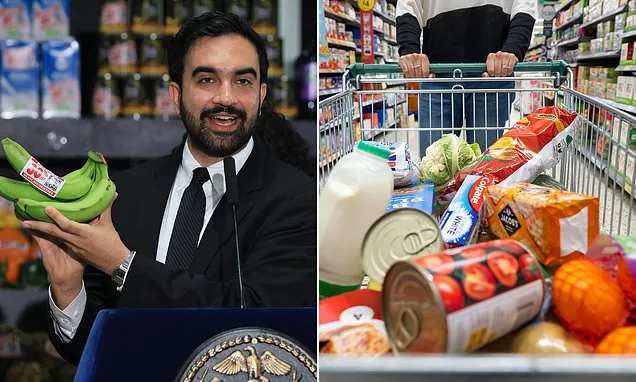
New York City’s proposed city-run grocery stores, intended to provide affordable food options, are facing criticism over a potential ID or membership requirement for shoppers seeking discounts. Critics argue this policy creates a double standard, contrasting sharply with arguments against voter identification laws, which Mayor Zohran Mamdani has previously opposed.
City Grocery Store Proposal Details
The initiative, spearheaded by Mayor Zohran Mamdani, aims to establish city-backed grocery stores to combat food deserts and offer residents access to discounted staple items. The program is designed to help New Yorkers afford food, not to facilitate bulk purchasing for resale, according to Mamdani. He stated, “The program is for New Yorkers to be able to put food on the table, not a program for people to be able to make a quick buck through reselling.”
The New York City Economic Development Corporation is exploring a “library card-esque” membership system. This system would identify shoppers and manage purchases, ensuring that discounts benefit local residents rather than commercial resellers. The first planned store is slated to open in 2027 at The Peninsula redevelopment site in Hunts Point, the Bronx, with four additional locations planned across the other boroughs. The administration estimates that shoppers could save approximately $90 per month, or about $1,000 annually, with discounts of around 30 percent on selected items. The projected capital cost for constructing and outfitting the five stores is approximately $70 million.
Backlash Over Potential ID Checks
The prospect of requiring identification or membership for discounts has ignited a firestorm of criticism, with opponents labeling the move hypocritical. Former Los Angeles GOP mayoral candidate Spencer Pratt was among the first to voice strong opposition, asserting, “Racist Commie Mamdani is going to make you show ID in his markets. You want your government-subsidized arugula? Show your papers! Ask for ID to vote? BIGOT!!!” He further characterized proponents as “disingenuous lying buffoons.”
David Sacks, a former White House AI and Crypto Czar, echoed these sentiments on the All-In Podcast, finding irony in the situation. “It is ironic that they’re going to be checking ID to make sure people aren’t coming over from Jersey but if you want to come over illegally from any country in the world, that’s just fine,” Sacks commented. Tech entrepreneur Elon Musk also questioned the policy, asking, “Are they seriously checking ID?” Senator Mike Lee drew a parallel, stating, “ID to vote: Jim Crow! ID to buy groceries: Democratic Socialism!”
Defenders Argue Against Comparison
Supporters of the city grocery initiative contend that the comparison between a store membership system and voter ID laws is fundamentally flawed. Congressman Ro Khanna, defending the plan on Fox News, emphasized its focus on addressing food insecurity in underserved areas. “The plan is aimed at food deserts, not replacing private grocery stores,” Khanna explained. He dismissed claims that the stores would negatively impact working-class New Yorkers, reiterating that the program’s intent is to provide access in neighborhoods lacking adequate supermarket options, not to compete with existing local businesses.
Khanna also pointed to external economic factors influencing grocery prices, attributing inflation partly to global conflicts. “Let me tell you what’s actually hurting and shafting and stealing from ordinary Americans. This war in Iran that has led to huge increases in grocery prices because farmers can’t get the fertilizer,” he stated.
Mayor Mamdani’s Stance on Identification Requirements
Mayor Mamdani has consistently opposed mandatory voter ID laws, arguing they can erect barriers that disenfranchise eligible voters. This is not the first time a program involving identification requirements has drawn scrutiny for him. In February, a city snow-shoveling initiative that required participants to provide identification faced accusations of hypocrisy. Mamdani defended that requirement, explaining that the IDs were necessary for federal employment verification purposes, as participants were compensated for their labor.
Lessons from Past Government Grocery Ventures
The New York City proposal emerges against a backdrop of challenges faced by similar government-backed food initiatives. The Sun Fresh Market in Kansas City, a city-supported grocery store launched in 2018 to improve access to fresh food on the city’s East Side, ceased operations in August 2025. Despite its initial goals, the store struggled financially for years. Shoppers reported persistent issues with empty shelves, while city officials cited a combination of factors for its closure, including rising crime, escalating operational costs, and a decline in customer traffic.
Conclusion
As New York City moves forward with its plan for municipal grocery stores, the debate over identification requirements highlights a complex intersection of public policy, economic access, and political discourse. While proponents aim to bolster food security and affordability, critics are leveraging the proposed membership system to challenge the administration’s consistency on identification mandates, drawing parallels to the contentious issue of voter ID laws.
