

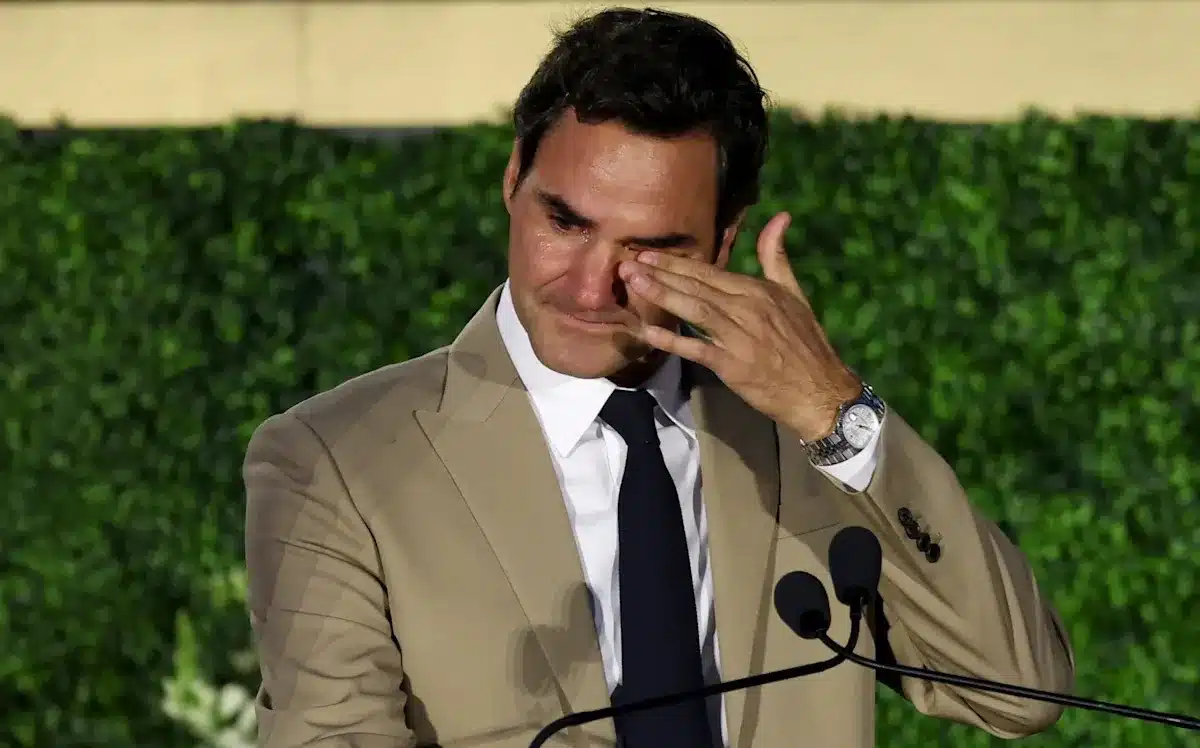
Roger Federer, one of tennis’s most celebrated figures, was officially inducted into the International Tennis Hall of Fame in a deeply emotional ceremony. His wife, Mirka Federer, made a rare public appearance to speak on his behalf, marking her first public address in 24 years. Mirka, who retired from professional tennis in 2002 due to a persistent foot injury, had reached a career-high ranking of World No. 76. She stepped away from the spotlight to support Federer’s burgeoning career, becoming a significant, though often unseen, force in his journey.
Mirka Federer’s Touching Tribute
In her speech introducing her husband, Mirka shared intimate details of their courtship and her early involvement in his career. She humorously recalled a comment from Andy Roddick after a Cincinnati final, where he expressed disbelief at losing to a player whose girlfriend had warmed him up. Mirka also lightheartedly pointed out Federer’s lack of ATP titles when they met at the Sydney Olympics in 2000, noting he was 18 and she was 21, playfully acknowledging she was the “older woman” he pursued persistently.
“I still remember Andy Roddick joking after the Cincinnati final, ‘I can’t believe I lost to a guy whose girlfriend warmed him up,'” Mirka recounted. She added, “He had exactly zero ATP titles. Zero.” Reflecting on their initial meeting, she said, “He was 18 and I was 21. Yes, I was the older woman. Apparently, Roger decided right away that age was just a number. He pursued me anyway, and thankfully he was persistent.”
A Ceremony of Emotion and Reflection
The induction ceremony began with the recognition of veteran tennis broadcaster Mary Carillo, honored in the “contributor” category. The evening culminated with Federer’s own address to the Hall of Fame’s esteemed members. Delivering his speech without notes, Federer, known for his emotional responses, became visibly moved multiple times, pausing to compose himself. He acknowledged the emotional toll, joking, “I need tissues and sunglasses,” before adding, “Oh my God. Now we’re going to do the Mirka bit. This is such a mess.”
Federer expressed his gratitude to Mirka for her speech, noting it was her first public address since the 2002 Hopman Cup, a mixed-doubles event where they represented Switzerland together. “I don’t know if you’ve been secretly practising,” he said to her, “but this is very high level and a tough act to follow. But I’m so happy you did it.”
Humor and Heartfelt Thanks
Injecting his characteristic humor, Federer shared amusing statistics from his career. He estimated wearing approximately 5,000 headbands, surpassing legends like Bjorn Borg and John McEnroe, and doubling up on socks, even wearing three pairs during a nervous Wimbledon first-round match. The most poignant moments of his speech came as he thanked the individuals who shaped his career. He paid special tribute to Peter Carter and Peter Lundgren, two influential figures who are no longer alive. “Peter Carter and super cool Peter Lundgren, two men who unfortunately are no longer with us, who not only helped my game but helped me grow up fast on the road,” Federer stated.
Federer spoke about the profound impact of Peter Carter’s death in a 2002 car crash. He described the devastating news, received while competing in Toronto, as a catalyst that taught him the importance of seizing every opportunity. This realization preceded his breakthrough year in 2003, when he secured his first Grand Slam title at Wimbledon, marking the beginning of an era of dominance.
Legacy and the Spirit of Tennis
Beyond personal achievements, Federer emphasized his deep appreciation for the sport itself and the community surrounding it. He highlighted the joy found in playing tennis, a sentiment he carried from his own training sessions, where he balanced rigorous practice with playful trick shots. He also extended his gratitude to the ball kids, recalling his own experience as a 13-year-old ball boy at the Swiss Indoors in Basel, cherishing the proximity to idols like Stefan Edberg and Boris Becker.
Federer concluded by celebrating the global reach of tennis, a sport played by children drawing chalk courts in streets and hitting against walls, supported by dedicated parents and coaches, and cheered on by fans in all conditions. “I will always see the sport through their eyes,” he declared, underscoring his enduring connection to the game’s fundamental spirit. His induction into the Hall of Fame serves as a testament to a remarkable career, marked by unparalleled success, enduring sportsmanship, and a profound love for tennis.
