

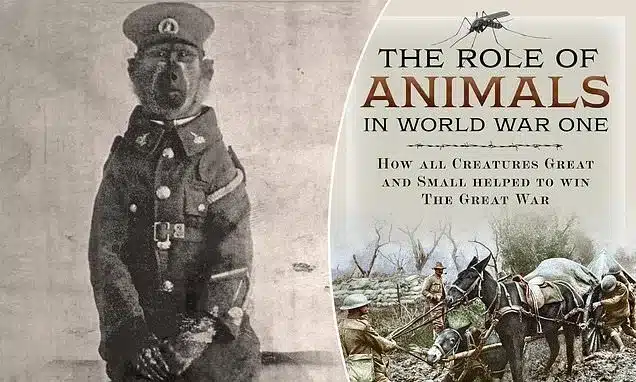
World War I, a conflict that claimed millions of human lives, also saw countless animals serve in vital roles, from sentry duty and medical aid to early warning systems and even companionship. While often overlooked, these creatures endured the horrors of the front lines alongside their human counterparts, with some achieving remarkable feats of survival and bravery. A new history delves into the diverse contributions of animals during the Great War, highlighting their impact on both the battlefield and the morale of soldiers.
The Diverse Roles of Animals in World War I
Beyond the well-known roles of horses and dogs, a surprising array of animals found themselves caught in the maelstrom of World War I. These included not only faithful steeds and canine companions but also goats, pigs, and even a baboon. These animals served in various capacities, offering practical support and much-needed emotional comfort to soldiers facing unimaginable hardship.
Corporal Jackie: The Sentry Baboon
One particularly unusual soldier was Corporal Jackie, a baboon who served with the 3rd South African Infantry. Jackie distinguished himself through his exceptional performance in sentry duty, demonstrating an unexpected aptitude for vigilance. His presence served as a unique form of morale support, a reminder of the world beyond the trenches.
Canine Courage: Medical Aid and Early Warnings
Dogs played a significant and often heroic role. Many were trained to carry medical packs, identifiable by red crosses on their backs, to aid wounded soldiers on battlefields like Gallipoli. These brave canines navigated treacherous terrain to bring supplies and comfort to the injured. However, their vital work often put them in grave danger, making them frequent targets for enemy snipers.
The acute hearing of dogs also made them invaluable as early warning systems. They could detect the sound of incoming artillery shells long before humans, alerting soldiers to take cover. Some dogs even learned to instinctively dig shallow trenches or lie flat, mimicking the protective behaviors of their human comrades.
Fritz and Old Bill: A Tale of Canine Resilience
The stories of individual dogs highlight their remarkable resilience. One such dog, Fritz, survived the sinking of a German trawler in 1914 after being struck by a British vessel. Found floating on a plank of wood, he was adopted by sailors and renamed Old Bill. His incredible journey continued as he went on to survive the Battle of Jutland in 1916, enduring three shrapnel wounds. Even after the HMS Falmouth, his eventual rescuer, sank, Old Bill was saved again. He spent his retirement at Plymouth Barracks, receiving a full naval funeral upon his death, a testament to his extraordinary life.
The Silent, Deadly Threat: Mosquitoes on the Balkan Front
While dogs and horses often garnered attention for their bravery, one of the most impactful, yet overlooked, creatures on the Balkan Front was the mosquito. These tiny insects were deadly carriers of disease, particularly malaria. Historical accounts indicate that a substantial number of soldiers who died at Salonika succumbed to malaria. Efforts to treat the sick involved bringing them back to England, where treatment camps were established. However, the spread of malaria was not contained to the camps; local populations also contracted the disease, leading to public health concerns.
The Scourge of Rats in the Trenches
The trenches were also infested with rats, which posed a constant nuisance and a significant psychological burden on soldiers. Lieutenant Alfred Johnson recalled the pervasive presence of rats, describing them as constantly fighting and squeaking all over sleeping soldiers. The unnerving experience of rats jumping at faces could push already exhausted soldiers, particularly those suffering from shell-shock, to their breaking point.
Noble Steeds: Horses in the Great War
Horses were indispensable to the war effort, with Britain alone sending approximately one million horses to the front. Tragically, nearly half of these animals perished. Their roles ranged from transportation and pulling artillery to serving in cavalry charges.
Warrior: A Survivor of the Last Cavalry Charge
A remarkable survivor was Warrior, a horse belonging to Major General John Seely. Warrior developed an extraordinary ability to gallop in a zig-zag pattern when hearing bullets, a skill that undoubtedly saved his life and that of his rider. He notably participated in the last great cavalry charge at Moreuil Wood in 1918, successfully navigating the dangerous engagement. Warrior and Seely returned to the Isle of Wight on Christmas Day and lived out their days together. In 1938, they were celebrated with a centenary ride, marking a combined age of 100, a poignant contrast to the horrors they had experienced in places like Ypres. Warrior lived to the age of 32, passing away in 1941.
Conclusion: A Legacy of Animal Service
The experiences of animals in World War I underscore their significant, though often unheralded, contributions to the war effort. From the sentry baboon and the courageous medical dogs to the disease-carrying mosquitoes and the resilient horses, these creatures faced immense challenges. Their stories serve as a powerful reminder of the multifaceted nature of warfare and the enduring bonds that can form between humans and animals, even in the most brutal of circumstances. The sacrifices and survivals of these animals are an integral part of the Great War’s complex legacy.
