

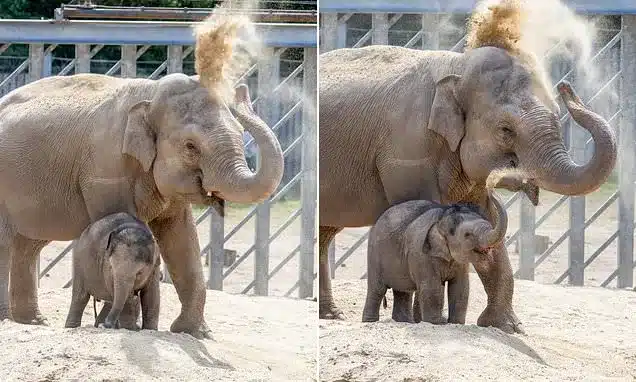
A young elephant calf named Zaiya has been observed at a UK zoo learning a vital survival skill: protecting herself from the sun and insects by mimicking her mother. The heartwarming display of learning occurred at Blackpool Zoo in Lancashire, where the calf, Zaiya, watched intently as her mother engaged in a behavior known as “dusting.” This natural practice involves using the trunk to pick up sand and toss it over the body, serving as a protective layer against the elements.
The Art of Dusting: Nature’s Sunscreen and Insect Repellent
Dusting is a crucial behavior for elephants, offering a multi-faceted defense mechanism. As observed by photographer Alison Allen, who captured the endearing moments, the primary function is to shield their sensitive skin from the sun’s harsh ultraviolet (UV) rays. Elephant skin, despite its thickness, is surprisingly vulnerable to sunburn. The layer of sand or mud acts as a natural sunscreen, blocking harmful radiation and preventing painful burns.
Beyond sun protection, dusting also plays a significant role in deterring bothersome insects. The dry layer of sand creates a barrier that repels flies, mosquitoes, and other biting parasites, offering relief and preventing potential infections or irritation. This behavior is essential for the elephants’ comfort and overall health, especially in environments with numerous biting insects.
Zaiya’s Learning Curve: From Observation to Imitation
The images show Zaiya standing close to her mother, observing the process. Soon after, the calf began to imitate the action, using her developing trunk to lift and shower herself with sand. This imitation is a key aspect of how young elephants acquire essential life skills. Elephants are highly social animals, and learning through observation and practice is fundamental to their development.
“It was so great to see baby Zaiya mastering the use of her trunk and throwing more sand this time,” noted Allen. “She will learn these things by copying her mum and the other adults.” This learning process highlights the importance of social bonds and mentorship within elephant herds.
Alloparenting: Shared Care and Skill Transfer in Elephant Societies
The phenomenon of older elephants teaching younger ones is part of a broader social structure known as “alloparenting.” In elephant societies, adult females often share the responsibility of caring for and raising calves that are not their own. This communal approach ensures that young elephants receive extensive guidance and learn the necessary skills for survival from multiple experienced individuals.
Alloparenting benefits the entire herd by distributing the workload of raising young and reinforcing social bonds. For the calves, it provides a rich learning environment where they can observe and practice behaviors like dusting, foraging, and social interactions under the watchful eyes of various adults. This shared care system is vital for the successful integration of young elephants into the herd and their long-term well-being.
Thermoregulation and Skin Health: Additional Benefits of Dusting
The benefits of dusting extend beyond sun and insect protection. Elephants also use this behavior for thermoregulation, helping to keep their large bodies cool under the hot sun. The sand or mud acts as an insulating layer, which can help dissipate heat. After bathing or getting wet, the dry layer also helps to lock in moisture, preventing their skin from drying out too quickly.
Furthermore, the gritty texture of the sand can help soothe existing insect bites and acts as a natural exfoliant. When elephants rub against trees or other rough surfaces after dusting, they can scrub off dead skin cells, promoting healthy skin renewal. This comprehensive behavior underscores the intelligence and adaptability of elephants in managing their physical needs through natural means.
A Glimpse into Elephant Development at Blackpool Zoo
The scene at Blackpool Zoo offered a clear illustration of these natural instincts and learning processes in action. Zaiya’s successful imitation of her mother’s dusting technique signals her growing understanding of how to care for her own skin and maintain comfort in her environment. As she continues to grow and interact with the herd, she will undoubtedly learn many more of the complex behaviors that define elephant life.
The zoo’s sand paddock provided the perfect setting for this educational display. Observing Zaiya’s progress not only provides fascinating insights into elephant behavior but also emphasizes the importance of providing environments where animals can exhibit natural behaviors and learn from one another. This learning process, driven by instinct and social interaction, is fundamental to the survival and thriving of elephants in both wild and managed settings.
