

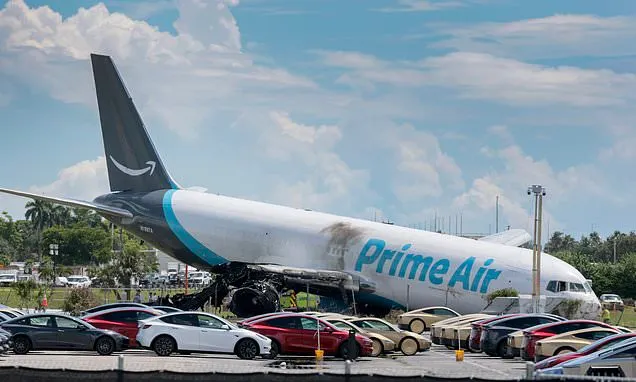
Amazon has suspended its use of cargo carrier 21 Air following a fatal runway overrun incident at Miami International Airport on September 6. The decision comes as the e-commerce giant reviews the circumstances surrounding the crash, which resulted in the deaths of five individuals. Amazon spokesperson Kelly Nantel stated that the company has been supporting the investigation and examining the events leading up to the tragedy.
Amazon’s Response to the Miami Crash
“After the tragic incident last weekend, we’ve spent time supporting the investigation and reviewing some of the surrounding circumstances, and we’ve decided to pause our operations with 21 Air, the operator of Flight 7598,” Nantel explained. Amazon will now reroute shipments previously handled by 21 Air to other carriers, including Sun Country Airlines, Hawaiian Airlines, Air Transport International, ABX Air, ASL Airlines, and Carojet.
The crash involved a Boeing 767 freighter operated by 21 Air, identified as Flight 7598. The aircraft overran the runway during a landing attempt, crashing through a fence and onto a local street, where it collided with vehicles. The five victims were identified as Rolando Aleman, 55; Yoel Rodriguez Naranjo, 53; Julio C Pineda, 75; Carlos Acosta Fajardo, 53; and Javierkys Reyes Quevedo, 47. The two pilots aboard the aircraft, Joseph Carroll, 55, and Jaime Felipe Silva Molina, 37, were hospitalized but have since been released.
Accusations of Safety Violations at 21 Air
The suspension of operations by Amazon follows reports citing former employees and pilots who allege a pattern of safety concerns at 21 Air. According to interviews and records reviewed by CBS News, some former employees claimed they were dismissed after raising issues related to safety.
Karl Seuring, a pilot with over three decades of experience, reportedly filed a legal complaint alleging that his concerns about safety issues were dismissed by a 21 Air manager with the response, “It’s not going to change.” Seuring’s case, which claimed retaliatory firing, was initially rejected by the Occupational Safety and Health Administration but is currently pending before a federal judge in a Department of Labor tribunal.
Specific Safety Concerns Raised
Documents cited by CBS News suggest that various safety complaints were allegedly overlooked by 21 Air management. These complaints reportedly included:
- Operating aircraft with mechanical faults.
- Inadequate rest periods for flight crews.
- Staffing pilots who may have had communication barriers in English.
Michael Anello, Seuring’s attorney, also stated that another former 21 Air pilot, Johnny Salmonson, felt pressured to operate flights that potentially violated required rest period regulations. “The management was pushing the pilots, and the result was he was retaliated against,” Anello told the outlet.
Seuring provided testimony about specific incidents, including a flight in April 2022 where a mechanical problem caused a plane to accelerate uncontrollably, potentially damaging its wing flaps. He described feeling “concerned for my own safety” during the event. He also recounted an incident in the spring of 2022 involving a flight from Alabama to Trinidad that experienced a pressurization issue, forcing an emergency diversion to Puerto Rico. Seuring alleged that the captain on that flight lacked command and that first officers had to intervene to ensure the plane landed safely.
Amir Anoshiravani, the captain in the latter incident, denied knowing Seuring and suggested Seuring’s claims stemmed from anger over being fired. “I don’t believe in lies. He has anger at the company because he was fired,” Anoshiravani told CBS News.
Bruce Joseph, another former 21 Air pilot, testified in his own Labor Department tribunal in March 2024 that employees were often discouraged from reporting safety issues. He accused a former director of safety of advising him not to log a safety concern without first consulting the company’s then-CEO, Mike Mendez. Joseph indicated that his concerns were only logged on rare occasions when he insisted, which he felt led to negative repercussions from Mendez.
21 Air’s Stance and Investigation Details
In response to the crash, 21 Air released a statement expressing devastation and offering condolences to the families of the victims. The company affirmed its commitment to supporting those affected and cooperating fully with the National Transportation Safety Board (NTSB), the Federal Aviation Administration (FAA), and local authorities. “We are confident in our safety policies, procedures and training,” the company stated, emphasizing its focus on supporting the ongoing investigation.
Jennifer Homendy, Chair of the NTSB, noted that the aircraft involved in the Miami crash was on its third flight of the day. Preliminary findings from the NTSB’s investigation revealed details from the cockpit voice recorder. Data indicated that as one pilot attempted to land, the other repeatedly cautioned about the aircraft’s excessive speed, with no consistent verbal response to these warnings. Approximately 15 seconds after touching down, a pilot initiated a go-around, a maneuver to abort the landing and circle back for another attempt.
The flight data recorder showed that the aircraft’s thrust increased during the landing phase, consistent with a go-around attempt. However, investigators noted that the speed brakes and thrust reversers were not deployed, which are critical systems for slowing an aircraft during landing. The reason for their non-deployment remains unclear.
A preliminary FAA report also highlighted that Miami International Airport is not equipped with an Engineered Materials Arresting System (EMAS). This safety system, installed at over 120 airports, uses beds of crushable material at runway ends to help stop aircraft that overrun the tarmac.
Conclusion
Amazon’s decision to pause operations with 21 Air underscores the seriousness with which the company views the safety implications arising from the Miami runway overrun incident. While the NTSB investigation into the crash continues, allegations of past safety issues at 21 Air have come to light, prompting scrutiny of the carrier’s operational practices. The outcome of the NTSB’s investigation will be crucial in determining the definitive causes of the crash and informing future safety protocols within the air cargo industry.
