

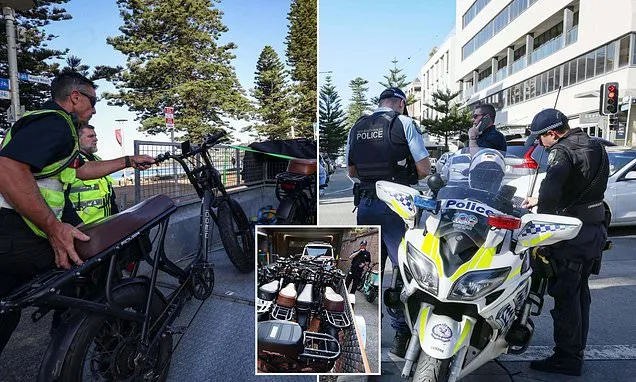
New legislation targeting illegal and modified electric bicycles has led to a significant crackdown in Sydney’s Northern Beaches, sparking a heated public debate about police priorities and road safety. Authorities seized 36 e-bikes across Manly, Curl Curl, Dee Why, and Avalon on Friday, marking the first use of new laws enacted on August 21 that empower officers to confiscate and destroy non-compliant electric bikes and other unregistered vehicles used in public spaces.
Police Operation and New Legislation
The operation, conducted by NSW Police and Transport for NSW officers, focused on identifying and removing e-bikes that were either illegal, modified, or excessively powerful. Among the seizures was an e-bike allegedly capable of reaching speeds exceeding 90 km/h, taken from a 14-year-old boy in Warriewood. Beyond confiscations, the operation resulted in 16 penalty notices and 46 cautions for various infractions, including breaches related to helmet use and mobile phone operation while riding.
The new laws are designed to bring electric bikes in line with bicycle regulations, emphasizing that they should function like bicycles, not motorcycles. Specifically, e-bikes are deemed illegal for public use if they can operate like a motorcycle under throttle or exceed 25 km/h while being power-assisted. Transport Secretary Josh Murray stressed that these measures are crucial for ensuring the safety of all road users, noting that non-compliant bikes pose a danger.
Public Divided Over E-Bike Enforcement
News of the crackdown quickly ignited a firestorm on social media, revealing a stark division among the Australian public regarding the police’s focus. Many expressed frustration, questioning why law enforcement resources were being directed towards e-bikes when more serious crimes, such as theft, organized crime, NDIS fraud, drug trafficking, and violent offenses, were perceived to be going unaddressed.
Comments reflected a sentiment that police were targeting easier offenses rather than tackling “real criminals.” One widely shared sentiment was: “Surely there are far more serious offences demanding our attention… thieves, organised crime, NDIS fraud, drug dealers and violent offenders to name just a few.” Another commenter sarcastically remarked, “Chasing hard core criminals right there guys. God forbid you actually chase the bad guys.” The comparison was also drawn to other potential enforcement targets, with one user asking, “Why aren’t they chasing illegal firearms instead of recreational bikes, I suppose it’s much easier than fighting real crime.”
Arguments for Personal Accountability and Targeted Enforcement
Conversely, a segment of the public argued for a more nuanced approach, emphasizing the need to distinguish between responsible riders and those engaging in reckless behavior. Suggestions included focusing on penalizing individuals who misuse e-bikes rather than implementing broad confiscations that could affect law-abiding citizens. This perspective advocated for accountability for wrongdoers without penalizing the wider community.
“Taking the bikes away from the hoons, not regular riders, is what matters,” one comment read. “The seizing of modified e-bikes is like seizing modified high performance cars from everyone regardless of their driving behaviour.” Another user suggested, “The answer should not be taking the bikes away but make individuals accountable. People doing the wrong thing should be fined and or treated appropriately, but leave the rest of the community alone regardless of their bikes!”
Support for Road Safety Measures
A significant portion of the public, however, lauded the police and Transport for NSW for their proactive stance on road safety. Many expressed support for the enforcement actions, drawing parallels to existing regulations for other vehicles.
Supporters highlighted the importance of adhering to road rules and vehicle compliance. “Excellent work, none of us are allowed unregistered uninsured and unlicensed on our roads for good reason. Thank goodness common sense has prevailed,” one commenter stated. Another added, “About time, keep pressure on. We do and pay for the right things and have the privilege to be on roads and so they should.” Positive feedback for the officers was also prevalent, with one user saying, “What a wonderful job done by the police. Great work lads and ladies of the force.”
Official Statements and Safety Concerns
Assistant Commissioner David Driver of the Traffic and Highway Patrol urged e-bike riders to ensure their vehicles comply with current legislation and to be aware of where they can and cannot ride. He acknowledged that most riders adhere to the rules but stated that police would enforce the new laws against non-compliant vehicles.
Transport Secretary Josh Murray reiterated the government’s commitment to e-bike safety. “We are serious about e-bike safety and operations like this will continue by NSW Police with support from Transport for NSW to ensure all road users are safe and complying with the state’s upgraded laws,” he said. He emphasized the legal definition of a road-legal e-bike: one that must behave like a bicycle and not exceed 25 km/h with power assistance. He also warned riders, “Before you or your child jumps on an e-bike, please make sure it’s road-legal, otherwise you risk losing the bike.”
Rising E-Bike Injury Statistics
The enforcement action comes amid growing concerns about e-bike-related injuries. Data from Sydney’s St Vincent’s Hospital revealed that its trauma team responded to 200 e-bike-related injuries in the previous year. Alarmingly, serious injuries from e-bikes had doubled in 2025 compared to the year prior, with nearly 10 percent of these cases requiring intensive care treatment, underscoring the public health dimension of the e-bike safety debate.
Conclusion
The recent e-bike crackdown in Sydney’s Northern Beaches has highlighted a complex issue with significant public interest. While authorities emphasize the importance of road safety and compliance with new legislation, the public remains divided on enforcement priorities. The debate reflects broader concerns about resource allocation in policing and the balance between regulating potentially dangerous activities and respecting individual freedoms. As the new laws are implemented, ongoing discussions are expected regarding their effectiveness and public acceptance.
