

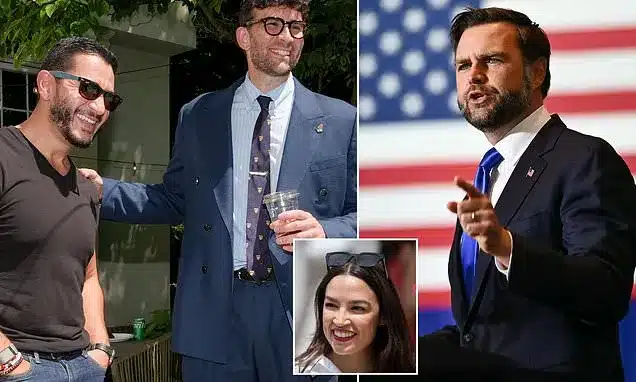
U.S. Senator JD Vance has asserted that the Democratic Party is increasingly beholden to its most radical elements, citing the embrace of controversial Twitch streamer Hasan Piker by prominent Democrats as evidence. Vance argues that this reliance on figures with extreme views demonstrates a party controlled by the “radical left,” making it difficult for mainstream Democrats to disavow such associations.
Vance Highlights Piker’s Controversial Statements
Speaking after a campaign event in North Carolina, Vance pointed to Piker’s past remarks as indicative of the Democratic Party’s ideological shift. Piker, a popular streamer with millions of followers across platforms like Twitch and YouTube, has made statements that Vance described as “completely insane.” These include characterizing the United States as the “top dog in terrorism,” ranking it below al-Qaeda, and presenting communist China as an economic and political model for the U.S.
Vance characterized Piker’s ideology as “straight up Marxism with some economic populism.” He contrasted the current political climate with previous eras, suggesting that while past Republican opponents held differing policies, they were not perceived as “crazy” in the way he views some contemporary Democrats. Vance specifically mentioned figures like Alexandria Ocasio-Cortez and Abdul El-Sayed as examples of Democrats whose public statements and actions he considers extreme.
Connections to Democratic Candidates
Hasan Piker has actively engaged with and supported numerous Democratic candidates. Notably, he has campaigned for or interviewed figures such as Michigan Senate candidate Abdul El-Sayed and New York Representative Alexandria Ocasio-Cortez. Vance suggested that these associations are not isolated incidents but rather a symptom of a broader trend where the Democratic Party’s platform and messaging are dictated by its most left-wing factions.
“This is not a party that’s actually about the American people anymore,” Vance stated. “It really is a party that’s dominated by and controlled by the far-left radical left.”
El-Sayed’s Defense and Piker’s Influence
Piker’s controversial remarks, including a past comment suggesting that the U.S. “deserved” 9/11, have become a focal point for Republican criticism. In Michigan, these comments have been featured in Republican attack ads targeting Abdul El-Sayed, who is in a closely contested race against Republican candidate Mike Rogers. Polling data indicates a tight contest, with recent surveys showing the candidates virtually tied.
El-Sayed has attempted to navigate the controversy surrounding his relationship with Piker. While acknowledging disagreements with some of Piker’s more extreme statements on terrorism, El-Sayed has emphasized the importance of engaging with Piker’s substantial audience. Piker’s significant online following, estimated at over three million on Twitch and nearly two million across YouTube and Instagram, represents a key demographic for Democratic outreach.
El-Sayed has defended his association by noting that Piker’s audience is crucial for reaching younger voters and those who may not typically engage with traditional political discourse. He has sought to distance himself from Piker’s most incendiary remarks while still leveraging the streamer’s reach.
Vance’s Campaign Strategy
Vance indicated his intention to continue highlighting Piker’s controversial views and the Democratic candidates’ associations with him. He believes that forcing Democrats to publicly disavow such figures will expose what he sees as the party’s susceptibility to radical ideologies. Vance expressed that it should be “very easy” for Democrats to distance themselves from Piker’s more extreme statements.
“They can’t do that because they’re so controlled by the interest groups of the far left of their own party,” Vance asserted. He suggested that the current Democratic Party is fundamentally different from previous iterations, making it easier to label current figures as “crazy” due to their public associations and statements.
Vance’s remarks came during a period of active campaigning, including an appearance in North Carolina to support Republican candidate Michael Whatley. This particular race is seen as crucial, with polls indicating a significant lead for the Democratic opponent, Roy Cooper. Vance’s strategy appears aimed at galvanizing Republican voters by drawing a stark contrast between his party and what he portrays as a Democratic Party under the sway of radical elements.
Conclusion
The debate underscores a broader tension within the Democratic Party regarding engagement with online influencers and the influence of progressive voices. Senator Vance’s critique centers on the perceived ideological control exerted by the “radical left” over the party’s direction and its candidates, using the controversial figure of Hasan Piker as a prime example to challenge Democratic politicians to define their boundaries and affiliations.
