

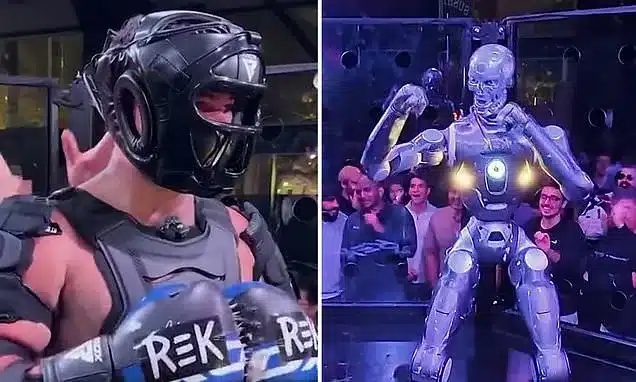
The line between science fiction and reality blurred last Friday in San Francisco when influencer Frankie Lapenna stepped into a cage to face a 6-foot humanoid robot in what is being billed as the first human versus robot boxing match. The event, hosted by robotics company REK, saw the human fighter engage in a series of bouts against increasingly formidable automated opponents.
While Lapenna made a determined effort, the spectacle highlighted the significant power and potential danger of advanced robotics. Initial moments of the fight showed Lapenna landing some effective punches, causing the robot to stagger. However, the tide quickly turned as the robot retaliated with a powerful sequence of kicks, sending the influencer across the cage.
Despite the dramatic visuals, REK stated that Lapenna ultimately won the overall contest against the specific robot featured in viral clips. He also reportedly went on to face an even larger robotic opponent later that same evening.
The Genesis of a Robot Fight Club
Cix Liv, CEO of REK, explained that the company’s primary focus is on staging fights between remote-controlled robots, drawing parallels to the concept depicted in the film ‘Real Steel.’ The idea of pitting humans against their robotic creations was not part of their initial business plan.
However, approximately two months prior to the event, Lapenna approached REK with a proposal to fight a robot himself. This proactive outreach presented an opportunity that the company decided to pursue. Initially, Lapenna expressed a desire to fight without protective gear, but REK insisted on safety measures. According to Liv, after witnessing the robot’s capabilities firsthand, Lapenna requested additional protective equipment.
For the bouts, Lapenna was equipped with motorcycle gear for impact protection and specialized boxing gloves designed to cushion his hands. The company emphasized that these measures were crucial for his safety, given the force the robots could generate.
Public Reaction and Safety Concerns
Footage of the human-robot confrontation quickly circulated on social media, eliciting strong reactions from viewers. Many expressed concern and disbelief, referencing popular culture narratives that often warn against such dangerous interactions.
Comments on platforms like Instagram included references to science fiction films that explore the perils of human-robot conflict, with one user noting, “Didn’t we have, like, 6 movies explaining why this is a bad idea?” Another commenter drew a parallel to the dystopian themes of the show ‘Black Mirror,’ suggesting the event had a cautionary undertone. A more direct sentiment urged, “Stop. Teaching. Them. To. Fight.”
The Robotic Combatants
Throughout the evening, Lapenna faced a total of three robots. His challenge began with a smaller Unitree G1 model before escalating to confrontations with two larger, 6-foot robots. These imposing machines are modified versions of the ENGINEAI T800, a model that can weigh up to 187 pounds (85 kg) and carries a price tag of approximately $40,500.
While not specifically engineered for combat, the T800’s powerful limbs provide a robust platform for robotic fighting applications. REK’s CEO highlighted the immense strength involved, noting that while an average adult can exert around 650 pounds (294 kg) of force when kicking, their large robots can deliver blows with up to 850 pounds (385 kg) of force. He cautioned potential human challengers, “they don’t realise that it’s like trying to punch a metal wall.”
The Outcome and Future Prospects
Contrary to the visual impression from brief clips, Liv clarified that Lapenna did indeed manage to ‘defeat’ the 6-foot robot seen delivering kicks in the widely shared footage. The influencer reportedly succeeded in unbalancing the machine, causing it to fall against a wall where its movement became restricted, leading to its ‘head’ becoming detached.
Liv indicated that the results of Lapenna’s subsequent fight against another large bot would be revealed in a future video, but hinted that this particular bout did not end favorably for the human participant. Despite the intense physical encounters, the most significant injury Lapenna sustained was a self-inflicted wound to his hand from punching the robot’s metallic exterior. He emerged from the other encounters largely unharmed.
REK maintains that hosting human-versus-robot fights was conceived purely as a publicity stunt and not as a long-term venture. However, the significant public interest and numerous requests from individuals eager to participate suggest that further such events might be considered. “But with so many people already begging to get in the ring, he says: ‘We’ll have to do it again,'” Liv commented.
Conclusion: A Stunt or a Precedent?
The human vs. robot boxing match organized by REK in San Francisco served as a dramatic demonstration of robotic capabilities and a unique spectacle for social media. While presented as a one-off stunt, the event has undeniably captured public imagination and raised questions about the future of human-robot interaction in competitive or entertainment contexts. The safety implications and the ethical considerations surrounding such displays remain subjects of ongoing discussion among viewers and industry observers alike.
