

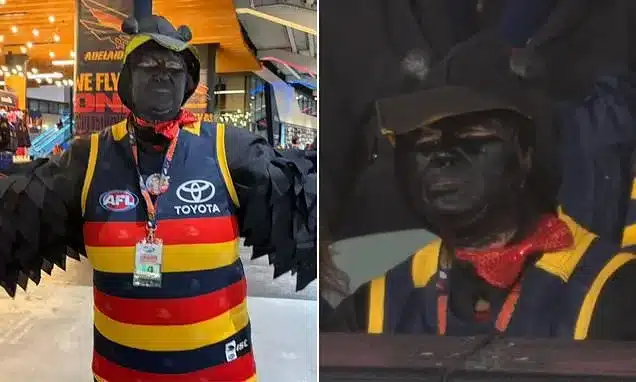
An Australian Rules Football (AFL) fan has ignited a widespread discussion about blackface after donning a costume intended to represent the Adelaide Crows mascot, Claude the Crow, during a recent match. The incident, which occurred at the Adelaide Oval during the team’s elimination final against the Western Bulldogs, drew significant attention online and among spectators.
Costume Sparks Online Controversy
Cameras captured the fan with her face painted black, complemented by a hat designed to resemble a crow’s eyes and beak. While the full costume reportedly included large black ‘wings’ covering her arms, these were not visible to television viewers during the broadcast. The sight of the fan’s face paint quickly became a focal point on social media, dividing opinions across Australia.
Many viewers expressed shock and dismay, interpreting the face paint as a clear instance of blackface. Comments on social media platforms reflected this sentiment, with some users questioning why such imagery was being shown on screen and expressing disbelief that blackface would appear at a public event in the current era. One widely shared comment read, “I thought I was seeing things, but nope, there it is. There’s a dude in blackface at the footy. In 2026. You’d expect it in 1926 perhaps. Why? Just, why?” Another user stated, “It is blackface though. Accidental but still blackface.” The Adelaide Crows club was also directly addressed, with one user asking, “It’s 2026, and there are people who still think this is okay. Hey (Adelaide Crows), okay with one of your members in blackface?”
Defense and Alternative Perspectives
Conversely, a significant portion of the online community defended the fan, arguing that her intention was not to cause offense but simply to embody the team’s mascot. These individuals suggested that the outrage was unwarranted and that the costume was a creative representation of a crow. “I know some people need to find reasons to be perpetually outraged, but this isn’t blackface,” one commenter wrote. Another user shared, “I must admit I did more than a double take last night but eventually saw it was an outfit – a pretty good one too!”
The fan herself later spoke to The Advertiser, providing context for her costume choice. She explained that she used black paint to make the costume more realistic, stating, “I just thought it would be more realistic (to wear black paint), that’s why I’ve got black gloves as well.” She reiterated her intention to dress as “Claude the crow,” the official mascot, and noted that many people had responded positively to her outfit, with some requesting photographs.
Nuanced Views Emerge
Beyond the binary of offense versus harmless intention, some Australians offered more nuanced perspectives. These individuals acknowledged that the fan likely did not intend to be racist but suggested that painting the face black was an unnecessary and potentially problematic choice, even when done in the context of a mascot costume. The argument was made that the resemblance to a crow could have been achieved through other costume elements, such as the hat and wings, without resorting to face paint that carries historical connotations of racism.
One such viewpoint suggested, “Old mate dressing as a crow clearly didn’t do it with the intention of being offensive. But that doesn’t take away the fact we are all old and aware enough to know that blackface in any form is unacceptable.” Another user commented on the visual aspect, saying, “I would say that if I had a big crow hat on, that I wouldn’t have to do blackface to convince everyone I was dressed as a crow. Maybe that’s me.” The idea that the fan might not have considered the implications without the full costume was also raised: “I’d imagine the bloke didn’t think how it would look without the wings on TV.”
Understanding Blackface and its Implications
The debate highlights a broader societal awareness regarding the historical context and impact of blackface. Originating in 19th-century minstrel shows, blackface involved performers, typically white, using burnt cork or shoe polish to darken their skin and exaggerate facial features, often portraying Black people in a demeaning and stereotypical manner. This practice is widely recognized as a deeply offensive form of racism.
In contemporary society, the use of blackface, regardless of intent, is often viewed as insensitive due to its historical associations. Even when individuals claim no racist motive, the visual resemblance to historical blackface imagery can cause distress and offense to those who understand its painful legacy. This sensitivity extends to situations where face paint is used for costumes, as the line between a creative portrayal and an offensive act can be perceived differently by various groups.
Conclusion: Intent vs. Impact
The Adelaide Crows fan’s costume incident serves as a potent reminder of the ongoing conversation surrounding cultural sensitivity and representation. While the fan asserted her intention was purely to represent the team’s mascot, the reaction underscores the importance of considering the potential impact of one’s actions, regardless of personal intent. The debate reflects a societal evolution where historical context and the potential for causing offense are increasingly weighed, even in seemingly innocuous situations like sporting events. The incident prompts reflection on how individuals can express team spirit and creativity without inadvertently invoking harmful historical practices.
