

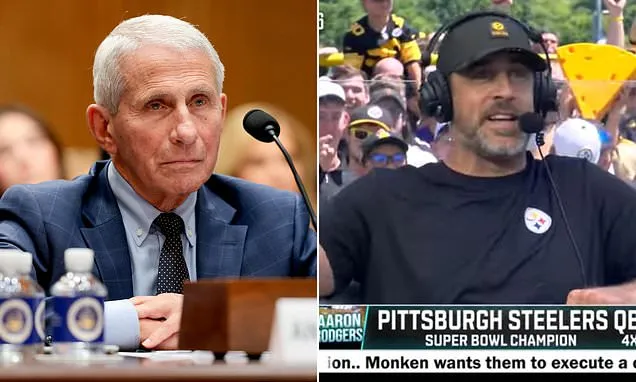
Dr. Anthony Fauci, former chief medical adviser to the White House, has had his legal representative respond to recent critical remarks made by NFL quarterback Aaron Rodgers. Rodgers, a vocal figure throughout the COVID-19 pandemic and known for his skepticism regarding vaccines, publicly labeled Fauci an “absolute coward” and an “absolute criminal” during a recent on-air appearance.
Rodgers’ On-Air Criticism of Fauci
The controversy stems from Fauci’s recent testimony before a Senate committee. During the hearing, Fauci invoked his Fifth Amendment right against self-incrimination more than 100 times when questioned by lawmakers. This action drew sharp criticism from various quarters, including Aaron Rodgers.
Appearing on ESPN, Rodgers dedicated a significant portion of his time to discussing Dr. Fauci. He began by referencing Fauci’s use of the Fifth Amendment, stating, “I’m going to plead the fifth… like that absolute coward Tony Fauci.” This comment escalated into a lengthy monologue, reportedly lasting around 13 minutes, during which Rodgers expressed his strong disapproval of Fauci’s actions and his perceived role during the pandemic.
Key Points from Rodgers’ Monologue:
- Rodgers questioned Fauci’s scientific credentials, asking, “I thought you were the science?”
- He criticized Fauci’s inability to answer questions during the hearing, especially after reportedly receiving a pardon.
- Rodgers suggested that Fauci was more interested in fame than in providing clear answers.
- He also touched upon the origins of the virus, asserting that its lab-made origin in China was no longer questionable.
- Rodgers referred to Fauci as an “absolute criminal” and reiterated the “coward” label.
Rodgers’ remarks on ESPN were made in the context of his own history of questioning COVID-19 protocols and vaccine efficacy. He had previously stated he was “immunized” rather than explicitly confirming vaccination, leading to speculation and public discussion about his vaccination status and his views on the NFL’s pandemic response measures.
Fauci’s Legal Team Responds
In response to Rodgers’ accusations, David Schertler, an attorney representing Dr. Fauci, issued a direct rebuttal. Speaking to The Athletic, Schertler dismissed Rodgers’ comments as uninformed.
“Aaron Rodgers doesn’t know what he’s talking about,” Schertler stated on behalf of Fauci. “He should stick to football.”
This statement from Fauci’s legal representative serves as a firm dismissal of the quarterback’s criticisms, suggesting that Rodgers lacks the necessary understanding of the complex issues involved and should refrain from commenting on matters outside his professional expertise.
Context of Fauci’s Senate Testimony
Dr. Fauci’s appearance before the Senate committee was part of ongoing investigations into the U.S. government’s response to the COVID-19 pandemic. The Fifth Amendment protects individuals from being compelled to give testimony that could incriminate themselves. Fauci’s repeated invocation of this right during questioning highlighted the sensitive and potentially contentious nature of the topics being discussed, which included the origins of the virus and the effectiveness of public health measures.
Lawmakers sought clarity on various aspects of the pandemic response, including the role of U.S. funding in research at the Wuhan Institute of Virology and the decision-making processes that guided public health policies. Fauci’s legal team has maintained that his actions during the hearing were within his constitutional rights and were necessary given the adversarial nature of the proceedings.
Broader Implications and Public Reaction
The exchange between Aaron Rodgers and Dr. Fauci underscores the deep divisions and ongoing debates surrounding the COVID-19 pandemic, public health policies, and the scientific community’s role. Rodgers’ high profile as a star athlete lends significant weight to his public statements, amplifying his criticisms to a wide audience.
Conversely, Dr. Fauci, a long-serving public health official and a prominent figure throughout the pandemic, remains a polarizing figure for some. His legal team’s response indicates a strategy to counter public attacks by asserting that critics, like Rodgers, are not fully informed about the facts or the legal protections available to witnesses in such hearings.
The incident also brings attention to the intersection of sports, public discourse, and scientific/medical policy. As the world continues to navigate the long-term impacts of the pandemic, discussions involving key figures like Fauci and public personalities like Rodgers are likely to persist, reflecting the complex and often contentious nature of public health in the modern era.
Conclusion
The public disagreement between Aaron Rodgers and Dr. Anthony Fauci, as articulated through Fauci’s legal representative, highlights the ongoing scrutiny of pandemic responses and the individuals involved. While Rodgers voiced strong accusations of cowardice and criminality, Fauci’s team dismissed these claims as unfounded, advising the quarterback to focus on his athletic career. This exchange serves as a stark reminder of the lingering controversies and differing perspectives surrounding the COVID-19 pandemic and its key figures.
