

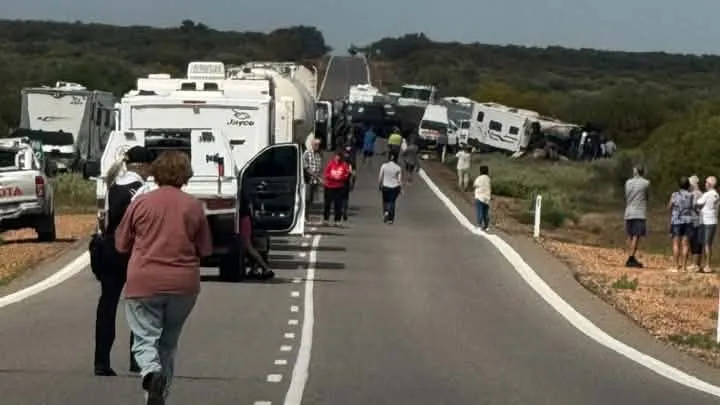
A serious road accident in Western Australia’s Gascoyne region has left four people, including a child, critically injured after a car collided with a caravan. The incident occurred south of the Overlander Roadhouse, near the popular tourist destination of Shark Bay, prompting a significant emergency response.
Emergency Response and Initial Treatment
Emergency services were alerted to the two-vehicle collision shortly before midday. St John WA paramedics were dispatched to the scene and provided immediate medical attention to four individuals. The severity of their injuries necessitated their transport to Shark Bay Airport, a remote airstrip located approximately 830 kilometers north of Perth.
At the airport, a critical juncture in the rescue operation unfolded as the Royal Flying Doctor Service’s (RFDS) emergency jet arrived. The specialized aircraft was on standby to evacuate a child suffering from life-threatening injuries to Perth Children’s Hospital, where they could receive advanced medical care. Meanwhile, the other three injured individuals were undergoing triage on the runway, with medical personnel assessing their conditions to determine the necessity and feasibility of further evacuation.
Impact on Local Traffic and Tourism
Following the collision, the Western Australia Police Force moved swiftly to close the North West Coastal Highway in the vicinity of the crash site. Authorities issued a strong advisory for motorists to avoid the area, anticipating significant traffic disruptions. The closure came at a particularly sensitive time, as the region is currently experiencing its peak tourist season.
The nearby Overlander Roadhouse became a temporary refuge for numerous travelers whose journeys were halted by the highway closure. Dozens of vehicles were observed stopped at the roadhouse, with occupants waiting for updates and the eventual reopening of the crucial transport route. The incident highlighted the challenges of emergency response in remote areas and the potential impact on both local communities and the vital tourism industry.
Understanding the Gascoyne Region and Road Safety
The Gascoyne region, known for its stark beauty and remote landscapes, stretches across a vast area of Western Australia. Its primary transport artery, the North West Coastal Highway, connects numerous communities and serves as a critical route for both commercial transport and tourism. The remoteness of the region, while offering unique attractions like Shark Bay, also presents significant logistical challenges for emergency services.
Incidents like this underscore the importance of road safety, particularly on long, often isolated stretches of highway. Factors such as driver fatigue, speed, and adherence to traffic laws are paramount. The distance between medical facilities in remote Western Australia means that any serious accident can have dire consequences if immediate and effective medical intervention is not possible.
The Role of the Royal Flying Doctor Service
The Royal Flying Doctor Service (RFDS) plays an indispensable role in providing critical medical care to people in rural and remote Australia. Equipped with specialized aircraft and highly trained medical staff, the RFDS is often the only lifeline for those facing medical emergencies far from urban hospitals. In this instance, the RFDS’s rapid deployment was crucial for the potential transfer of the critically injured child to a specialized pediatric facility.
The service operates 24/7, responding to a wide range of medical needs, from emergency retrievals like the one following this crash to routine patient transport and primary healthcare services. Their presence in the Gascoyne region, and indeed across vast swathes of Australia, is a testament to the commitment to ensuring equitable access to healthcare, regardless of geographical location.
Ongoing Investigations and Future Outlook
While the immediate focus was on the medical care of the injured and managing the traffic situation, investigations into the cause of the collision are expected to follow. WA Police will likely examine the circumstances surrounding the crash to determine contributing factors. The outcome of these investigations will be crucial in understanding how such accidents can be prevented in the future.
The incident serves as a somber reminder of the inherent risks associated with road travel, especially in remote areas. As the region recovers and the highway eventually reopens, the focus will remain on the well-being of those injured and the broader implications for road safety in Western Australia’s expansive outback.
The condition of the injured, particularly the child, will be closely monitored as they undergo treatment. The incident has cast a shadow over the peak tourist season, highlighting the fragility of life and the critical importance of emergency preparedness in remote locations.
