

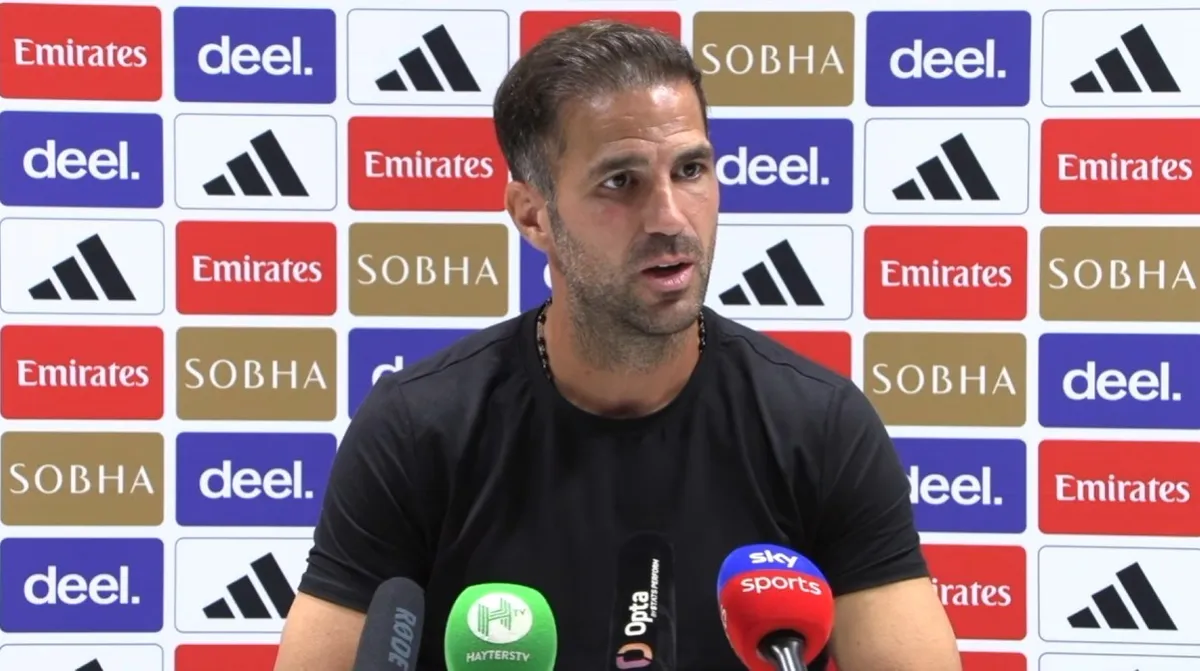
Cesc Fabregas, the former Arsenal midfielder, has lauded the club’s management and players for their unwavering commitment to a long-term vision, particularly highlighting the patience shown during Mikel Arteta’s tenure. Fabregas, now involved with Italian club Como, recently returned to the Emirates Stadium for a friendly match, where his observations led him to praise Arsenal’s strategic approach and the team’s dedication to the manager’s plan.
Arsenal’s Strategic Vision and Player Alignment
Speaking after Como’s 1-1 draw against Arsenal, which the Gunners eventually won on penalties, Fabregas expressed his admiration for the club’s hierarchy. He specifically commended the leadership, including sporting director Edu, for their steadfast support of Arteta, even through challenging periods. Fabregas noted that this consistency is a rare commodity in modern football, where coaching changes are frequent.
“Congratulations to the club in general starting from seven, eight years ago when they first started with this project,” Fabregas stated. “Because what you see in football every day, what Arsenal did, especially in the difficult moments, it doesn’t exist. I told Edu, I told Andrea (Berta) when I came last year to a Champions League game, I said congratulations to the whole club for the patience, for sticking together, for sticking to the plan when for three years in a row, correct me if I’m wrong, finished eighth, eighth, eighth, fourth year nearly Champions League, it was a big disappointment, Tottenham came, you finish fifth, but you keep going because you have a plan, because you have an objective, because you have progression, you keep going forward.”
Fabregas contrasted this approach with the common practice in football of rapidly dismissing managers after a few poor results. He believes that such instability hinders a team’s development and prevents the consistent implementation of a playing style. His own experience at Como, he suggested, is an attempt to emulate the stability and cultural foundation that Arsenal has cultivated.
The Importance of Stability in Football Projects
Fabregas elaborated on the value of sticking to a plan, even when results are not immediately forthcoming. He observed that Arsenal’s journey, marked by periods of struggle followed by gradual improvement, demonstrates the benefits of a sustained strategy. This resilience, he feels, is crucial for building a successful team and fostering a strong club culture.
“We lack this in football today,” Fabregas commented. “You lose three games, change the coach, he was playing one style, now you play another, at the end of the day I don’t believe in this a lot. I’m very lucky I’m in a project, of course with much lower level, the history, everything, but we’re trying to look at the stability Arsenal had, the values, the culture that they are bringing.”
Mikel Arteta’s Impact and Player Mentality
The former Arsenal captain also reserved special praise for Mikel Arteta’s management. Fabregas believes Arteta has done a “tremendous job” in transforming the team and instilling a positive mentality. He highlighted the current Arsenal squad’s character, describing them as “good guys” who are committed to playing attractive, effective football and are deeply aligned with the manager’s tactical instructions.
“I think Mikel has done a tremendous job,” Fabregas said. “So I can only wish them the best, really. Because most of the group, these guys now you talk to them, I don’t know… they’re good guys, they want to play good football, they are respectful, you can see how they stick to the plan all the time. Really, I’m super happy to come back here and smell this feeling.”
Arsenal’s Upcoming Challenges
Arsenal’s friendly against Como precedes their significant Community Shield clash against Manchester City this Sunday. This match serves as a crucial test before the commencement of their Premier League title defence. The Gunners will begin their campaign to retain the league crown at home against Coventry City on August 21st. The team’s performance in these early fixtures will be closely watched, with many anticipating a strong showing following their impressive league run last season.
Conclusion: A Culture of Belief and Progression
Cesc Fabregas’s insights offer a compelling perspective on the underlying strengths that have propelled Arsenal forward. His emphasis on patience, strategic planning, and the unwavering belief of both the club’s leadership and its players underscores the positive trajectory Arsenal is on. The “feeling” he experienced upon returning to the Emirates suggests a club that has successfully rebuilt a culture of trust and shared ambition, setting the stage for continued success in their upcoming title defence and beyond.
