

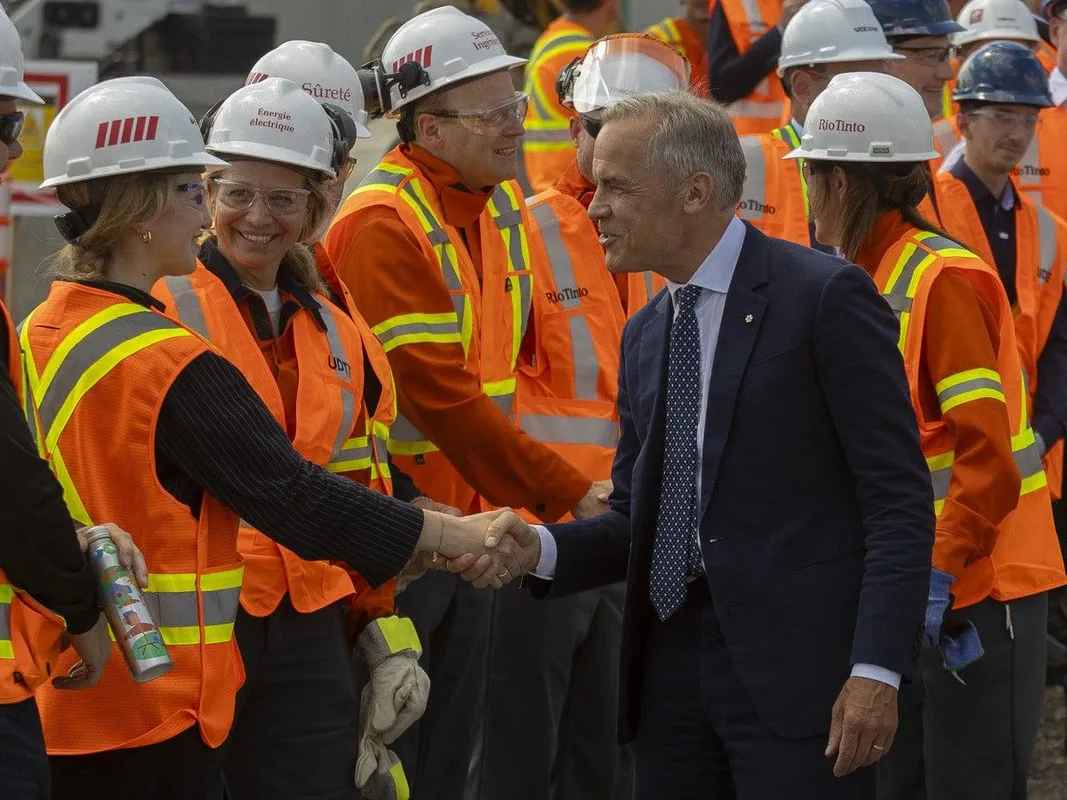
Newfoundland and Labrador, Quebec, and the federal government have announced a preliminary agreement aimed at significantly expanding the Churchill Falls hydroelectric facility and resolving a long-standing dispute over electricity pricing. The deal, reached after months of negotiations, includes plans for a major redevelopment of the existing site and the construction of the previously debated Gull Island generating station. While hailed as a potential win for all parties, crucial aspects of the agreement are not yet legally binding, leaving its finalization contingent on future political developments.
Massive Renewable Energy Expansion Planned
The proposed expansion at Churchill Falls, a cornerstone of Canada’s renewable energy infrastructure, aims to more than triple its generating capacity. According to federal officials, the combined projects—including the expansion of existing facilities, the new Gull Island plant, an onshore wind energy project, and new transmission lines—could boost the total output to 14,000 megawatts of renewable power. This would represent a substantial increase, with comparisons made to the generating capacity of BC Hydro and Bruce Power, and significantly exceeding the output of the Hoover Dam.
Prime Minister Mark Carney described the initiative as the largest renewable energy investment in Canadian history, underscoring its potential to reshape the nation’s energy landscape and contribute to climate goals. The federal government has pledged significant financial support, committing up to $10 billion towards the projects and promising to streamline the approval process through the newly established Major Projects Office.
Addressing Historical Grievances
The agreement also seeks to address decades of resentment in Newfoundland and Labrador stemming from the original 1969 energy deal. This earlier accord allowed Quebec’s Hydro-Québec to develop the Churchill Falls site and secure electricity at very low rates for many years, a situation widely perceived in Newfoundland and Labrador as disadvantageous to the province. Newfoundland and Labrador Premier Tony Wakeham characterized the 1969 deal as “one of the darkest chapters” in his province’s history, signaling a desire to move past this contentious legacy.
Quebec’s counterpart, Christine Frechette, expressed optimism about the new accord, stating, “What a great day it is for Quebec, Newfoundland and Labrador.” The renegotiated terms aim to create a more equitable arrangement for both provinces moving forward.
Non-Binding Nature and Political Uncertainties
Despite the fanfare surrounding the announcement, a significant caveat remains: much of the current agreement is non-binding. Newfoundland government officials indicated that the deal requires finalization and approval, likely by the end of the year. This provisional status introduces a degree of uncertainty, particularly given the upcoming provincial election in Quebec scheduled for October.
The Parti Québécois (PQ), which currently leads in Quebec’s opinion polls, has previously stated its intention to seek further compensation for the historical loss of Labrador territory, which occurred roughly a century ago. If elected, the PQ could attempt to renegotiate the terms of the deal, potentially jeopardizing the agreement for a second time in two years. This political backdrop may have influenced the timing of the announcement, with both provinces potentially seeking to solidify an accord before the Quebec election is called.
Background of Negotiations
The current announcement builds upon a memorandum of understanding (MOU) signed in 2024 between then-Quebec Premier François Legault and former Newfoundland and Labrador Premier Andrew Furey. That MOU aimed to develop the Gull Island project and expand Churchill Falls capacity, superseding the controversial 1969 agreement. However, following Tony Wakeham’s election as Newfoundland and Labrador premier in 2025, a review concluded that the 2024 MOU was not in the province’s best interests, prompting renewed negotiations.
The recent intensive talks, described as “occasionally tense but always positive,” involved Hydro-Québec and N.L. Hydro working to update the terms of the 2024 MOU. The culmination of these efforts is the preliminary deal announced on Monday, which saw the provincial governments and the federal government present a united front.
Future Outlook
The success of this ambitious expansion hinges on several factors. Securing final approvals, navigating the political landscape in Quebec, and finalizing the financial and operational details will be critical. The commitment of federal funding and the expedited review process are intended to provide momentum, but the non-binding nature of the current agreement means that the path forward requires continued collaboration and political will from all parties involved.
Should the deal be fully ratified, the expansion of Churchill Falls represents a monumental step in Canada’s transition to renewable energy, promising increased clean power generation and a potential resolution to a long-standing interprovincial dispute.
