

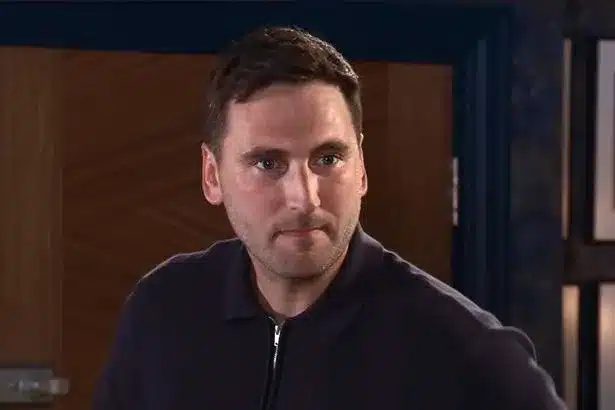
Jacob Roberts, the actor portraying Kit Green in the long-running ITV soap opera Coronation Street, has shared his thoughts on his character’s challenging new storyline involving a breast cancer diagnosis. The plot sees Kit, who joined the Weatherfield community in 2024 as the long-lost son of Bernie Winter, grappling with a serious health crisis.
Kit Green’s Diagnosis and Initial Reactions
Viewers have recently observed Kit exhibiting concerning behavior, including secretive phone calls, hinting that he might be concealing something significant. Upcoming episodes will reveal the source of his distress: a diagnosis of stage three breast cancer that has spread to his lymph nodes. A consultant delivers this news, leaving Kit to navigate the emotional and practical implications of his illness.
Despite the gravity of the situation, Kit initially attempts to maintain a brave facade for his family. However, it appears he may confide in fellow character Todd Grimshaw. Spoilers indicate that Kit will discuss his upcoming CT scan appointment with Todd, who will then encourage him to share his diagnosis with his loved ones.
Jacob Roberts on Portraying Kit’s Journey
Speaking about the storyline, Roberts explained the character’s path to diagnosis. “I think it was something that maybe has been putting off for a while because when it comes into the story, I do believe that it’s something that was concerning him and then with so much going on, he never had the time to go and actually follow it up,” he stated. “But when it comes to, he finds a lump, he finds a lump, and then he goes and gets it checked out, and then I think there’s some discharge from the lump, and then it’s like, ‘Oh, this is serious!’ So, yeah, he knows something’s wrong. He doesn’t know what it is, he just knows this isn’t normal.”
Roberts elaborated on Kit’s initial hesitation and subsequent medical consultations. “So, he does start to follow up and go to the doctors and has checkups, and they don’t tell him an answer straight away. So he’s in a bit of a dilemma, really. He’s sort of concerned about what’s going on.”
The Context of Familial BRCA Gene
The narrative unfolds against the backdrop of Bernie and Gemma Winter-Brown’s concerns about a potential familial BRCA gene mutation. This genetic predisposition, linked to an increased lifetime risk of certain cancers, prompts Bernie and Gemma to consider genetic testing. Unbeknownst to them and the audience, Kit has already been seeking medical attention for his own health concerns, adding a layer of dramatic irony to the unfolding events.
Roberts’ Enthusiasm for the Storyline
Roberts expressed his excitement upon receiving the storyline, viewing it as an opportunity to explore a different facet of Kit’s character beyond his police-related narratives. “I was excited to have something personal to Kit. I thought it takes him away from the police stuff and it was something where I thought, ‘Okay, well, this might show a different side to Kit’s character’,” he shared. “So yeah, I was really excited for it, and I thought, ‘Let’s give it a go!’”
He further elaborated on his commitment to portraying the storyline authentically. “And as soon as Kate [Brooks, Corrie’s producer] mentioned it to me, I thought, ‘Okay, I’m going to have to do some research with this, And, you know, it’s what actors want. Actors want to, I mean, I do anyway, but I want to know that I can get involved with something and be obsessive with it and hopefully tell it in the right way. So I was really excited when Kate told me the news.”
Addressing Misconceptions About Male Breast Cancer
A significant aspect of the storyline is the exploration of the common misconception that breast cancer only affects women. Roberts intentionally incorporated this into his portrayal, reflecting the reality that many men are unaware of the possibility. “I generally didn’t know that men could get breast cancer, and I felt, to make it authentic, that Kit shouldn’t know men could get breast cancer, because, you know, speaking to the charities, which has been really insightful, men didn’t know they could get it,” he explained. “So I wanted to go with that utter disbelief of like, ‘How can this be?’ You know, not only for his age, but, ‘How can I have this?'”
Collaboration with Cancer Support Charities
The Coronation Street production team is collaborating closely with Macmillan Cancer Support and Breast Cancer Now. This partnership aims to ensure an accurate and sensitive depiction of Kit’s cancer journey while simultaneously raising public awareness about the risks of male breast cancer. Roberts has actively engaged with these charities and spoken with men who have experienced breast cancer diagnoses as part of his preparation.
Jacob Roberts Shaves His Head for the Role
In a powerful move to enhance the authenticity of Kit’s experience with chemotherapy, Roberts has shaved his head. He described the decision as a way to visually represent the character’s treatment progression. “So he takes it upon himself, Kit, as soon as he hears that he’s going into chemo, and it’s a lovely scene with Ryan [Mulvey], who plays Brody, he just thinks, ‘Well, I’m going to shave it before it gets worse!'” Roberts recounted.
He detailed the phased approach to his appearance change. “So this is the longest it’s going to be for a few months, and gradually, we’ll be doing another stage of chemo where I think it gets shorter, and then it’ll get shorter. So yeah, I’ve gone full header, full shaved.”
Reflecting on his new look, Roberts admitted, “It was a bit weird at first. No one really wants to shave their head. I never wanted to shave my head, but I’m not going to do this part justice if I just, I think it’s good. I think it’ll look visually good on screen as well.” He also humorously noted his efforts to lose weight, adding, “I’m trying to lose a bit of weight as well, but it’s so hard to not drink when the sun shining like this. So, yeah, I’m getting there.”
This storyline promises to be a significant and impactful one for Coronation Street, offering viewers a poignant look at a serious health issue and its profound effects on individuals and their families.
