

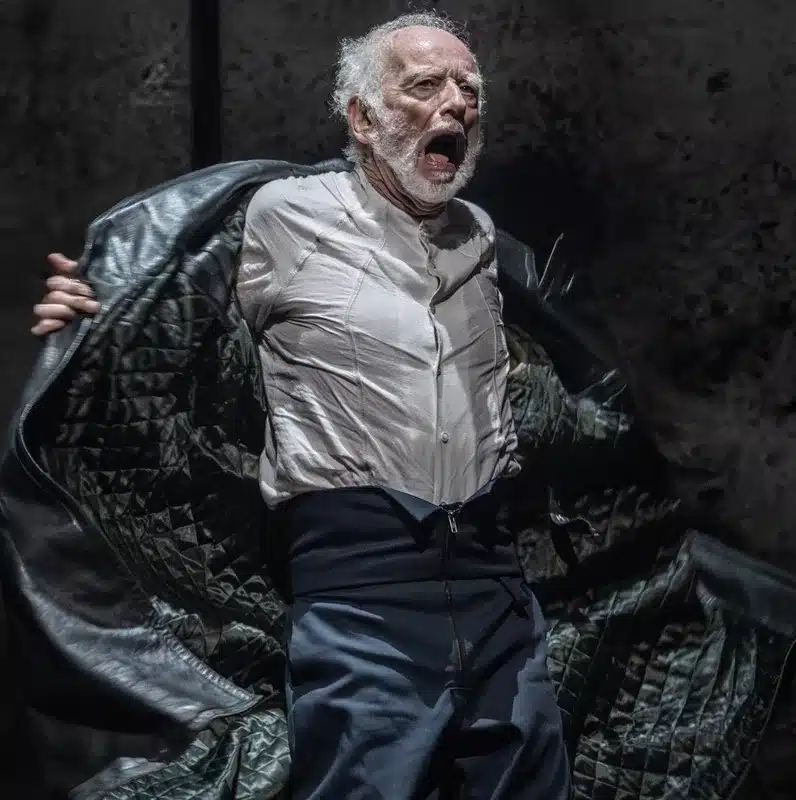
Ian McDiarmid, the esteemed Scottish actor, delivers a mesmerizing performance as the titular monarch in director Titas Halder’s affecting production of King Lear at Sheffield’s Crucible Theatre. This engagement marks McDiarmid’s return to the role after 21 years, having previously portrayed Lear in an adaptation by Edward Bond at the same venue. Now, at 82, McDiarmid once again embodies Shakespeare’s tragic king, capturing his initial joviality and subsequent descent into fear as he confronts old age.
A Masterclass in Character Evolution
A powerful portrayal of Lear, particularly by an actor of McDiarmid’s caliber, necessitates ample space for character development. Halder, alongside designer Richard Kent, has crafted a production that provides this by embracing a simultaneously spartan and abstract semi-minimalist aesthetic. While Lear and his subjects might invoke eighth-century deities, the production’s uncluttered sets, featuring materials like corroding metal and glass, and its distinctive costumes—a blend of Jacobean and modern styles—transcend strict historical specificity. This approach allows the emotional and psychological arc of the character to take center stage.
McDiarmid’s entrance as Lear is striking. Clad in a regal white cape, his initial, albeit misplaced, sense of absolute certainty creates a powerful contrast that sets the stage for his profound emotional and psychological unraveling. The pivotal moment arrives when Lear’s youngest daughter, Cordelia, portrayed with sharp precision by Bebe Sanders, refuses to participate in the sycophantic flattery the aging king demands from his three daughters. This refusal triggers Lear’s famous misjudgment and propels McDiarmid’s interpretation into a nuanced and compelling journey of decline.
The Descent into Self-Discovery
Accompanied by the Fool, played with remarkable vivacity by Max Revell as a 21st-century sportswear-clad truth-teller, McDiarmid’s Lear sheds his initial bombast. The performance traces a painful path of self-discovery, moving from bitter, often darkly humorous, sarcasm towards a poignant, paradoxical clarity as he grapples with his deteriorating mental state, famously pleading, “let me not be mad.” This anguished portrayal of mental decline resonates deeply, offering a recognizable depiction for those who have witnessed or experienced the effects of dementia in loved ones.
A Stellar Ensemble Cast
While McDiarmid’s Lear is undeniably mesmerizing, the production is elevated by a uniformly strong ensemble cast. Fode Simbo delivers a deliciously duplicitous performance as Edmund, Gloucester’s illegitimate son. His self-serving ambition, articulated through lines like “Let me, if not by birth, have lands by wit,” highlights the enduring modernity of Shakespeare’s text. Katie Wimpenny and Justina Kehinde offer gorgeously brutal and passionate portrayals of the ungrateful and avaricious sisters, Goneril and Regan, respectively.
The emotional core of the play is powerfully underscored by the reunion of the blinded Gloucester, played with captivating depth by David Birrell, with his wronged son Edgar, brought to life with great humility by Harry Redding. This moment exemplifies the production’s profound capacity for pathos. The overall effect is an open, intensely felt interpretation of King Lear, anchored by a subtle yet outstanding central performance.
Production Details
The production runs until September 19. Tickets can be purchased by calling 0114 249 6000 or visiting sheffieldtheatres.co.uk.
