

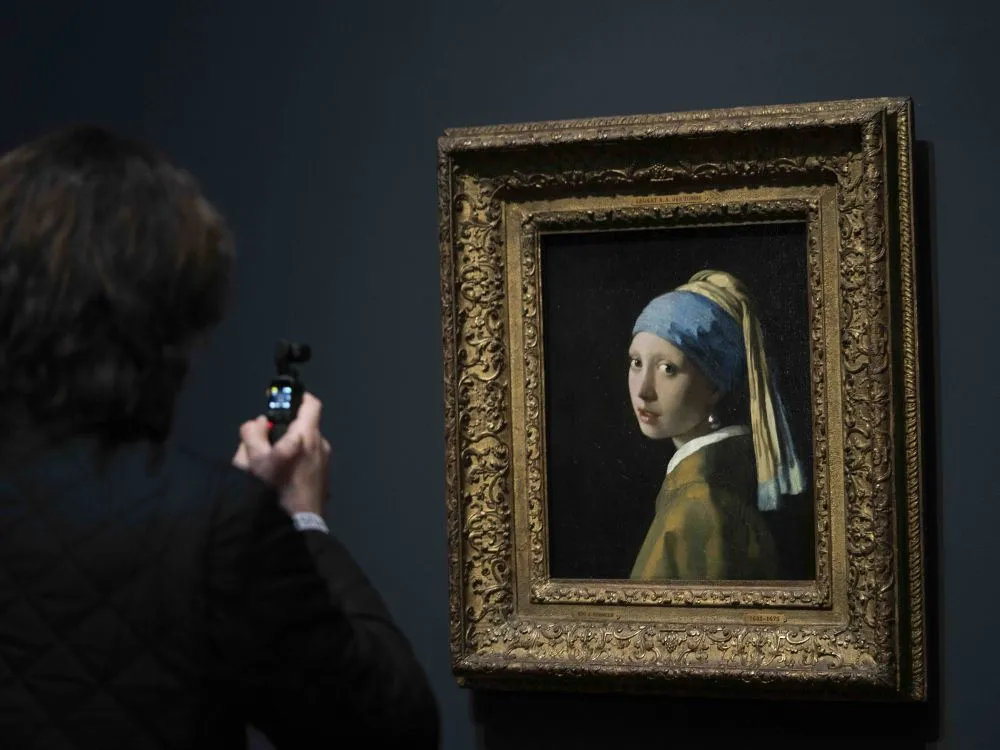
Johannes Vermeer, the 17th-century Dutch master, is renowned for his luminous depictions of everyday life. Paintings like ‘The Little Street’ and ‘The Girl with a Pearl Earring’ captivate viewers with their seemingly ordinary scenes imbued with an extraordinary sense of presence. However, a new perspective from art historian Andrew Graham-Dixon suggests that Vermeer’s celebrated works may hold a deeper, spiritual significance, serving as visual guides for his Christian faith.
Reinterpreting Vermeer’s Masterpieces
Andrew Graham-Dixon’s book, ‘Vermeer: A Life Lost and Found,’ posits that the artist’s relatively small oeuvre is not merely a collection of ‘snapshots’ of 17th-century Dutch life. Instead, Graham-Dixon argues that Vermeer’s paintings were intended as profound expressions of faith, specifically for the Remonstrant sect to which Vermeer and his family belonged. This interpretation challenges the long-held view of Vermeer as a painter of secular genre scenes.
The challenge in understanding Vermeer lies in the scarcity of direct evidence. The artist himself left little in the way of personal writings or detailed accounts of his intentions. Graham-Dixon’s approach, therefore, delves into the historical context of the Netherlands during Vermeer’s time, examining his family, associates, and the religious landscape that shaped his world. By looking through the lens of his community and their shared beliefs, Graham-Dixon seeks to reveal a new way of seeing both the people and the world depicted in Vermeer’s art.
The Dutch Republic: A Unique Crucible
Vermeer lived and worked in Delft during the Dutch Golden Age, a period of remarkable economic prosperity and cultural flourishing for the United Provinces. Following the Protestant Reformation in the 16th century, the Netherlands had broken away from Catholic Spanish rule, establishing a unique republic. This new state, though not a democracy but rather a federation of powerful oligarchs, became a global trading powerhouse. Organizations like the Dutch East India Company fueled its wealth, dealing in goods from across the world.
This era saw a boom in the art market, with painting becoming a significant industry. While religious art remained prevalent, ‘genre painting’—scenes of everyday life with moral undertones—gained immense popularity. Vermeer’s early works included biblical subjects, and he was also capable of producing genre scenes. Paintings such as ‘The Glass of Wine’ and ‘The Girl with the Wine Glass’ depict social interactions, often with a subtle moral commentary, rendered with Vermeer’s unparalleled mastery of light and composition.
The Remonstrant Influence
The dominant religious force in the Dutch Republic was the Dutch Reformed Church, heavily influenced by Calvinism. This theology emphasized original sin and predestination. However, dissenting interpretations emerged, notably from Jacob Arminius and his followers, the Remonstrants. The Remonstrants advocated for a more humane Christianity, rejecting formal church hierarchies and emphasizing private worship, prayer, and biblical discussion in small, home-based gatherings. They also championed the equality of men and women and religious tolerance.
Vermeer and his parents were Remonstrants. This religious affiliation, coupled with the republic’s tolerance for private worship, provided a fertile ground for his artistic development. Graham-Dixon suggests that Vermeer’s patrons, Pieter Claes van Ruijven and his wife Maria de Knuijt, who were also Remonstrants, commissioned works not just for aesthetic pleasure but as visual aids for their religious community.
Faith Embodied in Everyday Scenes
Graham-Dixon proposes that paintings often viewed as secular genre scenes were, in fact, imbued with spiritual meaning for the Remonstrant community. For instance, ‘Woman Holding a Balance’ might not be about admiring wealth but about a Christian’s contemplation of true value. Similarly, ‘The Milkmaid’ could symbolize actively doing good by feeding the poor, with even details like a nail on the wall carrying symbolic weight, possibly representing the crucifixion of Christ.
Even the iconic ‘Girl with a Pearl Earring’ is reinterpreted by Graham-Dixon. He suggests it is a portrait of Magdalena van Ruijven, the daughter of his patrons, depicted as Mary Magdalene. The painting, in this view, captures a moment of spiritual revelation as she turns towards Christ’s voice, her gaze meeting the viewer’s.
‘The Little Street’ and the ‘Church Invisible’
‘The Little Street,’ a painting that deeply moved visitors at the Rijksmuseum, is also given a spiritual dimension. Graham-Dixon identifies it as a specific street in Delft, the Oude Delft. The house on the left, the Golden Eagle, was the home of the van Ruijvens. The black door visible leads to an alley housing a ‘schuilkerk’—a hidden church used by Remonstrant believers. Thus, the seemingly ordinary street scene becomes a representation of the ‘church invisible,’ the hidden community of faith.
A Legacy of Quiet Intensity
Andrew Graham-Dixon’s interpretation, supported by extensive research, presents Vermeer not just as a master of light and realism but as a painter of profound spiritual concepts. While some details of his theory may be debated, the argument that Vermeer’s art served a religious purpose offers a compelling new lens through which to view his work. The quiet intensity captured in his paintings, whether secular or spiritual, continues to resonate, inviting viewers to find a deeper reality within the transient moments of life, much like the poet William Blake’s vision of seeing the infinite in the ordinary.
