

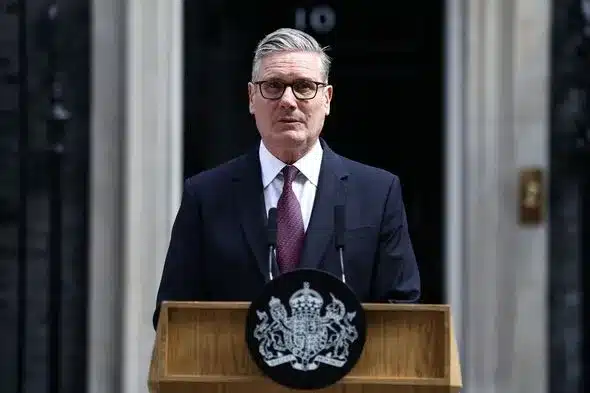
A significant announcement regarding historical forced adoptions in England was made, prompting a special broadcast interruption. On Thursday, July 2, news channels shifted focus to Downing Street as it was revealed that Sir Keir Starmer would issue a formal apology on behalf of the state to survivors affected by these past practices.
Breaking News: Formal Apology for Forced Adoptions
During the early morning program ‘Mornings with Ridge and Frost,’ hosts Sophy Ridge and Wilfred Frost were interrupted to deliver this major breaking news. Wilfred Frost reported the development, stating, “We’ve just learned that the Prime Minister will make a formal apology on behalf of the state to all of those who have been affected by historic forced adoptions in England.” The announcement signaled a pivotal moment in acknowledging the pain and trauma experienced by individuals subjected to forced adoption policies in the past.
To provide further context and analysis, political correspondent Alexandra Rogers was brought onto the program. Her insights were crucial in detailing the implications of the apology and the historical background of forced adoptions, a practice that deeply impacted countless families across England for decades.
Understanding Forced Adoptions
Forced adoptions refer to a period, primarily spanning from the post-World War II era until the late 1970s, when unmarried mothers were often coerced or pressured by authorities, medical professionals, and even family members into relinquishing their babies for adoption. This practice was particularly prevalent during the 1950s and 1960s.
The circumstances surrounding these adoptions were frequently characterized by:
- Social Stigma: Unmarried mothers faced immense societal disapproval, leading to shame and isolation.
- Lack of Support: Many young women received little to no support from their families or the state, leaving them vulnerable.
- Coercion: There are numerous accounts of mothers being misled about their rights, the adoption process, or the long-term consequences for them and their children.
- Secrecy: Adoptions were often conducted with a high degree of secrecy, preventing mothers and children from knowing each other’s whereabouts or having contact.
The consequences for both mothers and adopted children were profound and long-lasting, often leading to grief, identity issues, and a sense of loss that persisted throughout their lives. Many survivors have campaigned for decades for official recognition and an apology for the injustices they endured.
The Significance of a State Apology
The decision by Sir Keir Starmer to issue a formal apology on behalf of the state carries significant weight. Such an apology is seen as a crucial step towards:
- Acknowledgement of Harm: It formally recognizes the suffering caused by past government policies and societal attitudes.
- Validation for Survivors: It validates the experiences of those who have spoken out about their trauma and campaigned for justice.
- Reconciliation: It opens a path towards healing and reconciliation for individuals, families, and the broader community.
- Learning from the Past: It serves as a commitment to ensure such practices are never repeated.
Political commentators noted that such apologies, while not erasing the past, are vital for national healing and for demonstrating a commitment to human rights and ethical governance. The timing of the apology, delivered by the Prime Minister, underscores its importance and the government’s intent to address this historical wrong.
Broader Context and Future Implications
The apology is expected to be met with a mix of relief, gratitude, and perhaps continued calls for further action from survivor groups. Many will be looking to see what support services or restorative measures might accompany the formal acknowledgement. The government’s commitment to addressing the legacy of forced adoptions could also influence future policies related to family welfare, adoption, and support for vulnerable individuals.
This development marks a significant moment in the ongoing efforts to confront and rectify historical injustices within the United Kingdom. The focus now shifts to the details of the apology itself and the subsequent actions that will follow, aiming to provide a measure of closure and justice for those affected by forced adoptions.
