

Embarking on a kitchen renovation can be an exciting prospect, with the allure of sleek, modern designs often taking center stage. However, an interior design expert is cautioning homeowners against blindly following the latest trends, highlighting several popular choices that could lead to long-term regret. Thanim Malique, a design consultant, emphasizes the critical balance between aesthetics and practicality, advising that what appears fashionable may not always be the most functional or suitable for individual needs.
Avoiding Common Kitchen Renovation Pitfalls
Malique’s insights, shared with a focus on user experience, point to several design elements that, while popular, can introduce unforeseen challenges. His core philosophy revolves around ensuring a kitchen is not only visually appealing but also a highly usable space tailored to the homeowner’s lifestyle. “What we think we want is not always what is right for us,” Malique stated. “As a kitchen designer, I try to find a balance between design and practicality. Some customers might want something that doesn’t actually work for them, and it is my job to identify and help my customers arrive at a conclusion that works for them.”
Eye-Level Ovens: A Space-Saving Illusion
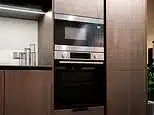
Eye-level ovens, often integrated into tall cabinets, are frequently chosen to reduce the need for bending and kneeling, a seemingly beneficial feature, especially for those with mobility issues. Malique acknowledges this advantage, noting that it can be a genuinely smart solution for reducing strain. However, he warns of a significant drawback: the loss of valuable counter space. “The catch is that a tall oven-larder feature can remove around 600mm of worktop space, which can make an already small kitchen feel cramped or overwhelming,” he explained. “In compact layouts, losing that surface area can directly impact day-to-day usability.” This trade-off means that while the oven is more accessible, the surrounding workspace can become significantly compromised, particularly in smaller kitchens.
Wooden Worktops: High Maintenance Charm
Wooden worktops are celebrated for their ability to impart warmth, character, and a sense of luxury to a kitchen. Their natural beauty is undeniable, but Malique points out that their upkeep is often underestimated. “They also need more care than most people expect,” he noted. Wood is susceptible to drying out and requires regular oiling and maintenance to preserve its appearance and integrity. For busy individuals or those who prefer a low-maintenance environment, wooden worktops might not align with their lifestyle, even if the aesthetic is highly desired. “If a customer is busy or doesn’t want upkeep, wooden worktops may not match their lifestyle,” he remarked.
J-Pull Handles: Sleekness vs. Accessibility
The quest for a minimalist, handle-free look has made J-pull handles a popular choice. These integrated handles offer a clean, streamlined appearance and are particularly useful in narrow kitchen layouts by avoiding protruding hardware. However, Malique raises concerns about their usability for individuals with certain physical limitations, such as arthritis. “If a customer has arthritis, the experience of pulling drawers can be harder than expected,” he explained. The design of J-pulls can make gripping difficult, and the force required for soft-close mechanisms, combined with the weight of full drawers, can present a significant challenge for those with sensitive joints.
‘Trendy’ Extractor Fans: Style Over Functionality
Modern kitchen designs often feature extractor fans that are integrated more subtly, aligning with wall units to create a continuous, linear look and avoid the visual disruption of bulky appliances. While this approach contributes to a sleeker aesthetic, it can create practical issues for active cooks. Malique highlights that lower-positioned hoods can make it difficult to work with large pots and pans. Furthermore, this design is generally only suitable for induction hobs. Gas hobs introduce flame and heat considerations, requiring greater clearance between the hob and the hood for safety, rendering this trendy extractor placement unfeasible in many kitchens.
Integrated Wall Microwaves: Convenience with Caveats
Built-in microwaves, often placed in wall cabinets, are a clever solution for saving precious counter space. However, their elevated position can lead to accessibility issues. Malique points out that reaching for hot items from a microwave mounted high up can be risky. Additionally, the depth of wall cabinets can sometimes restrict the internal capacity of the microwave, potentially preventing larger dinner plates from fitting, which negates some of the convenience.
Accent Colours: Impact on Perceived Space
Using two-tone color schemes, with different colors for base and wall units, can add depth and visual interest to a kitchen. This approach can break up the visual mass and create a dynamic look. However, Malique cautions that in smaller kitchens, such schemes can inadvertently make the space feel more compact and cluttered. “The ‘mixed palette’ look can shift from stylish to overwhelming depending on room size and lighting,” he observed. The effectiveness of two-tone designs is highly dependent on the scale and lighting conditions of the room.
Budget Considerations: The Cost of Compromise
While budget is a significant factor in any renovation, Malique advises against compromising on key elements that can undermine the overall aesthetic. Keeping existing appliances or sinks, even if functional, can make a new, cohesive kitchen appear dated by comparison. He suggests that homeowners weigh the short-term savings against the long-term desired outcome. “In these cases, the decision becomes: is the customer saving money now, or investing to achieve the look they actually want?” Malique stated. He often works with clients to explore financing options if a slightly higher investment is needed to achieve their vision.
Corner Units: Maximizing Usability and Storage
The design of corner units significantly impacts both accessibility and storage capacity. L-shaped corner units are generally preferred for their superior usability, allowing for easier viewing and access to stored items. In contrast, straight corner units can obscure parts of the internal storage, making items difficult to retrieve and prone to being ‘lost’ in the corner. While solutions like pull-out carousels exist for straight corners, Malique notes that these mechanisms consume internal space, thus reducing overall storage capacity. The choice between maximizing access or storage ultimately depends on the homeowner’s priorities.
Conclusion: Prioritizing Functionality in Kitchen Design
Ultimately, Malique’s advice underscores the importance of thoughtful planning in kitchen renovations. Trends should be evaluated not just for their visual appeal but for their practical implications and suitability for the homeowner’s daily life and physical needs. A well-designed kitchen is a harmonious blend of style and function, ensuring it remains a practical and enjoyable space for years to come.
