

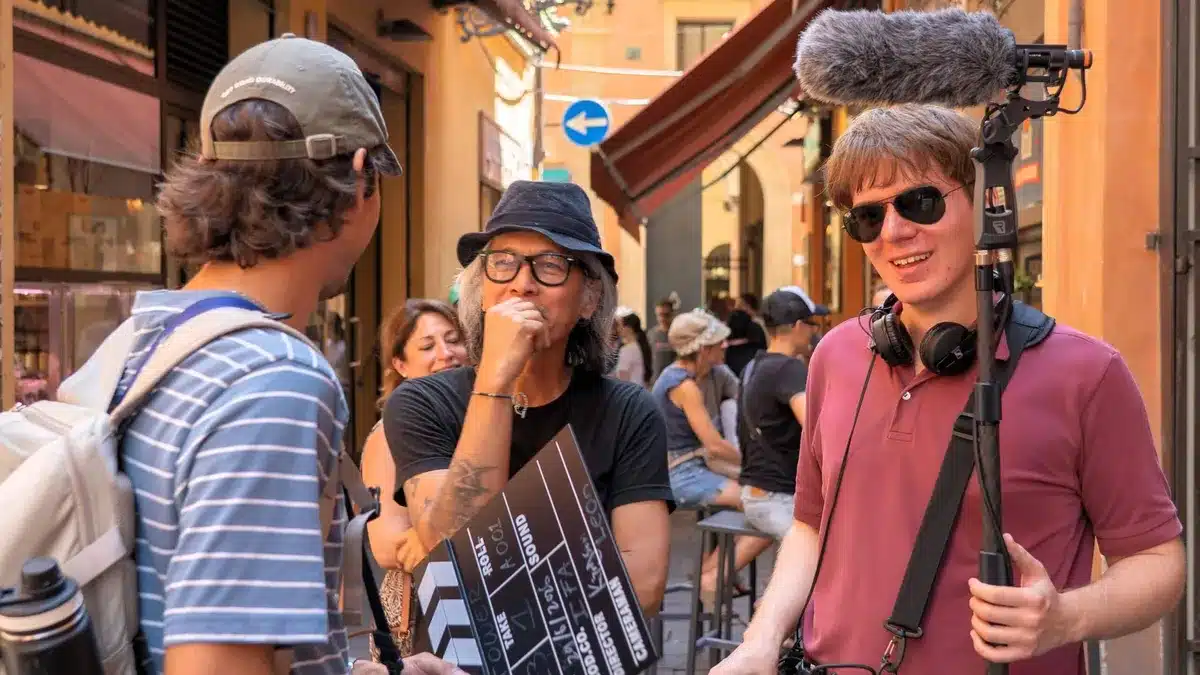
Renowned Filipino filmmaker Lav Diaz is currently imparting his cinematic wisdom as the lead instructor for the International Filmmaking Academy (IFA) master class in Bologna, Italy. Following in the footsteps of esteemed directors such as Bernardo Bertolucci, Jane Campion, Cristian Mungiu, and Asghar Farhadi, Diaz is guiding emerging filmmakers through an intensive creative process.
Guiding Emerging Talent
The International Filmmaking Academy, established in 2012 by filmmaker and producer Gian Vittorio Baldi, aims to foster independent artistic voices. Marija Krunic, president and co-founder of IFA, highlighted Diaz’s suitability for the role, stating, “He encourages filmmakers to stay close to their inner voice, to resist imitation, to think independently and to remain faithful to their own artistic voice. That is exactly why we invited him to teach at the International Filmmaking Academy.”
Diaz’s master class, now in its 13th edition, commenced on June 25 and will conclude on July 7. Over this period, he is dedicating more than nine hours daily to mentoring 15 filmmakers hailing from 15 different countries. The comprehensive program covers the entire filmmaking journey, from writing and shooting to editing, culminating in the premiere of each participant’s short film at the Cineteca di Bologna.
The diverse group of participants represents countries including New Zealand, Mexico, France, Hong Kong, Ireland, Australia, the United Kingdom, Honduras, Canada, Finland, the USA, Brazil, Italy, Japan, and Switzerland.
Tribute and Screenings in Bologna
While Diaz is in Bologna, the Cineteca di Bologna, a significant film archive, is honoring his contributions with special screenings of two of his acclaimed works: “Magellan” and “When the Waves Are Gone” (2022). Both films, which previously premiered at the Venice Film Festival, are set to be shown in Bologna on July 3.
“Magellan,” featuring Gael Garcia Bernal in the titular role, will be screened in the historic Piazza Maggiore as part of Bologna’s “cinema under the stars” summer series and the Il Cinema Ritrovato Festival. Diaz is also scheduled to engage with audiences through public discussions, panels, and question-and-answer sessions.
Krunic noted that IFA has hosted a prominent film author annually for the past 12 years during Il Cinema Ritrovato, recognized as one of the world’s most important festivals for restored cinema. This year marks the festival’s 40th edition.
Coincidentally, another celebrated Filipino filmmaker, the late Lino Brocka, was also honored with a screening of his 4K digitally restored film “Weighed But Found Wanting” (Tinimbang ka ngunit kulang) on June 21, also as part of Il Cinema Ritrovato. Diaz expressed regret at missing Brocka’s screening due to his arrival in Bologna on the same day, acknowledging the positive critical reception of the restored film.
Diaz’s Approach to Teaching
Lav Diaz has a history of conducting master classes internationally, with previous engagements in Cuba, Berlin, Locarno, Croatia, and Russia. He finds deep satisfaction in sharing his experiences, particularly with younger generations of filmmakers.
“There’s deep fulfillment in sharing experiences, especially with the youth, in every respect nurturing for both, as I’m imparting the little knowledge that I know and I’m really learning from them, as well,” Diaz shared. He also praised the IFA program for its capacity to foster “fresh and radical approaches to understanding the great medium of cinema.”
Describing the master class as a fourteen-day mentorship and collaboration, Diaz commended Marija Krunic as a “true visionary” with immense faith in cinema. He emphasized a collaborative, guidance-based, and informal approach to foster trust and kinship among the participants. “We are a group, a unit. I’m applying my one-on-one methodology so I can create an earnest relationship with them. Fundamentally, it’s just guidance-based, a very informal approach, to develop a deeper connection. They talk, I listen to them. I talk to them. They listen, Halos tumatambay lang kami, to develop trust, kinship,” he explained.
Regarding the participants’ films, Diaz stated he did not impose specific length requirements, focusing instead on developing the durational aspect during post-production. He expressed confidence in the students’ work, encouraging them to “work harder.”
Reflections on “Magellan” and “When the Waves Are Gone”
Diaz reflected on the journey of “Magellan,” which earned him the Best Film award, the Golden Spike, at the Valladolid International Film Festival. He described the experience as an “amazing voyage” that, while not financially rewarding, was sustained by a continuous creative momentum.
The film has garnered further recognition, being named one of “The Best Movies of 2026 So Far” by Rolling Stone and receiving a special release in The Criterion Collection.
Recalling the making of “When the Waves Are Gone,” which won multiple Gawad Urian awards, Diaz shared the challenges faced during the pandemic, including crew illnesses. His extensive location scouting in Bicol provided him with “transcendental insight” and affirmed his faith in cinema and life, describing the film as a “pilgrimage to the nature of cinema” that also addressed the drug war under former president Rodrigo Duterte.
Artistic Rigor and Generosity
Krunic described Diaz’s presence at the master class as embodying “total presence, radical generosity, and a way of working that dissolves the gap between teaching and creation.” She noted that Diaz, like previous IFA instructors such as Abbas Kiarostami and Béla Tarr, pushes the boundaries of cinematic education.
“What Lav Diaz brings goes beyond technique. He brings a way of seeing cinema as patience, as listening, as truth. He meets each filmmaker with empathy and intensity, and gently pushes them beyond their limits – not toward his vision, but toward their own,” Krunic stated. She added that Diaz’s approach expands IFA’s mission to help emerging filmmakers affirm their artistic identity and undergo a profound transformative experience.
A Call to Action: “Cinema is not a spectator sport”
In a letter to his students, Diaz shared his philosophy, emphasizing honesty and idealism. He described his own journey as a shy, naive, yet idealistic young man with a dream to make cinema, acknowledging that he still seeks enlightenment and strives to contribute to humanity through his art.
He praised Krunic’s “optimism, enthusiasm, generosity, her love for cinema,” and the freedom she grants students to work on their materials on their own terms. Diaz urged his students to embrace urgency and engage with the world directly: “Go to Ukraine, now! Go to Gaza, now! Go to North Africa, now! Go to Myanmar, now! Go to Iran, now! Go to Tibet, now! Cinema is not a spectator sport.”
Diaz concluded his letter by stating his role as a listener and servant, eager to learn from his students and create cinema in their own language and vision. He signed off as “A farmer, sometimes a filmmaker,” adding, “Salamat po!” (Thank you!).
Upcoming Film: “Kawalan”
Diaz also provided an update on his latest film, “Kawalan,” currently in post-production. The film, shot in Sampaloc, Quezon, has been noted by The Hollywood Reporter as a potential entry for the Venice Film Festival.
The Hollywood Reporter described “Kawalan” as a “durational opus” set in the Philippines during the pre-World War II Commonwealth period. It follows a town mayor who organizes his community to establish a hidden settlement in the forest to escape the impending Japanese invasion.
The cast of “Kawalan” includes regular collaborators such as Nanding Josef, Janine Gutierrez, Hazel Orencio, Shaina Magdayao, Paul Jake Paule, Amado Arjay Babon, and Jay-R Escandor.
Future Aspirations
Looking ahead, Diaz expressed a desire to conduct a filmmaking class in his hometown of Sampaloc, Quezon, aiming to provide young people with an intensive exploration of the art of cinema and life itself. “Balak kong gawin sa Sampaloc, Quezon, para sa ating mga kabataan – isang masinsinang pagtahak sa sining ng cinema at sa buhay,” he stated.
