

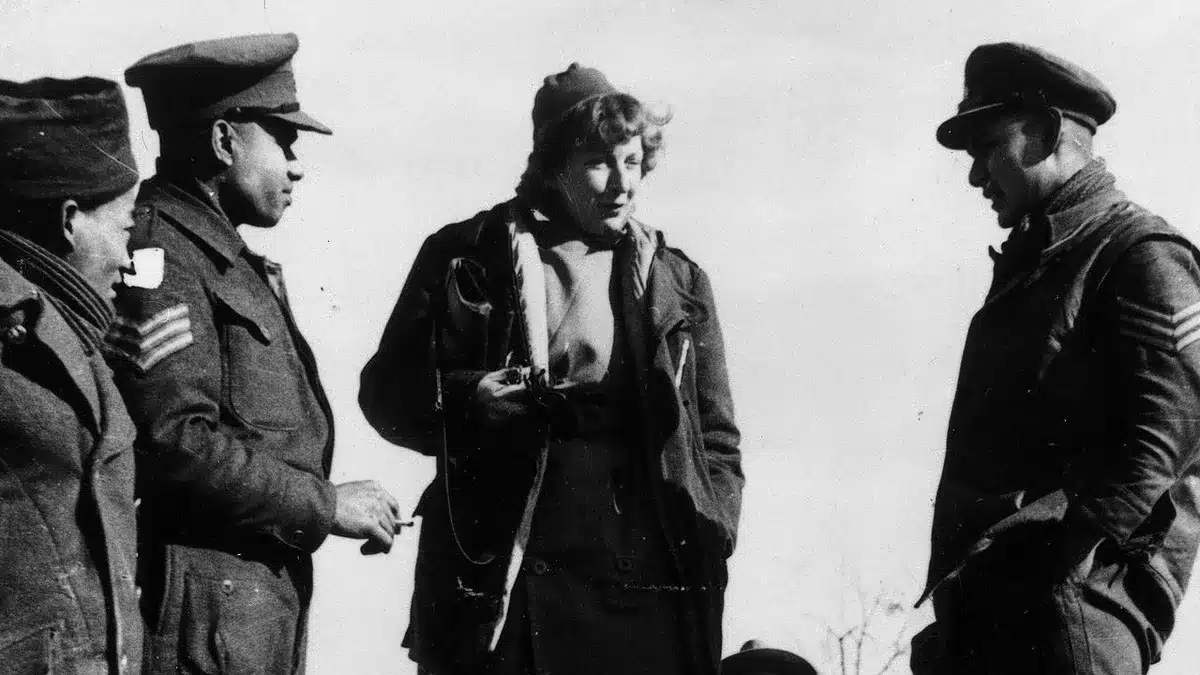
Martha Gellhorn’s Audacious Journey to Cover D-Day
In June 1944, American journalist and author Martha Gellhorn employed a remarkable ruse to gain firsthand access to the D-Day landings in Normandy. Her dispatches, renowned for their vivid portrayals of war’s brutality and humanity, often focused on the everyday experiences of those caught in conflict. Gellhorn’s career, spanning six decades, saw her cover major global events, from the Spanish Civil War and the Vietnam War to the liberation of Dachau concentration camp.
A Daring Subterfuge to Reach the Front Lines
Gellhorn recounted her clandestine boarding of a hospital ship to a news outlet in 1991. “I had sneaked on to a hospital ship,” she revealed at the age of 82. “Somebody probably onshore asked me what I was doing, and I said, ‘I’m just going on this ship to interview the nurses – a woman’s feature.’ You could always get by with that. It always sounded harmless and idiotic, and it worked a treat. ‘I’m just doing the woman’s angle,’ and nobody’s interested anymore. And then I just locked myself in a toilet until such time as we were afloat.”
Her ability to navigate challenging circumstances was a hallmark of her extraordinary personal life. She cultivated friendships with influential figures, including the Roosevelts, and maintained her independence even after marrying Ernest Hemingway, refusing to be overshadowed by his fame.
Competition and Determination in War Reporting
Gellhorn’s drive to reports the heart of conflict was evident even during her marriage to Hemingway. While living in Cuba in 1943, a period when Hemingway was unsuccessfully hunting German submarines, she grew increasingly restless. Her foray into war correspondence began in Spain in 1937, an experience she described as accidental. Her biographer noted that Gellhorn traveled to Spain to be with Hemingway, who encouraged her to write about what she knew: people, rather than military strategy.
Her early work, funded by an article for Vogue testing a chemical peel, quickly shifted to the grim realities of civilian life under siege in Madrid. She found her calling, confiding to a friend that she would “stick to misery which is my province… and the hell with the flesh.” Despite Hemingway’s desire for her to remain home after their marriage in 1940, Gellhorn continued to pursue assignments, even accompanying the US Fifth Army to Monte Cassino in 1943, eliciting a pointed question from Hemingway: “Are you a war correspondent or a wife in my bed?”
By 1944, a professional rivalry intensified. Gellhorn had hoped to cover the D-Day invasion for Collier’s magazine, but Hemingway secured the assignment. While he traveled to London, Gellhorn embarked on a two-week journey to Europe aboard a Norwegian freighter laden with explosives. Despite official military prohibitions against female journalists covering the Allied landings, Gellhorn remained undeterred.
“To me, all the people in the rear who make rules, they exist to be thwarted,” she stated. This defiance led her to be on the first hospital ship to reach Normandy, arriving at Omaha Beach on June 7th, making her the sole female correspondent present at the D-Day landings.
Poetic Observations Amidst Chaos
Upon her return to London, Gellhorn was arrested for entering Normandy without authorization and was sent to a nurse’s training camp. However, she soon arranged a flight to Italy with a British pilot to cover the Allied advance.
Her ability to transcend gender barriers in a male-dominated field was highlighted by international correspondent Lyse Doucet. “She didn’t allow others – and herself – to let gender define her and her work,” Doucet observed. “In what was then a male-dominated profession, Gellhorn showed that women couldn’t just report on war, they could excel at it.”
Gellhorn’s firsthand account of Omaha Beach provided a stark contrast to Hemingway’s report, which ran first but without him having set foot on shore. Her dispatch masterfully blended the overwhelming scale of the scene with poignant details. Amidst the backdrop of troops disembarking, clanking tanks, and unseen aircraft, she noted a washing line strung on a landing craft, with dance music emanating from its radio, all while mines detonated on the beach.
“There were barrage balloons, looking like comic toy elephants, bouncing in the high wind above the massed ships,” she wrote, capturing the surreal juxtaposition of daily life and conflict.
The Human Face of War
Gellhorn’s commitment to witnessing the human cost of conflict defined her career, as reflected in her 1959 collection, “The Face of War.” The introduction stated, “War happens to people, one by one.” She excelled at conveying the sensory details of wartime for both soldiers and civilians.
“It may seem obvious and essential now, but Gellhorn’s focus on the people on the ground, not the powerful at the top, was her signature,” commented Doucet. Gellhorn’s D-Day account captured the surprise of young American soldiers encountering the abundance of food in Normandy, a region known for its agricultural output. “Everything was confused and astounding: first, there were the deadly bleak beaches, and then the villages where they were greeted with flowers and cookies – and often by snipers and booby traps.”
Her writing also captured the dark humor that helped individuals cope with extreme circumstances. She recounted a soldier’s remark about a welcoming foxhole inland, contingent on not minding eating sand during an air raid. Her companion’s polite refusal, citing guests aboard their landing craft, exemplifies Gellhorn’s skill in illustrating resilience through everyday interactions amidst profound horror.
Gellhorn’s approach to enduring such experiences was articulated in her essay “The War in Finland”: “The way people stay half-sane in war, I imagine, is to suspend a large part of their reasoning minds, lose most of their sensitivity, laugh when they get the smallest chance, and go a bit, but increasingly, crazy.”
