

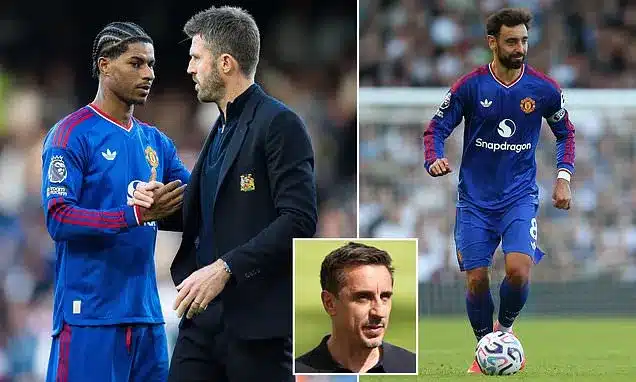
Manchester United’s recent performances have sparked debate, with critics highlighting a perceived lack of running and intensity. However, manager Michael Carrick remains steadfast in his belief that raw statistics like distance covered and sprints made do not solely define success on the football pitch. This contrasts sharply with the views of some former players and a segment of the fanbase who prioritize visible effort and high-octane play.
Carrick’s Stance on Running Statistics
Michael Carrick has long articulated his perspective on football metrics, even before taking the helm at Manchester United. He acknowledges that the team might not lead in certain physical output categories, but he argues that efficiency and tactical control have historically been more crucial for winning. Recalling his playing days, Carrick noted in his 2018 book, ‘Between the Lines,’ that while teams might cover more ground against Manchester United at Old Trafford, the team often secured victories through effective possession and clinical finishing, a hallmark of the Sir Alex Ferguson era.
This philosophy is not without its critics. At his previous managerial role with Middlesbrough, supporters often pointed to a lack of pressing intensity and subsequent defensive vulnerabilities as the team’s primary weakness. While Carrick has midfielders like Kobbie Mainoo and Youri Tielemans, who are adept on the ball, the team’s effectiveness without possession has drawn parallels to past shortcomings.
The Debate Over Intensity and Effort
The core of the discussion revolves around a fundamental difference in expectations. A significant portion of the fanbase desires to see visible intensity and relentless effort, often described as a ‘buzzword’ that has long been associated with Manchester United. Conversely, Carrick’s managerial approach appears to de-emphasize these specific metrics, focusing instead on a more controlled, possession-based style.
This divergence in philosophy becomes particularly apparent when Manchester United is not winning. The team has faced several disappointing results, including losses and draws, leading to scrutiny of their physical output. Statistics reveal that United has been at or near the bottom of the league in sprints made, distance covered at high intensity, and time spent sprinting. Furthermore, the team spends a considerable amount of time walking without the ball, a statistic that raises concerns for those who value constant pressing.
Carrick, however, consistently rejects the notion that his team appears passive. He often interprets periods of the game as controlled spells or strategic patience rather than a lack of effort or ideas. He contends that expecting complete dominance for the entire match in the modern Premier League is unrealistic.
Analyzing the Numbers: Beyond the Surface
While statistics showing Manchester United lagging in running metrics, such as covering significantly less ground than opponents in a single match, have gone viral, Carrick’s supporters point to a different set of numbers that support his approach.
- Attacking Output: Manchester United ranks first in the league for total shots (113) and touches in the opposition’s box (182).
- Expected Goals (xG): The team ranks third in the league for xG (9.9), indicating they are creating high-quality scoring opportunities.
- Possession and Passing: United is fourth in possession and second for accurate passes per match, showcasing their control on the ball.
- Defensive Solidity: They have allowed the fewest touches in their own penalty area (92), suggesting a degree of defensive organization when in possession.
These statistics suggest that the team’s perceived ‘lethargy’ might, in part, be a deliberate tactical choice. Carrick’s underlying belief is that while hard work is essential, the metrics used to measure it are not the sole determinants of victory. He seems to be building a team that aims to dominate possession and control the tempo of the game, a style influenced by his own experiences as a midfielder.
Influences and Contrasting Views
Carrick’s perspective is shaped by his playing career and his understanding of the game. He believes his background as a midfielder provides him with a unique vantage point, connecting different phases of play and informing his coaching ideology. He also considers what he believes supporters want to see, aiming for a blend of effective football and engagement.
However, this approach stands in contrast to the views of several prominent figures in football. Former managers like Ralf Rangnick and Erik ten Hag, as well as coaches like Ruben Amorim, have emphasized the critical role of intensity, physicality, and pressing in modern football. Even director of football Jason Wilcox has spoken about the importance of intensity in training.
Matheus Cunha, a player, also highlighted the importance of intensity after a recent match. The prevailing sentiment among these individuals is that a high level of physical exertion and constant pressure are foundational to success in today’s fast-paced Premier League.
Conclusion: A Philosophical Standoff
As Manchester United heads into an international break, the debate over Carrick’s philosophy versus the perceived need for visible intensity continues. Carrick appears committed to his vision of a possession-dominant, strategically controlled team, even if it means diverging from the high-energy, high-sprint model favored by many. Whether this approach, which he seems determined to implement, will ultimately lead to sustained success remains to be seen, but it is clear that Carrick is prepared to manage the club on his own terms, prioritizing his deeply held beliefs about how the game should be played.
