

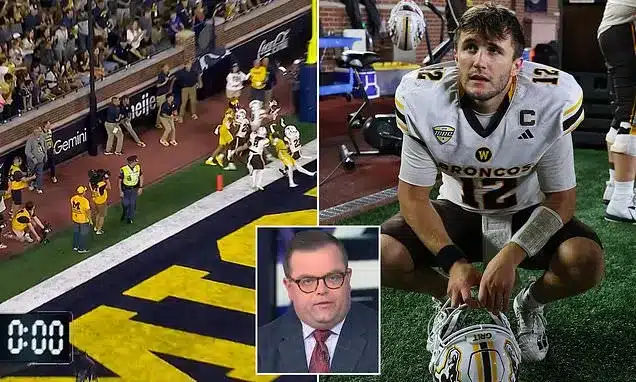
NBC broadcaster John Fanta has addressed a significant controversy surrounding the final seconds of the recent Michigan vs. Western Michigan football game, which saw a dramatic, game-winning touchdown for Michigan after a disputed clock stoppage. The incident sparked widespread accusations of a ‘rigged’ game on social media, fueled by an apparent discrepancy between the official game clock and the clock displayed on the television broadcast.
The Controversial Ending
The game was poised for one of college football’s most stunning upsets as Western Michigan appeared to bat down a Hail Mary pass from Michigan quarterback Bryce Underwood as time expired. However, officials controversially added one second back to the clock, granting Michigan another opportunity. Underwood then connected with JJ Buchanan on a 47-yard touchdown pass as the clock hit zero for the second time, securing a narrow 13-12 victory for Michigan. This dramatic finish, while celebrated by Wolverines fans, immediately drew scrutiny due to the clock controversy.
Discrepancy in Game Clocks
Fans watching the NBC broadcast noticed that the game clock displayed on screen seemed to hit 0:00 just as the Hail Mary pass was batted down. However, subsequent footage released by the Big Ten conference showed officials reviewing the play and determining that one second remained on the clock. This disparity between the broadcast clock and the official clock used by the referees led to an outcry from viewers who felt the game was unfairly influenced.
Broadcaster’s Explanation
During halftime of another game on Sunday night, John Fanta, an NBC broadcaster who covered the Michigan game, directly addressed the confusion. He emphasized that the official timekeeping is solely the responsibility of the Big Ten conference and the game officials, not the broadcast cameras. “The official time of the game is kept by the Big Ten,” Fanta stated. “Our cameras are not the official arbiter of time keeping within the game. That is the Big Ten and game officials’ responsibility.” He further noted that the Big Ten had released a statement and raw video to clarify the decision-making process.
Big Ten’s Official Statement and Footage
The Big Ten’s statement, accompanying the released footage, explained the officials’ reasoning. The review determined that Western Michigan player Micah Davis, wearing number 18, had jumped from out of bounds when he touched the ball. According to NCAA football rules, if a player touches a ball while out of bounds, the play is dead. The officials concluded that at the moment Davis made contact with the ball, there was one second remaining on the clock. The statement also detailed the replay process:
- A side-by-side view of the play and the game clock was used.
- A direct shot of the stadium’s game clock was utilized for the determination.
- The Big Ten asserted that all broadcast cameras, including the one focused on the game clock, are synchronized using a strobe system approximately 85 minutes before kickoff to ensure alignment.
The footage reportedly showed officials reviewing the play and stating, “When 18 is touching the football we’ve got one second on the clock.” This explanation, however, did not fully quell the doubts among many viewers who observed a different timeline on their screens.
Fan Reactions and Rebuttals
Social media platforms were flooded with comments questioning the clock discrepancy. Many users expressed disbelief, with one asking, “Why is this clock completely misaligned with the clock the broadcast had, which they confirmed was in sync with the official game clock?” Another comment sarcastically noted, “Oh ya you have a special clock only you can see the rest of us can’t, so that’s all that matters…”
Despite the ongoing debate, prominent Michigan fan Dave Portnoy offered a different perspective. He argued that it was “hilarious” to suggest Michigan, a high-profile program, would resort to cheating. Portnoy asserted that “Integrity and character will always come before winning at Michigan. That what makes Michigan Michigan.”
Official Acceptance and Lingering Questions
The MAC commissioner, Jon Steinbrecher, stated that he and Western Michigan officials had reviewed the Big Ten’s explanation and accepted it. He commended both teams for their efforts and thanked the Big Ten for its prompt clarification. “I commend Western Michigan for the outstanding effort and a well-played game, and I offer my congratulations to Michigan,” Steinbrecher said in a statement. “I also appreciate the collaborative efforts of the Big Ten office and its prompt response in reviewing the play and providing the requested clarification.”
However, some analysts, like NBC rules analyst Terry McAulay, initially expressed confusion. McAulay suggested that the broadcast clock might have been accurate and questioned how the official ruling of one second could have been reached if the broadcast clock was indeed synchronized. He pointed out that the ball appeared to still be in the air when the broadcast clock showed zero. “The ball isn’t even close to touching a player when it goes to zero,” McAulay observed. “Now, their Hawkeye system apparently either had different sync or whatever, and they came up with one second when it touched the player. I don’t see how that happened, assuming our clock is correct. It is clearly not touching a player. The ball is clearly still in the air when the clock goes to zero on our screen. So you know, the Big Ten is gonna have to tell a lot of us, how did they get to one second on this play?”
Conclusion
While the Big Ten has provided an official explanation and supporting video evidence, the visual discrepancy between the broadcast clock and the official clock used by referees has left a lingering sense of doubt for many observers. The incident highlights the critical role of accurate timekeeping in high-stakes sports and the challenges in maintaining perfect synchronization across all broadcast and official systems.
