

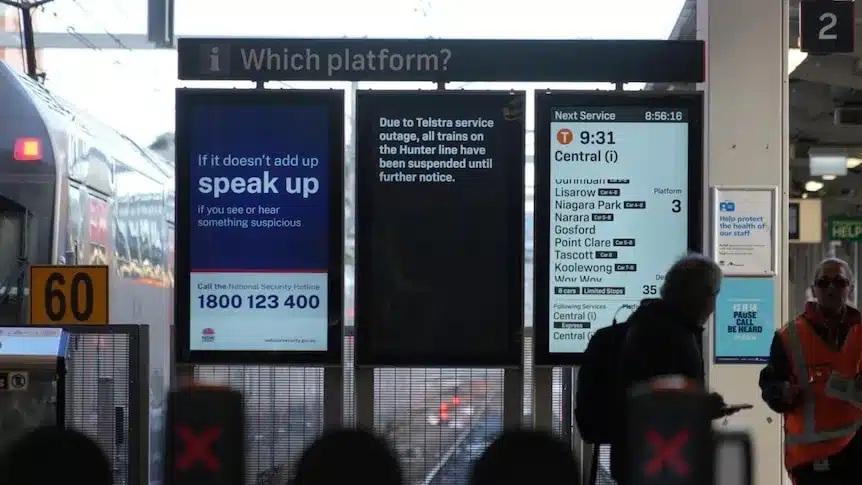
Passenger and freight train services across New South Wales have been significantly disrupted, with cancellations and suspensions reported due to a widespread Telstra network outage impacting essential communications. The Australian Rail Track Corporation (ARTC) has also halted coal and freight services as a precautionary measure, leaving the duration of the disruptions uncertain.
Hunter Region and Southern Highlands Services Halted
Commuters in the NSW Hunter region and the Southern Highlands faced considerable inconvenience as passenger train services were suspended. Transport for NSW (TfNSW) confirmed that multiple rail lines were affected by a loss of communications, a critical component relying on Telstra infrastructure. In Newcastle, services on the Hunter Line between Newcastle Interchange and Maitland were initially cancelled on Wednesday morning. A TfNSW spokesperson stated, “Trains are not running between these stations due to an external telecommunication issue.” Passengers were advised to allow extra travel time and monitor announcements for updates.
The disruption later extended to the entire Hunter Line, impacting services between Newcastle and Scone, as well as Dungog. One commuter, Wayne, described his experience travelling from Telarah to Newcastle. “By the time I got to the gym I wasn’t able to use the gym app that I normally use, but [when I] finished and came to the train station there were no trains on the Hunter Line,” he recounted. While he considered the impact mainly an inconvenience due to his retired status, he acknowledged the broader disruption for many others.
Intercity and Freight Operations Affected
The outage also brought train services between Sydney and Canberra to a standstill. Acting coordinator-general Matt Longland confirmed that services to and from the nation’s capital were halted mid-journey due to a loss of communication with the control centre. This suspension meant that passengers on these routes were stranded or required to find alternative arrangements.
Beyond passenger transport, the Australian Rail Track Corporation (ARTC) took the step of suspending coal and freight services as a safety precaution. An ARTC spokesperson explained, “As a safety precaution, ARTC has implemented established emergency protocols and safely brought rail services on the network to a stand while the telecommunications outage is resolved.” The corporation is working closely with Telstra and other stakeholders to monitor the situation and facilitate the safe resumption of operations. The spokesperson noted that while safety boom gates remained operational, there was no confirmed timeframe for the restoration of telecommunications services, and it would take time for the network to return to normal operations post-restoration.
Impact on Emergency Services and Public Safety
The national Telstra outage raised concerns regarding emergency communications. NSW Police issued a statement advising residents that while Triple Zero (000) systems themselves were not affected, individuals attempting to call from a Telstra device might experience difficulties connecting. They recommended using a non-Telstra device, a landline, or Wi-Fi calling if unable to get through. NSW Health Minister Ryan Park confirmed that a management centre had been established within the ambulance division to detect and respond to any dropped calls, ensuring continuity of emergency response. He reported no known instances of individuals being unable to contact Triple Zero or missing telehealth appointments, and that hospital systems were functioning with backup measures in place.
Broader Inconveniences and Travel Disruptions
While Sydney Metropolitan services and Opal systems were reportedly unaffected, the broader impact of the Telstra outage rippled through various aspects of daily life and travel. Sydney Airport operations continued, but commuters experienced significant inconveniences. One traveller, Nick, heading to Melbourne, found it “difficult to plan my day” due to the inability to access communication for flight information and contacting family.
Another passenger, Kim, travelling to the Gold Coast for her child’s dance competition, experienced severe mobile connectivity issues, with her phone fluctuating between 5G and SOS modes, rapidly draining her battery. This left her without internet access and unable to check flight status. Similarly, Felicia, en route to Uluru from Newcastle, had her navigation maps fail, causing anxiety about reaching the airport on time. She had to rely on another phone with service to navigate and ascertain the situation.
Uncertainty Regarding Service Restoration
Both TfNSW and the ARTC have indicated that the timeline for restoring full rail services remains unclear. The resolution of the train cancellations and suspensions is directly dependent on the restoration of Telstra’s network. Until communications are fully restored and tested, rail operators will continue to exercise caution, ensuring all safety protocols are met before resuming normal operations. Passengers are urged to stay informed through official transport channels for the latest updates on service availability.
The incident highlights the critical reliance of modern infrastructure, including public transportation and emergency services, on robust telecommunications networks. The widespread nature of the Telstra outage underscores the potential for significant disruption when these essential services are compromised, affecting not only daily commutes but also broader economic activities like freight transport.
