

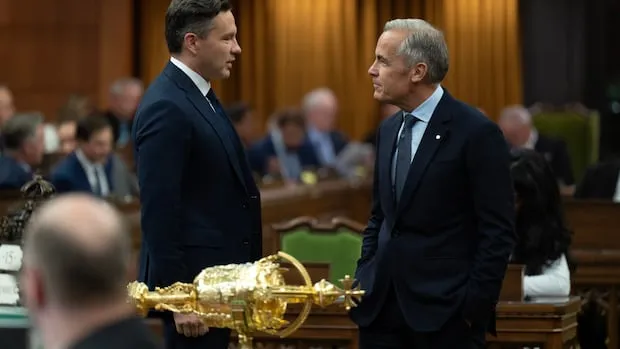
Conservative Leader Pierre Poilievre drew a sharp line in his recent speech on Canada-United States relations, countering Prime Minister Mark Carney’s claim of a “rupture.” Invoking John F. Kennedy’s words on the shared geography, history, economics, and necessity binding the two nations, Poilievre emphasized that this insight reflects a truth beyond temporary disputes.
Poilievre Stresses Stable Partnership
“Canada’s prosperity and security are inseparable from a stable relationship with the United States,” Poilievre declared at the Economic Club of Canada. He warned against proclaiming a permanent break with the nation’s largest customer and closest neighbor to pursue a strategic alliance with Beijing.
Poilievre clarified that Canada must prioritize its enduring ties with the U.S. while acknowledging Carney never explicitly rejected the need for stability or proposed fully replacing trade and security links with China.
Carney Declares End of Old Ties
Prime Minister Carney has stated that Canada’s “old relationship” with the United States is over. He described the U.S. as Canada’s most important security ally but noted that the economic integration and deepening trade once central to that bond have ended.
Poilievre highlighted the historic partnership between Canada and the U.S. as the greatest any two countries have forged. “It’s important to distinguish between governments and people. Politicians come and go. People remain,” he said.
He pointed out that American workers—from miners in Appalachia to energy workers in Texas and engineers in California—do not seek to harm Canadians daily. A recent Abacus Data survey supports this, with 64 percent of Americans holding positive views of Canada.
Poilievre urged nurturing allies within the U.S., even as some voters back President Donald Trump.
Long-Term Focus Amid Trump Era
“At the end of the day, President Trump will be in the position for the next three years,” Poilievre noted in a post-speech question-and-answer session. He stressed focusing on Canada’s long-term interests to protect jobs and livelihoods, as the centuries-old U.S. relationship will endure.
Canadian foreign policy scholar Kim Nossal argues in his 2023 book Canada Alone that an America First Republican return signals the U.S. political system no longer reliably produces post-1945 governments, forcing Western states to adapt.
Geography Drives Cooperation
Poilievre underscored geography as the most permanent factor in international relations, explaining why Canada remains tied to the U.S. as its top trading partner and defense collaborator—ruling out alternatives like joining the European Union.
Both leaders advocate diversifying trade, boosting military capacity, and strengthening the economy, but differences emerge in execution.
Policy Divergences
Carney recently unveiled an auto strategy diverging from U.S. vehicle emissions standards, offering incentives for Canadian manufacturing and allowing some Chinese electric vehicle imports to counter American pressures.
Poilievre proposed sacrificing Chinese EV imports for a tariff-free auto pact with the U.S. Carney has questioned heavy defense spending on American firms, while Poilievre suggested using U.S. equipment purchases as trade leverage.
Poilievre also called for digital sovereignty and protections for Canadian intellectual property. Broader discussions could extend to cultural and food sovereignty.
In a Davos address, Carney warned nations cannot accept integration as mutual benefit when it leads to subordination, pushing leaders to minimize dependencies while navigating geographic realities with the U.S.
The core debate in Canadian politics centers on balancing sovereignty imperatives with pragmatic U.S. coexistence.
