

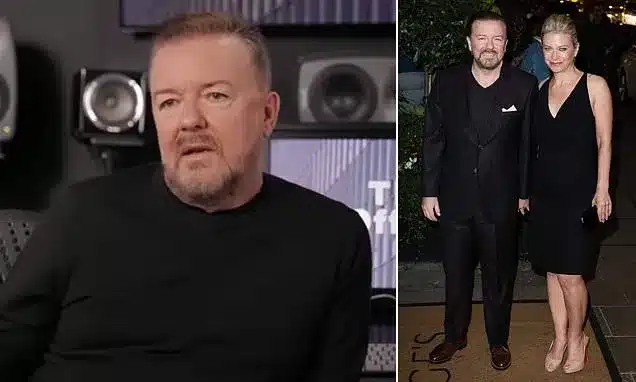
Comedian Ricky Gervais has expressed a complex and somewhat contradictory stance on the prospect of receiving a knighthood, describing the honor as “irrelevant” while admitting he might accept it, particularly if it would irk certain individuals. His remarks come amidst revelations about his plans to marry long-term partner Jane Fallon, a decision influenced by potential inheritance tax implications.
Gervais’s Ambivalent View on Knighthood
Speaking on his YouTube channel, Gervais shared his thoughts on the possibility of being offered a knighthood. He stated that while he doesn’t believe he will be offered one, his perspective might have differed if his mother were alive. Currently, he finds the honor largely meaningless. “I think it’s so irrelevant, isn’t it? It’s like… it’s tourism, isn’t it?” he mused, questioning its significance in contemporary society.
Despite his reservations, Gervais acknowledged a sense of obligation not to offend if an offer were made. “If someone offers me something, I don’t want to insult them,” he admitted, calling it a “tricky one.” He speculated that if he were to decline, he might not announce it to avoid causing embarrassment to the institution offering the honor.
Gervais humorously suggested that he might accept the title purely for the reaction it would provoke. “All the people that would be really annoyed, that would just tip the balance. I like that. It’s my favourite,” he quipped, indicating a potential willingness to accept the honor if it served to provoke a strong, negative reaction from those he finds disagreeable.
He contrasted the modern perception of a knighthood with its historical significance. “Do you know what, if a knighthood meant like it did in the olden days, I could ride around on a big horse with a sword, I’d take it,” he said. “But as it is, it doesn’t mean anything, does it?” He also questioned the practical impact, noting, “I couldn’t be called Sir by anyone, so I don’t know if it would make a lot of difference.”
Marriage Plans and Inheritance Tax
Gervais’s comments on the knighthood follow closely on the heels of his announcement that he plans to marry his partner of nearly 40 years, Jane Fallon. This decision, he revealed in an interview with Saga Magazine, is primarily driven by financial considerations, specifically to mitigate inheritance tax.
For decades, Gervais has been an outspoken critic of marriage, often stating there was no reason to wed, especially given his atheistic views. However, the potential tax benefits for their estate appear to have shifted his perspective. “It is [the reason]. And that will be the reason I marry,” he confirmed when asked if tax was the motivation. He highlighted the practical absurdity, noting, “How more married can you be? We share all our money, we’ve been living together for 40 years. Some marriages don’t last a year.”
The couple, both 65, are facing the reality of needing to formalize their union. Gervais expressed a sense of urgency, stating, “It’s horrible isn’t it? ‘I’ve got to get around to marrying, before I die.'” This sentiment is underscored by Fallon’s recent diagnosis with breast cancer, which was detected early through a routine mammogram.
Inheritance Tax Implications for Unmarried Couples
Under current UK law, unmarried couples do not automatically qualify for the spouse exemption, which allows estates to be passed to a surviving husband, wife, or civil partner without incurring inheritance tax. This exemption is a significant financial advantage, as estates exceeding the tax-free threshold can be subject to a tax rate of up to 40 percent.
Given Gervais’s considerable wealth, estimated at £141 million, and Fallon’s net worth of £1.3 million, the inheritance tax implications are substantial. Gervais owns a significant property portfolio, including a £14.75 million mansion in Hampstead, London, two New York apartments, and a riverside property in Marlow, Buckinghamshire. He recently secured permission to build a £5 million mansion on the Marlow estate, which is designed to include extensive amenities such as a home gym, drawing room, lift, and a master suite with a terrace overlooking a tennis court and pond.
A Lifelong Partnership
Ricky Gervais and Jane Fallon met in 1982 while studying at University College London. They moved in together two years later and have built a life partnership without the legal bonds of marriage or children. Fallon has previously spoken about her lack of traditional romantic aspirations, stating on the “Second Act” podcast that she never fantasized about weddings or motherhood as a child. Her childhood dreams involved acquiring a dog or focusing on her career and living arrangements.
Gervais has consistently maintained that their long-standing union served all practical purposes of marriage. He has described their relationship as a “fake marriage” that has endured longer than many legal unions. Their shared finances and decades-long cohabitation underscore the depth of their commitment, independent of formal marital status.
Conclusion
Ricky Gervais’s candid reflections reveal a pragmatic approach to societal honors and personal relationships. While he dismisses the significance of a knighthood in his own life, his willingness to accept it for the right reasons—or to provoke the wrong ones—adds a characteristic layer of humor and defiance. Simultaneously, his decision to marry Jane Fallon, driven by financial prudence rather than traditional sentiment, highlights the evolving nature of long-term partnerships and the practical considerations that can influence even the most unconventional individuals.
