

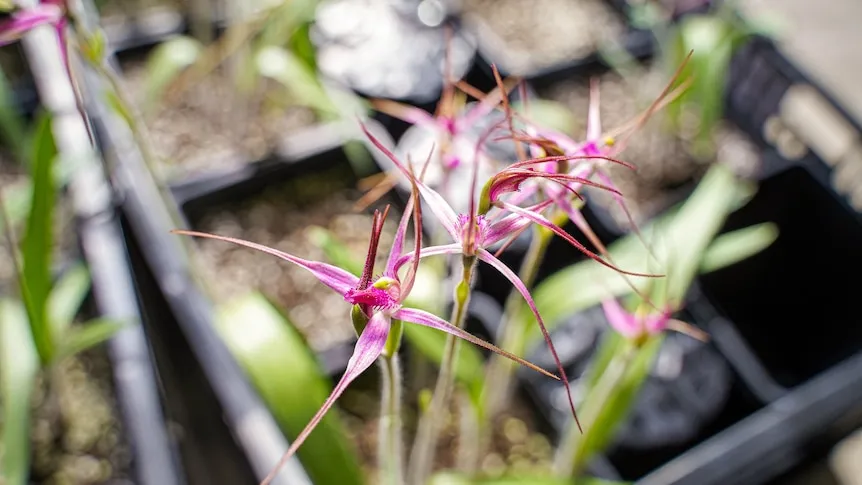
In a secluded location outside Melbourne, a critical conservation effort is underway to bolster the population of one of Australia’s most endangered orchids: the rosella spider orchid (Caladenia rosella). Scientists and dedicated volunteers are meticulously preparing and planting hundreds of these rare plants, aiming to significantly increase their numbers in the wild. This initiative highlights the complex and labor-intensive process required to rescue species teetering on the brink of extinction.
Saving a Critically Endangered Species
The rosella spider orchid, found exclusively in Victoria, is classified as critically endangered. Its numbers have dwindled to such an extent that its survival is precarious. The current reintroduction program involves planting approximately 500 cultivated orchids, nearly doubling the existing wild population. This significant undertaking is the culmination of years of dedicated work, from painstakingly raising the orchids from seed to preparing them for their return to their natural habitat.
Alex McLachlan, a research scientist at the Royal Botanic Gardens Victoria, explained the intricate process. “There’s about a thousand in total,” he noted, referring to the cultivated plants, adding with a touch of humor that there are too many to name individually. “But I am very happy to see them going back out into the wild where they belong.” The volunteers’ task involves carefully extracting the root-like tubers from pots, measuring plant dimensions, and recording details like the number of flowers and leaves before transplanting them.
The effort requires substantial resources and expertise. “People don’t realise how much effort and how much money it is to get from a seed to this,” McLachlan emphasized. This sentiment underscores the broader challenge facing Australia, where hundreds of orchid species are at risk of extinction.
The Cryptic Nature of Orchids
Orchids are notoriously elusive, often blending seamlessly with their surroundings. Megan Hirst, the project lead and a research scientist at the Royal Botanic Gardens Victoria, described this characteristic as “crypticness.” She elaborated on their complex needs: “They need specialised pollinators. They have to have a relationship with the soil, the fungi. They’re really picky.” This pickiness means that even a slight alteration in environmental conditions can jeopardize their survival.
When these conditions are met, however, the result is a spectacular bloom. “When [orchids] come out and flower, it’s taken a lot to get there. It’s an awesome event,” Dr. Hirst stated. Australia boasts an astonishing diversity of orchids, many of which have evolved unique strategies to attract specific pollinators. For instance, the Canberra spider orchid mimics the appearance and scent of a female wasp, while greenhood orchids trap gnats within their hinged flowers. The flying duck orchid is renowned for its remarkable resemblance to a bird in flight.
Despite their beauty and evolutionary marvels, many Australian orchids face severe threats. According to the EPBC Act List of Threatened Flora, over 200 species are at risk of extinction. Conservation groups, including the orchid conservation team at the Botanic Gardens Victoria, are actively working to propagate and reintroduce threatened species. “There’s about eight threatened species, including non-orchid species, that are going back out into the wild this year,” McLachlan mentioned.
Symbiotic Relationships and Population Recovery
The rosella spider orchid’s survival is intricately linked to a specific pollinator: the native bee Leioproctus platycephalus. This bee is attracted by the orchid’s musky, sweet scent. “It’s a pretty widespread bee, but this orchid is highly specialised to it,” explained Linda Riquelme, an ecologist at La Trobe University. The orchid relies on the bee to transfer its pollen, which is packaged in small structures called pollinia.
Historically, the rosella spider orchid was found across parts of Victoria and New South Wales. However, its range has drastically contracted to just four known locations near Melbourne, covering an area no larger than a suburb. By the year 2000, only 120 wild plants remained. Concerted conservation efforts, including habitat protection and the introduction of supplementary plants, have led to a recovery. In 2023, scientists recorded 655 mature plants. While this increase is encouraging, the species still requires ongoing support to prevent extinction.
The establishment of a new, secret planting site marks a crucial step. This fifth location has been chosen specifically because the vital pollinator, Leioproctus platycephalus, has been confirmed to inhabit the area, ensuring the plants have the best chance of success. “Hopefully, there’s going to be more plants here than there are anywhere else,” Dr. Hirst expressed optimism.
The Long Road from Seed to Bloom
Cultivating orchids from seed is a complex and lengthy process. “It is hard,” Mr. McLachlan admitted. The initial germination relies on a symbiotic relationship with specific fungi, such as the Serendipita genus for spider orchids. These microscopic fungi colonize the plant’s roots, a structure known as a peloton, and are essential for the seedling’s development. “It won’t germinate without the fungi,” he stated.
The process begins with growing the fungi and then introducing it to orchid seeds in sterile petri dishes to prevent contamination. Once seedlings emerge, they are nurtured in controlled growth rooms for approximately three months until they are ready to be transferred to flasks. After several more months in flasks, when their leaves reach a matchstick size, they are finally potted into soil. It typically takes another one to two years for these plants to mature sufficiently for transplanting into the ground, ensuring they are robust enough to survive.
A Collaborative Effort
The planting day itself, often occurring on a cold July morning, represents a significant milestone, though not the final one. “It’s not the end point but, this is the fun bit,” Dr. Hirst remarked. “It’s taken years of work to get here.” Volunteers from across Victoria converge on land provided by organizations like Nature Conservancy Australia, bringing hundreds of potted rosella spider orchids.
The atmosphere on planting day can initially be one of organized chaos, as Dr. Hirst described, evolving into focused teamwork. The dedication of the volunteers is palpable. “Orchids, she explains, have much more of a cult following than some other plants,” she observed, noting the diverse group of participants, from local enthusiasts to those who have traveled considerable distances. The shared commitment to the orchids’ future is evident, with participants ranging from members of orchid societies meticulously preparing the ground to ecology PhD students carefully placing each plant.
Dr. Hirst expressed deep emotion when reflecting on the volunteers’ commitment. “Everyone’s really trying their hardest. There’s obviously a shared experience here, everyone wants a good outcome. There’s got to be something behind that, and I think we’re tapping into it.”
Despite the successes and the palpable enthusiasm, Dr. Hirst acknowledged the immense scale of the conservation challenge. “It’s trying to rally enough support,” she said. “If you’re going to do it properly… there are things that need to be done. It’s not like we can just grab a couple of plants and whack them in.” She concluded with a hopeful yet pragmatic note: “It’s very doable, but we need funding to do that.”
