

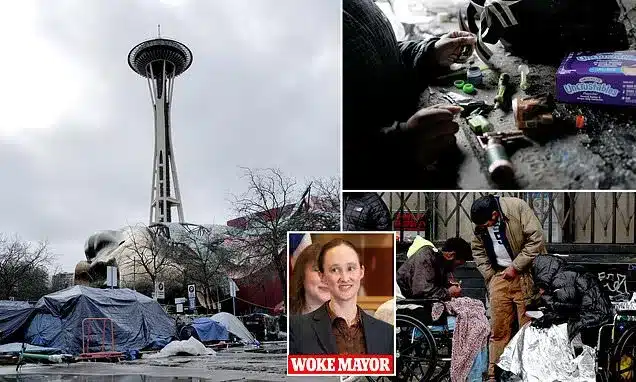
Seattle is facing criticism from its own residents following a significant street cleanup effort undertaken in preparation for the FIFA World Cup. While the city’s downtown has been temporarily revitalized, many locals express deep skepticism, fearing a swift return to pre-event conditions characterized by visible homelessness and open drug use. Governor Bob Ferguson’s praise for the city’s improved appearance has amplified these concerns, drawing sharp rebukes from citizens who believe the cleanup is a superficial measure masking a persistent, long-term problem.
A City Transformed, Temporarily
In anticipation of hosting World Cup matches, Seattle has reportedly invested nearly $32 million in a comprehensive cleanup initiative. This effort focused on beautifying tourist-heavy areas, clearing encampments, and relocating individuals experiencing homelessness to less conspicuous locations. The results were noted by at least one visitor, who described Seattle’s downtown as ‘clean,’ ‘walkable,’ and ‘incredible.’ Washington Governor Bob Ferguson highlighted this positive feedback in a social media post, quoting a tourist who lauded the city’s transformation and deemed its downtown ‘world class.’
Residents’ Deep-Seated Concerns
However, this optimistic portrayal has been met with considerable backlash from Seattle residents. For years, the city has grappled with substantial challenges, including widespread open drug use and a significant homeless population whose encampments have become a visible feature of the urban landscape. Data from the Department of Housing and Urban Development indicates Seattle has the third-largest homeless population among U.S. cities, trailing only New York City and Los Angeles. While Seattle’s total homeless population of approximately 17,000 is smaller than those of the larger metropolises, its proportion relative to the city’s population of just over 823,400 is notably higher. This higher percentage share, coupled with the fact that 64 percent of homeless individuals in Seattle are unsheltered, according to the King County Regional Homelessness Authority, makes the issue highly conspicuous.
Unsheltered individuals often reside in tents, vehicles, or directly on the streets, with encampments frequently appearing near prominent landmarks like the Space Needle. Reports from earlier in the year documented harrowing scenes of encampments and public drug use in various Seattle neighborhoods.
Skepticism Fueled by Past Experiences
The current cleanup has been widely perceived by residents not as a solution, but as a temporary facade designed to impress international visitors. This sentiment is largely rooted in prior experiences. During the 2023 MLB All-Star Week, Seattle also undertook a similar cleanup effort. Critics point out that once the event concluded and national attention shifted away, the city’s streets reportedly reverted to their previous state, leading to a resurgence of visible homelessness and disorder.
This pattern has led many to view the World Cup preparations through a lens of deep cynicism. Responses to Governor Ferguson’s social media post were inundated with criticism. Residents expressed frustration, with one commenter stating, ‘You cleaned up and put on window dressing for the Cup visitors- now it’s over and we are going back to your chaos, filth and crime.’ Another resident questioned the sustainability of the improvements, asking, ‘It sure as hell better look great but can we keep it that way Bob???’
Further fueling the skepticism are accusations that the city’s approach involves merely relocating the homeless population to less visible areas, rather than addressing the root causes of homelessness. One user commented, ‘the homeless zombie population was temporarily relocated to Chinatown. As soon as the soccer crowd leaves, they’ll be back and downtown will relapse into its former ghost-town self.’
Policy Criticisms and Local Leadership
The criticism extends to the broader policy decisions made by Democratic leadership in Seattle and Washington state. Some residents attribute the city’s ongoing struggles to specific policies, with one user directly blaming ‘Democrat policies’ for the perceived decline and predicting a return to a ‘cesspool’ under the current administration. This sentiment often targets Mayor Katie Wilson and City Attorney Erika Evans.
Mayor Wilson, who took office in January, has faced accusations, which she denies, of directing the Seattle Police Department not to arrest individuals for public drug use. Her administration reportedly works closely with City Attorney Evans, whose office has implemented policies that make it more difficult to prosecute cases involving public drug use. A January memo from Evans’s office mandates that individuals arrested for public drug offenses must be referred to the city’s ‘LEAD’ (Law Enforcement Assisted Diversion) program, which aims to connect addicts with treatment services.
These policy directions are seen by some critics as echoing approaches taken in the early 2020s by cities like San Francisco and Portland. Those cities experimented with ‘harm reduction’ strategies, which, according to critics, resulted in significant increases in crime, homelessness, and urban blight before policies were eventually reversed. Seattle itself has been under a Civil Emergency declaration for homelessness since 2015, highlighting the long-standing nature of the issue.
The Path Forward
The $32 million cleanup ahead of the World Cup is viewed by many critics as a short-term fix for a problem that requires sustained, comprehensive solutions. As the international spotlight of the World Cup shines on Seattle, residents are watching closely, hoping that the temporary improvements might spur genuine, long-term change, but fearing that the city will soon revert to the challenges it has faced for over a decade.
