

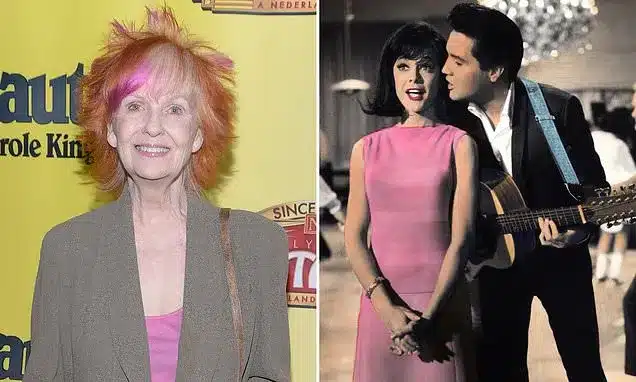
Actress and singer Shelley Fabares, celebrated for her roles on iconic television shows and her work with Elvis Presley, has died at the age of 82. Her family confirmed her passing on Saturday, August 22, stating she died surrounded by loved ones in Los Angeles. Fabares was a prominent figure in Hollywood, known for her roles as Mary Stone on The Donna Reed Show and Christine Armstrong on Coach. Her career also included memorable performances opposite Elvis Presley in three films and a guest appearance on the popular sitcom Mork & Mindy.
A Multifaceted Career in Entertainment
Shelley Fabares’ journey in entertainment began at a young age. Encouraged by her mother, she started modeling at three years old and made her television debut at age 10 in 1954 on Letter to Loretta. Her early experiences as a child actress shaped her perspective on the industry. In a 1994 interview, she reflected on the challenges of growing up in the spotlight, noting the disciplined environment of film sets contrasted with the natural freedoms of childhood.
Her breakthrough role came in 1958 when she was cast as Mary Stone, the teenage daughter of Donna and Alex Stone, in The Donna Reed Show. This role not only established her as a television presence but also served as a springboard for her singing career. Encouraged by producer Tony Owen, who was married to her aunt, Fabares and her on-screen brother Paul Peterson began incorporating musical numbers into the show. This led to her most famous hit, “Johnny Angel.”
Musical Success and Film Roles
Released in 1962, “Johnny Angel” became a massive success, soaring to the number one spot on the Billboard Hot 100 chart. This achievement marked a significant milestone in her career, launching her as a recording artist. Throughout her music career, Fabares released four albums, further solidifying her versatility.
Fabares also made a notable impact on the big screen, particularly through her collaborations with rock and roll legend Elvis Presley. She starred alongside him in three films: Girl Happy (1965), Spinout (1966), and Clambake (1967). These roles showcased her ability to transition between television and film, working with some of the era’s biggest stars.
Personal Life and Later Career
Beyond her professional achievements, Fabares maintained a rich personal life. She was married to music producer Lou Adler from 1964 to 1966, later finalizing their divorce in 1980. In 1984, she married actor Mike Farrell, known for his role on M*A*S*H. Their union lasted until her passing, with Farrell by her side.
Fabares faced significant health challenges, undergoing a liver transplant in 2000 following a diagnosis of autoimmune hepatitis. Despite these trials, she remained a beloved figure, remembered for her warmth and grace.
Family Tributes and Legacy
In a statement released to the press, Fabares’ family expressed their profound grief and love for her. They described her as a “source of love, strength, laughter, and comfort,” highlighting her devotion as a wife, stepmother, and friend. Her family emphasized that while millions knew her as a talented actress and singer, her greatest legacy was the personal love and cherished friendships she cultivated.
“She was a devoted wife, cherished stepmother, daughter, sister, niece, aunt, family member, and loyal friend whose warmth, generosity, humor, and grace made an enduring difference in the lives of everyone who knew her,” the family stated. “She had a remarkable ability to make people feel welcomed, valued, and cared for.”
The family also noted her enduring impact on American television and film, from her early role on The Donna Reed Show and her hit song “Johnny Angel” to her work with Elvis Presley and her role on Coach. They concluded by sharing their deep sense of loss but also their gratitude for the years they shared and the joy she brought to many. “We are heartbroken by her loss, yet profoundly grateful for the years we shared with her and for the joy, compassion, and love she brought to so many,” they added.
Fabares’ career spanned decades, leaving an indelible mark on both television and film. Her family requested privacy as they grieve, finding solace in the enduring nature of her work and the memories she created.
