

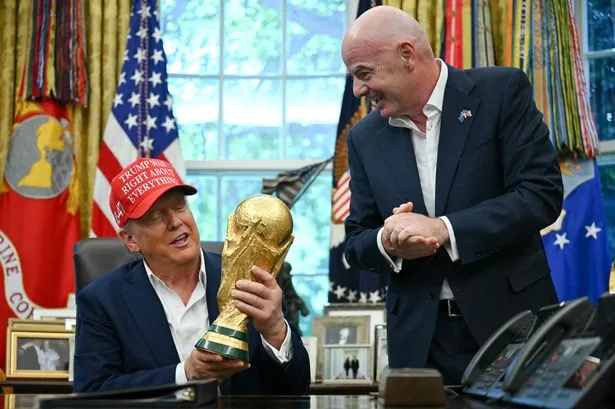
The World Cup final on Sunday presents a potentially awkward scenario for Donald Trump, as Spain faces Argentina at MetLife Stadium. Should Spain emerge victorious, Trump would be tasked with presenting the World Cup trophy to a nation he has recently criticized harshly, a situation that could be perceived as a significant humiliation.
Trump’s Stance on Spain and the World Cup
For years, the World Cup has been viewed as a significant event, and the current tournament has been no exception. However, the narrative surrounding Donald Trump’s involvement, or lack thereof, has taken center stage. Despite the tournament being held in the United States, Trump notably did not attend any matches involving the U.S. men’s national team. This absence, from a leader often seen embracing nationalistic symbols, has drawn considerable attention and speculation.
Trump’s public statements regarding Spain have been particularly pointed. Recently, at the NATO summit, he expressed a desire to distance himself from the country, stating, “I don’t want anything to do with Spain,” and labeling its people as “hopeless, bad people.” He further suggested severing trade relations between Washington and Madrid. This strong rhetoric stands in stark contrast to the potential necessity of congratulating Spain’s captain and handing over the sport’s most coveted prize.
Reasons for Trump’s Absence from U.S. Matches
Reports suggest that Trump’s decision to avoid attending U.S. matches stemmed from concerns about potential crowd reactions. Specifically, there were anxieties about stadium chants referencing Jeffrey Epstein, the late financier with whom Trump had associations. Officials reportedly worried that Trump’s presence in stadiums, particularly those with English-speaking crowds, could lead to embarrassing live broadcasts of chants directed at him.
This fear of uncontrolled public reaction is seen by some as a significant departure from Trump’s self-portrayal as a fearless leader. The dynamic of a football stadium, where direct interaction with the crowd is unavoidable and press secretaries are not present to manage the narrative, is vastly different from the controlled environment of the White House. Despite earlier boasts of attending multiple games, his only scheduled appearance is now the final, where he will present the trophy alongside FIFA President Gianni Infantino.
The Spain-U.S. Diplomatic Friction
The diplomatic row between the United States and Spain, particularly concerning defense and military base usage, appears to be a significant backdrop to Trump’s recent comments. Spain’s refusal to allow U.S. military bases on its territory to be used for strikes on Iran outside of United Nations authorization is believed to have been a key point of contention. This stance, which prioritized Spanish sovereignty and adherence to international norms over direct alignment with U.S. foreign policy objectives in the Middle East, reportedly angered Trump.
The refusal to act as a launchpad for potential U.S. military action in Iran, on terms dictated by Washington, is seen as a direct challenge to Trump’s foreign policy approach. His subsequent strong reactions, including insults and trade threats, are interpreted by some as a personal affront rather than a purely policy-based disagreement.
Football’s Potential for Public Reckoning
The narrative suggests that football, with its global reach and passionate fan bases, can become a platform for unexpected public statements and reactions. The article recalls an instance where the Belgian team reportedly mocked Trump after their victory over the U.S. in the knockout stages, following a controversial refereeing decision that Trump had allegedly discussed with Infantino. This incident is presented as an example of how international sports can amplify political sentiments.
The potential for Spain’s victory to serve as a public rebuke to Trump’s perceived interference and vanity in the tournament is highlighted. The article posits that Spain, having defied U.S. demands on defense and military cooperation, might deliver a symbolic message through their on-field success and the subsequent trophy presentation.
Past Incidents and Future Implications
Past appearances by Trump at sporting events have also been cited, including a Club World Cup final at the same MetLife Stadium where he was reportedly booed during the national anthem and again during the trophy presentation. The article suggests a pattern of Trump seeking to insert himself into moments belonging to the athletes and teams.
The decision for Trump and Infantino to jointly present the trophy is viewed as a deliberate choice to place Trump at the center of the final image, despite his limited engagement with the tournament itself. The article concludes by emphasizing that if Spain wins, the image of Trump presenting them with the World Cup could serve as a poignant symbol, contrasting the President who has publicly insulted allies with a nation that has stood firm on its principles.
Conclusion
The World Cup final between Spain and Argentina is more than just a sporting event; it is poised to be a moment of significant symbolic weight. For Donald Trump, the prospect of awarding the trophy to Spain, a country with which he has recently engaged in public disputes, presents a complex and potentially uncomfortable situation. The tournament’s narrative has been intertwined with political commentary, and the final outcome could offer a unique form of public reckoning, highlighting the intersection of international sports and geopolitical relations.
