

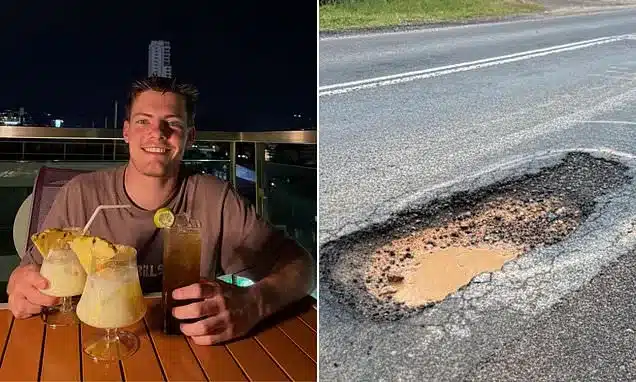
A university student in Victoria has been denied government compensation for extensive car damage caused by a large pothole, despite spending nearly all his life savings on repairs. Zane Stanton, 21, encountered the hazardous road defect on Boneo Road near Boneo, approximately 90 kilometers south of Melbourne, in August of the previous year. The incident left his vehicle severely damaged, forcing him to pay a substantial sum for necessary repairs.
Pothole Wreaks Havoc on Student’s Vehicle
The impact with the substantial pothole shattered two of Mr. Stanton’s car rims, rendering the vehicle undrivable. “I was stuck driving on a tilt,” he recounted, explaining that he had to be towed from the roadside. The total cost for the repairs amounted to $2,932.50. This significant expense consumed the majority of his savings, leaving him with very little financial cushion.
Mr. Stanton, who juggles two jobs, described the upfront cost as a considerable struggle. “I was pretty much left with next to nothing,” he stated. Following the initial shock of the repair quote, his parents encouraged him to file a compensation claim with Transport for Victoria (TfV), believing he would be eligible for reimbursement under the state’s road rules.
Victoria’s Road Compensation Scheme and Technicalities
Victoria’s policy allows for compensation claims when property damage caused by the condition of a state-managed road exceeds a specific threshold. In Mr. Stanton’s case, the repair costs surpassed the minimum requirement of $1,681, with the government intended to cover the amount above this figure.
However, after nearly a year of navigating what he termed “heavy bureaucratic processes,” Mr. Stanton’s claim was rejected. The reason cited was a technicality within Victoria’s road management regulations. According to Transport for Victoria’s Road Management Plan (RMP), the government is not liable for damages resulting from roads that have been inspected for hazards at least once every two weeks.
The Technicality That Led to Rejection
The rejection letter, which was reviewed by news outlets, stated that the road in question had undergone inspections twice within the 11 days preceding the incident. Consequently, TfV asserted that its “inspection and maintenance works complied with the RMP timeframes and… TfV is therefore not liable for the damages.” The department further clarified that this compliance meant TfV had not been negligent in its road management and therefore did not accept liability.
Student’s Outrage and Concerns Over Claim Rejections
Mr. Stanton expressed profound disappointment and outrage at the decision. He highlighted statistics indicating that TfV had rejected a staggering 98 percent of similar claims over the past two years. “I was honestly shocked at how (a damage claim) like that could be denied, and then I looked into the specific reasons and was even more outraged,” he said.
He voiced his belief that such technicalities and self-written policies allow the department to consistently deny claims. “(It’s) just due to little policies and bylaws that they write themselves in codes that they have to follow,” Mr. Stanton commented.
Questioning Road Maintenance and Pothole Formation
Furthermore, Mr. Stanton raised serious questions about the continued presence of such a large pothole on the road, especially if it had been recently inspected. “I don’t think a pothole that big forms in less than two weeks,” he remarked, implying a potential disconnect between reported inspections and the actual road conditions.
Government Response and Road Maintenance Initiatives
In response to inquiries, a spokesperson for the Department of Transport and Planning stated that while they could not comment on individual cases, the department is committed to significant investment in road maintenance across Victoria. They pointed to a “record-breaking $1.04 billion road maintenance blitz” aimed at rebuilding, repairing, and resurfacing roads throughout the state to improve safety for all road users.
The spokesperson also indicated that the government is undertaking a review of the current legislation concerning claims for property damage compensation. Maintenance crews are actively working on roads across Victoria and conduct regular inspections to identify and address necessary repairs.
Conclusion: A Call for Review and Fairer Processes
Zane Stanton’s experience underscores a frustrating reality for many road users who suffer damage due to poor road conditions. While government bodies adhere to specific regulations and inspection schedules, the outcome for individuals can feel unjust, particularly when significant personal financial hardship results. The high rate of claim rejections and the reliance on technicalities raise questions about the fairness and accessibility of the compensation process. The ongoing review of legislation by the Victorian government may offer an opportunity to address these concerns and ensure a more equitable system for those impacted by road defects.
