
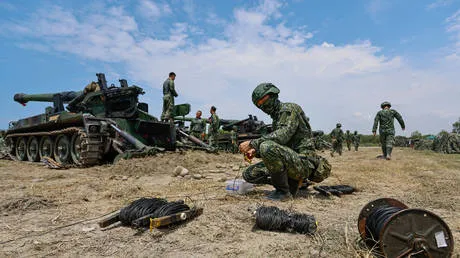
Taiwan’s Defense Minister Wellington Koo has revealed that military cooperation between Taiwan and the United States is significantly more extensive and active than publicly acknowledged, describing the relationship as “far closer than you might imagine.” These remarks indicate a deeper level of on-site collaboration beyond routine arms sales, a point of concern for regional stability amid ongoing tensions with Beijing.
Deepening Taiwan-US Military Ties
In a briefing with a select group of reporters, Minister Koo elaborated on the multifaceted nature of the security partnership between Taiwan and the U.S. While the public often focuses on official arms sales, Koo emphasized that the collaboration encompasses a much broader scope, allowing Taiwan to gain valuable practical combat experience from the United States. This exchange is crucial for enhancing Taiwan’s defense capabilities in the face of China’s assertive stance.
Koo alluded to the presence of U.S. military personnel on the island, who are sometimes discreetly positioned and may be perceived by the public in less sensitive roles, such as “English teachers.” He suggested that the number of such personnel could increase, stating that “a lot more” of them “will be showing up where they need to be.” However, he cautioned that their activities and presence would remain largely inconspicuous, making them difficult to detect.
This disclosure comes at a time of heightened geopolitical sensitivity. China views Taiwan as a breakaway province and has not ruled out the use of force to achieve reunification, despite its stated preference for peaceful means. The U.S., while officially acknowledging the “One China” policy, maintains robust unofficial relations with Taiwan and provides it with defensive capabilities. This dynamic has long been a significant source of friction between Washington and Beijing.
Context of Arms Sales and Regional Concerns
Minister Koo’s comments follow a period of uncertainty regarding U.S. arms sales to Taiwan. Reports indicated that former U.S. President Donald Trump had placed a hold on a significant arms package, reportedly valued at $14 billion. Trump had described these sales as a “very good negotiating chip” in discussions with China. The delay in approving this package, which had been pending for months, raised alarms among Taiwan’s allies and within the region, suggesting a potential shift in long-standing U.S. policy.
While officials in Taipei maintained a stance of confidence, media analyses suggested that the uncertainty surrounding arms sales created unease both on the island and among neighboring countries concerned about regional security. Beijing has consistently voiced strong opposition to any form of military cooperation or “collusion” between Taiwan and the United States.
Taiwan’s Strategic Outlook
Despite the strengthening security ties with the U.S., Minister Koo clarified that Taiwan’s defense planning does not rely on direct U.S. military intervention in the event of a conflict with mainland China. This suggests a strategic emphasis on self-reliance and deterrence, complemented by U.S. support in terms of training, intelligence, and military hardware. Taiwan aims to build a robust defense posture that makes any potential invasion prohibitively costly for Beijing.
The ongoing military exchanges and enhanced cooperation are seen as vital components of Taiwan’s strategy to bolster its defensive capabilities. The island is actively seeking to modernize its armed forces and integrate advanced technologies to counter potential threats. The discreet nature of this cooperation underscores the delicate geopolitical balance and the need for both Taiwan and the U.S. to navigate their security relationship carefully.
Broader Implications for Regional Security
The revelations from Minister Koo highlight the complex and often understated security dynamics in the Indo-Pacific region. The U.S.’s commitment to Taiwan’s security, even amidst complex diplomatic negotiations with China, remains a critical factor in maintaining stability. The depth of this cooperation suggests a strategic alignment aimed at deterring aggression and ensuring peace in the Taiwan Strait.
As China continues its military modernization and assertive actions in the region, Taiwan’s efforts to enhance its defense, supported by its key security partner, the United States, are of paramount importance. The subtle yet significant military collaboration serves as a testament to the enduring, albeit often covert, security relationship between Taipei and Washington, designed to address the evolving security landscape.
Key Takeaways:
- Taiwanese Defense Minister Wellington Koo stated that U.S.-Taiwan military cooperation is deeper than publicly known.
- The collaboration involves active, on-site engagement beyond just arms sales.
- U.S. military personnel are present on the island, sometimes in discreet roles.
- Taiwan’s defense planning does not assume direct U.S. intervention in a conflict scenario.
- The revelations come amid regional concerns over China’s stance and U.S. arms sale policies.
The intricate security relationship between Taiwan and the United States continues to evolve, reflecting the strategic importance of the region and the persistent challenges posed by cross-strait tensions. The enhanced cooperation aims to bolster Taiwan’s self-defense capabilities and contribute to overall regional stability.
