

Plans to significantly increase the number of asylum seekers housed in residential properties in Thetford, Norfolk, have ignited fresh controversy, with local officials and residents expressing strong opposition. The Home Office intends to expand the current capacity of 56 beds to accommodate a much larger population, a move critics argue will exacerbate existing tensions and occur without adequate public consultation.
Escalating Tensions in Thetford
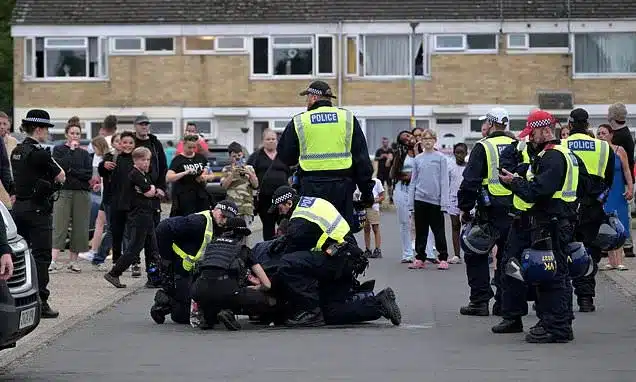
Thetford has become a focal point for protests regarding the housing of asylum seekers. In recent months, the town, located near RAF Barnham, has witnessed several nights of demonstrations against the use of residential addresses for asylum accommodation. These protests have, at times, required police intervention, with some incidents leading to arrests and injuries among officers.
The proposed expansion by the Home Office aims to quadruple the number of asylum seekers in local housing, representing a 428 percent increase. This development comes on the heels of ongoing demonstrations at RAF Barnham, where plans are in place to house at least 1,250 migrants on the former military base. The proximity of the military base and the residential housing plans has led to accusations that the Home Office is “pouring fuel on the fire” by pursuing both initiatives simultaneously.
Local Political Reaction
Political figures at both county and district levels have voiced strong objections. Scott Hussey, a Reform councillor for Norfolk County Council and Breckland District Council, described the plans for expanding asylum seeker housing in houses of multiple occupation (HMOs) as a “double whammy.” He criticized the Home Office’s approach, stating, “Not content with trying to turn RAF Barnham into a near-permanent super camp for illegal immigrants, the Home Office now admits they’ve only just got started with their programme of housing migrants in houses.”
Hussey further highlighted that Thetford has already shouldered a significant burden in housing asylum seekers and anticipates further increases. He expressed concern that the accelerated program of housing young, single, undocumented men in communities, coupled with the RAF Barnham plans, has proceeded “with no public consultation whatsoever,” fueling anger and frustration among residents.
Sam Chapman-Allen, the Conservative leader of Breckland Council, has been a vocal critic of the government’s “dispersed accommodation” policy. This policy was introduced as an alternative to costly hotel accommodations, which had also drawn national protests. Chapman-Allen emphasized the unacceptability of central government placing asylum seekers into communities without proper consultation, adequate infrastructure, or necessary support services. He stated, “For months, I have challenged a national system in which decisions affecting our towns and villages are taken behind closed doors, with little transparency and no meaningful voice for the people expected to live with the consequences.” Breckland Council has pledged not to remain silent while decisions are imposed upon its communities and is demanding a fundamental policy change, full transparency, and meaningful consultation.
Background of Protests and Government Policy
The situation in Thetford is part of a broader national challenge concerning asylum accommodation. Violence erupted in the town on August 4 when residents surrounded houses reportedly used by asylum seekers. The subsequent nights saw further disorder, with two police officers requiring hospital treatment—one struck by a rock and another sustaining a serious bite. Several arrests were made during these disturbances.
Similar protests have occurred in other Breckland towns, including Watton, where migrants were relocated from the Brook Hotel in Bowthorpe. Dereham has also seen prolonged disputes over a local hotel used for asylum seekers. These events underscore a pattern of community resistance to the dispersed accommodation policy.
The Home Office maintains that community concerns are central to its immigration reforms. A spokesperson stated, “We are closing every asylum hotel and moving asylum seekers into alternative accommodation, including former military sites. We are working to fairly house asylum seekers across the country, engaging with local authorities to reduce the impact on communities.”
Home Office Figures and Dispersal Targets
Official figures reveal that as of March this year, 97,519 individuals were receiving asylum support. The majority, 72,768, were housed in “other” accommodation, including dispersed housing like HMOs. Another 20,885 were in hotels, with a smaller group receiving only subsistence support.
A transcript from a meeting between Home Office officials and Norfolk County Council, which took place on August 5, indicated that Breckland currently has 56 bed spaces available for dispersed accommodation, representing 23 percent of its target. A civil servant noted that the authority was “somewhere below where the target would normally be for Breckland,” suggesting a push to increase numbers to meet national dispersal goals.
Terry Jermy, the Labour MP for South West Norfolk, while acknowledging the government’s efforts to reduce immigration, has consistently opposed the use of HMOs for asylum seekers, calling for the Home Office to cease the practice.
Conclusion
The escalating situation in Thetford highlights the deep-seated concerns surrounding the government’s asylum accommodation policies. The proposed quadrupling of asylum seekers in residential homes, combined with the large-scale plans for RAF Barnham, has intensified local opposition. Residents and local authorities are demanding greater transparency, meaningful consultation, and a fundamental shift in national policy to ensure that decisions impacting communities are made collaboratively and with due consideration for local infrastructure and resident well-being.
