

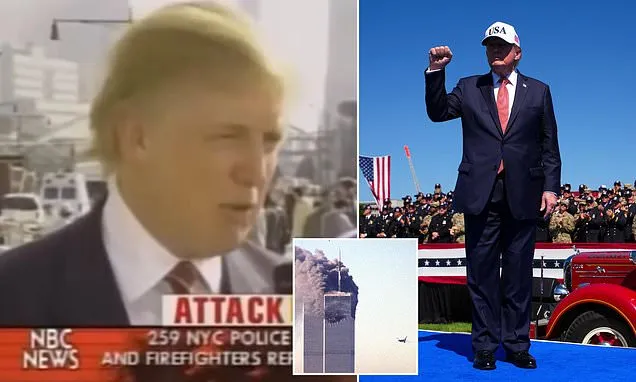
Donald Trump has forcefully responded to accusations that a personal account he shared about his presence at Ground Zero following the September 11, 2001, terrorist attacks is fabricated. The former president recounted a story during a recent speech honoring first responders, describing how he was near the World Trade Center site shortly after the attacks and was allegedly pulled from an unstable building by firefighters.
The narrative, shared during an event on Tuesday, has drawn sharp criticism from political opponents and commentators. California Governor Gavin Newsom, for instance, characterized the story as a “lie.” Media personality Rachel Maddow deemed the account “dubious,” and numerous individuals on social media platforms have claimed Trump invented the experience.
Trump took to his social media platform, Truth Social, to denounce these claims, specifically addressing a report by New York Magazine that questioned his recollection of events. The magazine’s article suggested he told a “weird lie about where he was on 9/11.”
“The Failing New York Magazine wrote a story that I wasn’t down at the World Trade Center after the Tragedy of September 11th, because nobody saw me there,” Trump posted. “Well, I don’t think I would be the first thing on anyone’s mind but, I was there, obviously not on the same day as the collapse, but shortly thereafter, with a large group of Construction Workers.”
Trump’s Account of 9/11 Presence
While Trump watched the attacks unfold from his Manhattan residence, Trump Tower, his subsequent actions and experiences at Ground Zero have been a subject of contention. In past interviews following the event, Trump stated he brought approximately 100 construction workers to the site. However, his more recent narrative about being rescued by firefighters from a precarious building near Ground Zero has ignited fresh scrutiny and accusations of dishonesty.
Trump has countered these challenges by sharing numerous interviews he conducted in the immediate aftermath of 9/11. These interviews, he argues, corroborate his accounts of experiencing shaky, unstable buildings and frequent evacuations in the area.
“I was building a big building in New York, and I took the whole crew down there right after this happened,” Trump explained, further detailing his past assertions of bringing a construction crew to Ground Zero. “The United States Steel Building was creaking, really creaking, and we thought it was going to fall down… We thought it was coming down on top of us, and two firemen—big, strong guys, and I’m not the smallest guy in the world—they grabbed me under the arm, said, ‘Got to get out of here!’ And they literally lifted me up.” He added, with a touch of humor, that it was a significant effort due to his size, but ultimately the building “didn’t come down.”
Addressing Media Scrutiny
The renewed focus on his story about being extracted from a dangerous building by firefighters has led to a strong rebuttal from Trump. He issued a lengthy statement, reportedly nearly 500 words, targeting New York Magazine and The New York Times for questioning his memory. Trump asserted that “everything I saw was exactly accurate.”
In his statement, Trump cited his former head of security, Matthew Calamari, as someone who had repeatedly attested to the story’s validity with various journalists, suggesting it was a narrative that “just won’t die.”
The former president’s remarks also touched upon coverage from The New York Times concerning his schedule for 9/11 memorial events, particularly his attendance at the Pentagon ceremony rather than the New York service. The report suggested that Trump’s remarks at the Pentagon were arranged after he was denied an opportunity to speak at the New York service.
Trump vehemently denied this allegation. He reiterated on Truth Social that politicians are generally not permitted to speak at the annual New York ceremony. “I have been to the New York solemn ceremony numerous times, and nobody speaks,” he wrote. “Certainly I would not want to violate that, even if I could.” He further stated, “Again, speeches are not made at the New York event and, even if they were, I never asked to speak. Fake News is getting worse and worse in the U.S.A.”
Consequently, Trump demanded retractions from both New York Magazine and The New York Times regarding their reporting on his 9/11 speech plans and his presence at Ground Zero.
Corroborating Evidence from Past Interviews
To support his claims, Trump shared several video clips of news coverage from the period shortly after the September 11 attacks. These clips feature a younger Trump giving interviews where he discusses the precarious and hazardous conditions of buildings near Ground Zero. He also highlighted instances of common evacuations for individuals working on or inspecting the damaged structures.
“It’s very dangerous because every few minutes a whistle will go off, and everyone will just run because you have all the buildings around it that are in such a weakened state that people just don’t know,” Trump told NBC News in a 2001 interview that he reposted online. This statement, along with other archival footage, forms part of his defense against the recent allegations of fabricating his experience at Ground Zero.
Conclusion
The controversy highlights the enduring sensitivity surrounding the 9/11 attacks and the differing recollections of events from that period. Donald Trump’s strong defense, bolstered by archival interviews, aims to counter claims that his personal narrative of being at Ground Zero and experiencing its dangers is untrue. As the debate continues, the focus remains on the veracity of his accounts and the media’s role in reporting on them.
