

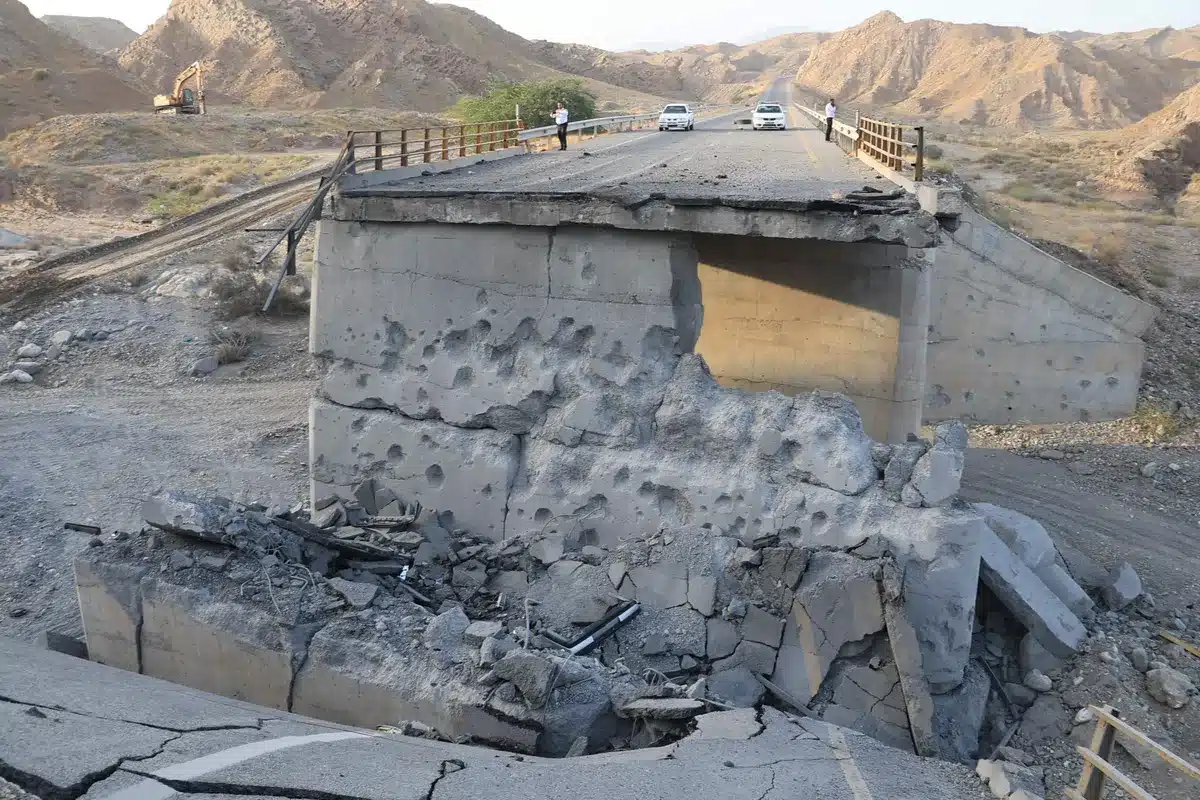
The United States conducted further airstrikes against Iran on Sunday, escalating retaliatory actions following the deaths of American troops. The strikes came as Iran launched missiles toward Jordan, raising concerns about a potential expansion of the conflict into neighboring Israel. This latest exchange marks a significant increase in tensions, pushing the U.S. and Iran closer to a broader confrontation after a temporary agreement aimed at ending hostilities has faltered. Shipping traffic through the vital Strait of Hormuz has also been severely disrupted.
Escalation of Military Actions
U.S. military officials stated that the recent strikes were aimed at Iran’s Revolutionary Guard, a key military and political force within the country. This action was a direct response to the killing of U.S. service members in Jordan on Friday. The ongoing campaign, now in its second week, has seen U.S. forces target various Iranian infrastructure, including bridges, water desalination plants, and electrical facilities. In parallel, Iran has directed attacks towards countries allied with the United States throughout the Middle East. Air defense systems in Kuwait, Jordan, and Bahrain were activated to intercept Iranian drones and missiles.
Iran’s Nuclear Site and Infrastructure Targets
Iran’s atomic energy agency reported that U.S. strikes hit the construction site of a planned nuclear power plant in the country’s southwest. Satellite imagery of the Darkhovin nuclear plant site, as of early July, indicated earthmoving activities but minimal construction. Iran had not previously disclosed this site as a target. The International Atomic Energy Agency confirmed that the facility, in its initial construction phases, contained no nuclear material during its last inspection. U.S. military officials from the Central Command described their targets as Iranian military coastal surveillance and air defense facilities, maritime assets, and missile and drone storage sites. The stated objective was to diminish Iran’s capacity to control the Strait of Hormuz and to swiftly penalize the Revolutionary Guard forces.
Regional Repercussions and Warnings
Jordan’s military confirmed the downing of several Iranian missiles, reporting no casualties or damage. The country, which hosts significant U.S. military bases and utilizes American air defense systems, summoned Iran’s charge d’affaires to lodge a protest. Israel’s military issued a warning that missiles directed toward Jordan’s port city of Aqaba could potentially spill over into Israeli territory, prompting concerns of air-raid sirens for the first time in weeks. The Israeli city of Eilat, adjacent to Aqaba, reported launching interceptors to mitigate falling debris.
Impact on Civilian Infrastructure and Global Trade
Kuwait reported that one of its power and water desalination plants sustained damage from an attack, causing fires. The Ministry of Electricity, Water and Renewable Energy assured that the power grid remained stable, highlighting the critical role of desalination plants, which supply approximately 90% of Kuwait’s drinking water. The Secretary-General of the Gulf Cooperation Council, Jasem Mohamed al-Budaiwi, condemned Iran’s strikes on civilian infrastructure, labeling them as potential war crimes. International humanitarian law generally prohibits attacks on civilian infrastructure like bridges and power plants, though exceptions exist if these sites are used for military purposes, provided attacks are proportionate and minimize civilian harm.
The Strait of Hormuz: A Critical Chokepoint
The Strait of Hormuz, a crucial waterway through which a significant portion of global oil supplies transited before the recent escalations, remains a focal point of the conflict. U.S. naval blockades have been reimposed on Iranian ports to impede crude oil shipments. The U.S. military reported redirecting five ships and disabling one in recent days. A maritime organization overseen by the U.S. Navy issued a severe threat warning to mariners, citing a high likelihood of deliberate hostile actions. Shipping traffic in the strait has drastically reduced, with only a handful of transits recorded recently compared to a daily average of nearly 140 before the conflict intensified.
Diplomatic Standoff and Human Cost
Iranian Supreme Leader Mojtaba Khamenei issued a warning of severe repercussions if U.S. attacks persist. An Iranian negotiator indicated that Tehran is suspending its commitments under the interim agreement, accusing the U.S. of violations. The interim deal, intended to provide a framework for negotiating a permanent end to the conflict and addressing issues like Iran’s nuclear program, has reached its midpoint without resolution. Since the conflict began, 16 U.S. service members have been killed and over 430 wounded. Iranian authorities reported at least 50 deaths and 517 injuries resulting from recent U.S. strikes. The broader impact of the conflict is also felt globally, affecting fuel prices and the availability of goods in vulnerable regions.
