

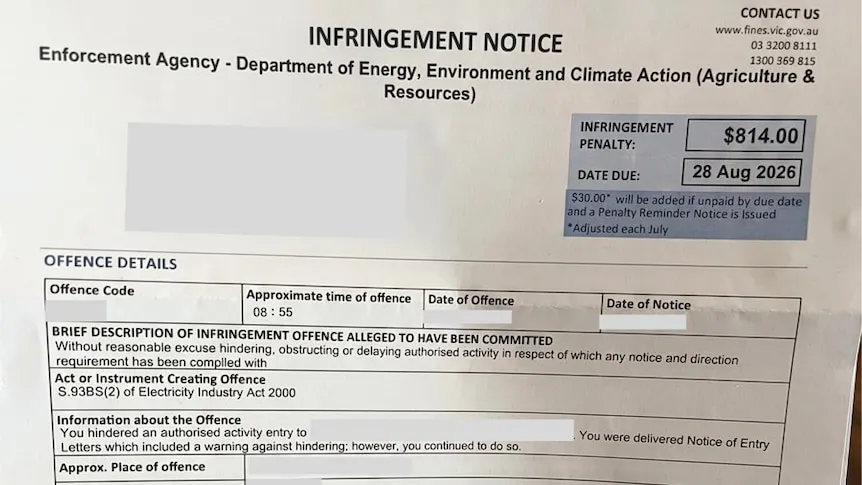
In Victoria’s west, twelve farmers have been issued with infringement notices totaling $814 each for denying authorised officers access to their private land. These officers require entry to properties situated along the planned route of the VNI West transmission line project to conduct essential suitability assessments. In addition to the fines, six formal warnings were also issued to other property owners who refused access.
VNI West Project and Land Access Disputes
The VNI West project, a significant transmission line initiative, necessitates access to private land for comprehensive surveys. These surveys are crucial for evaluating the agricultural, environmental, cultural, and heritage impacts of the proposed infrastructure. The fines, issued by the Victorian Department of Energy, Environment and Climate Change (DEECA), cite farmers for “without reasonable excuse hindering, obstructing or delaying authorised activity” by preventing officers from entering their land. DEECA has been approached for comment on the matter.
VicGrid, the organisation overseeing the planning of the transmission works, has stated that it does not issue infringement notices and cannot influence the outcome of any reviews or court proceedings. A spokesperson for VicGrid indicated that the organisation has consistently strived to achieve voluntary agreements with landholders over an extended period. They highlighted efforts such as enhancing access and early benefit payments, agreeing on site induction protocols and seasonal timing, and offering landholders the option to select their own survey specialists.
VicGrid also underscored that under the Electricity Industry Act 2000, transmission companies possess established powers to access land for activities related to the planning and maintenance of transmission infrastructure, including conducting surveys. This legal framework underpins the necessity of land access for the project’s progression.
Farmer’s Stance and Legal Challenge
Trent Carter, a stud sheep farmer from Marnoo and one of the recipients of the fine, has declared his intention to contest the penalty in court and refuses to pay. Carter views the situation as a broader warning to property owners nationwide, asserting that private ownership may not offer absolute protection against government-led infrastructure projects. “What we think is ours, isn’t necessarily ours and it’s open slather for governments to come in and do what they’d like to do if they want,” Carter stated.
He expressed a commitment to seeking legal counsel to represent the interests of other property owners and to establish a legal precedent. “I’ll be seeking legal advice going forward, we’ve got to represent everybody else who’s a property owner and set a precedent, not get bullied,” he added.
Challenges with Project Communication and Timing
Carter detailed difficulties encountered during the project’s planning phase, citing issues with communication and the timing of access requests. He noted that authorities had sought access during critical agricultural periods, such as sowing and harvest. “They were trying to gain access in mid April in the middle of sowing. Last time it was the middle of harvest,” he explained.
He further elaborated on the specific challenges posed by the lambing season, which runs from April to mid-August. “I said to [government] we were at the beginning of our lambing season which runs from April to mid August. During lambing minimal disturbance is required to ensure animal welfare standards are met.” This highlights a recurring conflict between the project’s operational needs and the seasonal demands of farming practices.
Broader Context of Farmer Resistance
The fines issued to these farmers are part of an ongoing pattern of resistance from landowners concerned about the VNI West project. Farmers have previously voiced threats to deny access for transmission planning work, aware of the potential consequences, including substantial fines and confrontations with law enforcement. The project’s route traverses significant agricultural land, raising concerns about its impact on farming operations and the rural landscape.
The VNI West transmission line is intended to bolster Victoria’s electricity grid capacity and support the integration of renewable energy sources. However, its development has faced considerable opposition from some landholders who feel their concerns are not adequately addressed or that their property rights are being infringed upon. The legal challenge initiated by Mr. Carter is expected to bring these land access disputes to the forefront of public and legal scrutiny.
Next Steps and Potential Precedent
The outcome of Mr. Carter’s legal challenge could set a significant precedent for future land access negotiations concerning major infrastructure projects in Victoria and potentially across Australia. Landowners facing similar situations will be closely watching the proceedings. The case underscores the complex balance between national energy infrastructure development and the rights and concerns of private property owners.
As the legal process unfolds, it is likely to generate further discussion about the adequacy of current legislation governing land access for essential infrastructure and the methods employed by developers to engage with affected communities. The situation highlights the critical need for effective communication, fair compensation, and respectful negotiation in projects that impact rural landholders.
