

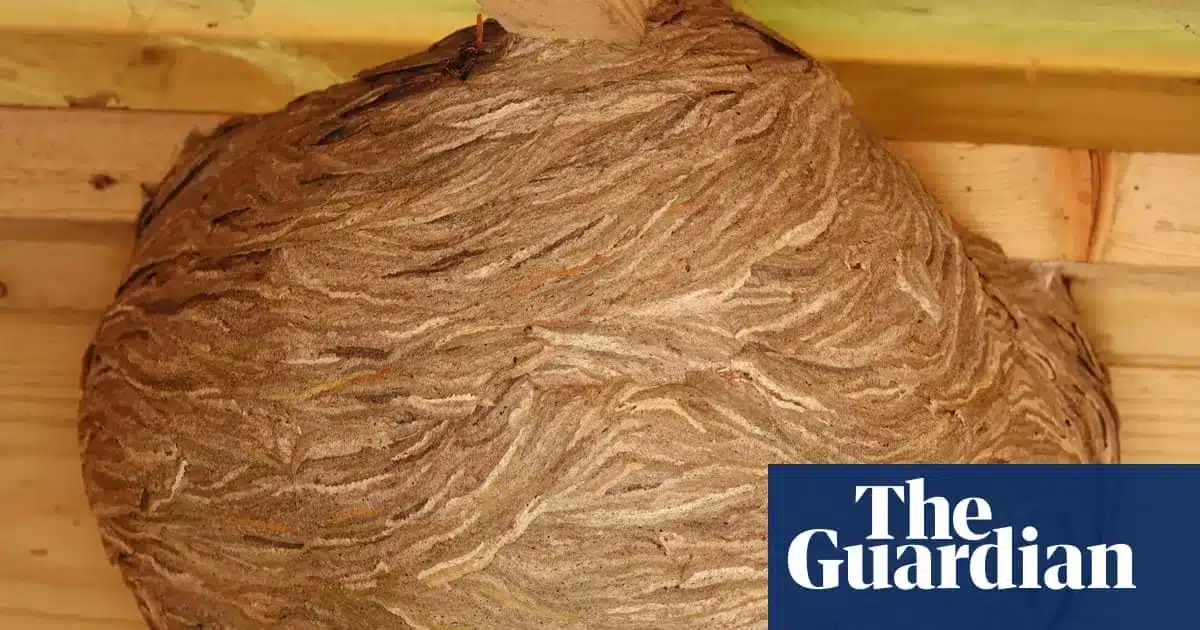
A remarkable natural spectacle unfolded in a garden shed, culminating in a football-sized wasps’ nest that served as a testament to the intricate social structures and industrious nature of these insects. The discovery, initially made on June 9th, began with the sighting of a small, paper-like “lampshade” hanging from a shed beam. This initial observation quickly led to the realization that the shed was occupied by a thriving colony of wasps, prompting its closure for nearly ten weeks to avoid disturbance.
The Emergence of a Wasp Metropolis
During the ten-week period of closure, the shed’s back beam became a hub of constant activity. Wasps were observed making rapid trips to the shed’s rear wall, entering through a narrow slit to access the interior where their nest was being constructed. It was only when the activity noticeably subsided, signaling the end of the colony’s active season, that the shed doors could be safely reopened. What was once a small structure had, over the summer, expanded dramatically to the size of a football.
Architectural Ingenuity and Material Sourcing
Detailed examination of the nest, aided by photographic evidence, revealed the sophisticated methods employed by the wasps. Workers were observed sourcing building materials from at least nine different locations, each yielding wood pulp of varying shades. This diverse sourcing contributed to the nest’s striking visual appeal, with its exterior composed of roughly equal bands of color, ranging from off-white to a rich cedar red. The sheer scale of the construction is staggering; a nest of this size can house approximately 5,000 worker wasps, with the total number of individuals involved throughout the colony’s life potentially reaching 25,000.
The construction process itself is a marvel of engineering. It’s estimated that approximately 5 centimeters of the nest’s vertical wall comprises around 36 distinct, horizontally layered bands. This meticulous layering is not merely aesthetic but functional, providing structural integrity and insulation. Furthermore, the nest is not a static structure; wasps continuously modify and expand the interior as the colony’s needs evolve. This internal remodeling creates multiple layers within the outer wall, accommodating numerous tiers of brood cells.
The Brood Cells: Nurseries of the Colony
Suspended within the nest’s complex architecture are an estimated six to ten tiers of brood cells. These cells serve as nurseries where the colony’s offspring are raised. The development of these young wasps relies on a constant supply of food, gathered by the worker wasps from the surrounding garden’s invertebrate population. It is estimated that tens of thousands of insects are consumed to sustain the growth of a single colony.
A Social Ecosystem: Cooperation and Control
The functioning of a wasp colony is a complex interplay of cooperation and hierarchical control. While adult wasps feed the developing larvae, they themselves receive sustenance from the larvae in the form of sugary saliva. This reciprocal feeding arrangement is crucial for the colony’s survival. Presiding over this intricate society is the queen wasp. Her role extends beyond reproduction; she exerts chemical control over her daughters, suppressing their own reproductive instincts and ensuring their focus remains on serving the colony’s collective needs and furthering the queen’s genetic lineage.
The Nest as a Symbol
This extraordinary paper sphere, therefore, represents far more than just an insect dwelling. It embodies a new generation in the making, a complex family saga unfolding over a single summer. It can be viewed as a sculptural work of art, meticulously crafted from the resources of the local environment. The entire endeavor, from material gathering to the raising of thousands of young, is funded by the garden’s own ecosystem, highlighting the interconnectedness of nature. The construction and life cycle of this wasps’ nest serve as a powerful reminder of the hidden, complex, and often beautiful natural processes occurring all around us, a testament to a summer of extraordinary, collaborative work by a hidden sisterhood.
