

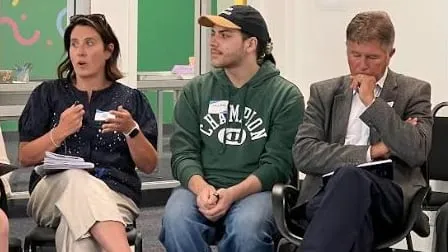
A Saint John youth is amplifying calls for a national strategy to support children and young people, emphasizing the need for a clearer path to success and greater opportunities. Chris Miller, a recent high school graduate, shared his personal journey of finding direction and skills through the Saint John Learning Exchange, highlighting how practical training and collaborative experiences can significantly impact a young person’s future.
Miller’s involvement in a roundtable discussion on Bill S-212, the National Strategy for Youth and Children Act, brought his perspective directly to local leaders, provincial representatives, and senators. The Learning Exchange, a non-profit organization dedicated to helping individuals achieve their educational and employment goals, provided Miller with valuable skills in culinary arts and carpentry, alongside crucial soft skills like teamwork and patience. “I got to learn a lot… working in a group with people and having patience,” Miller stated. “You can also work on your leadership skills when working in a group.”
The Need for a Cohesive National Approach
Senator Rosemary Moodie, a key proponent of Bill S-212, hosted the Saint John roundtable, bringing together youth, non-profit leaders, and community stakeholders. Moodie underscored that while various levels of government are making efforts to address issues like child poverty and youth unemployment, a unified national strategy is essential for truly improving the lives of young Canadians.
“Among the OECD countries, we’re the only one at our level of wealth that doesn’t have a plan,” Senator Moodie observed. She cited reports from organizations like UNICEF, indicating that Canada is not performing as well as it might believe in supporting its youth. “In recent results, we’ve seen that we have significant room for improvement. We’re 27th in physical health, 27 out of 37 countries… We are 22nd in mental well-being and 20th in skills acquisition,” Moodie added, pointing to specific areas where national intervention could yield better outcomes.
The urgency of the situation is further illustrated by New Brunswick’s child poverty rate, which stands at 21.9 percent, according to the Human Development Council. In specific communities like Campbellton and Saint John, these rates are even higher, reaching 41.2 percent and 30.7 percent, respectively. These statistics highlight the critical need for targeted interventions and support systems.
Scaling Up Successful Programs
Senator Moodie emphasized the importance of replicating successful programs nationwide. She pointed to initiatives like the READY project, which Miller benefited from, as models that could be expanded to address the challenges faced by youth across the country. A national strategy, she explained, would facilitate the transition of promising pilot programs into scalable solutions.
“We need things to move from being pilots to being scaled up when they’re successful across our country, and we need to abandon the things that are not working,” Moodie stated. The READY project itself has seen growth, recently receiving $4.4 million in federal funding to reduce its waiting list and increase its capacity to serve up to 200 young people annually.
June Breau-Nason, executive director of the Teen Resource Centre, another organization supporting local youth, echoed the sentiment that a national strategy could unlock vital funding. Such a strategy, she believes, could bolster programs aimed at enhancing mental and physical health, reducing child poverty, and tackling persistent youth unemployment. “If this opens up a conversation that brings funding to community agencies that have proven results, I think that’s important,” Breau-Nason commented. “My hope is that any national strategy will trickle down to our community.”
Empowering Youth Voices
Chris Miller expressed that the push for a national children and youth strategy is long overdue. He feels that such legislation should have been enacted much earlier to provide consistent support and opportunities for young people. “This bill that was being talked about — it’s something that should have already been a thing,” Miller asserted. “Just helping students and kids in general, really, no matter the age, actually be looked after, cared about, and given an opportunity in life, not just expected to be on the street.”
Miller reflected on the challenges young people face when navigating difficult environments. “You’re surrounded by adults who chose not so good decisions in their lives, and then you’re a kid trying to navigate your way through your life… I’m just hoping that this bill helps kids realize that there’s a better way, there’s a better path,” he added.
Dayna Lutes, project manager for the READY initiative, affirmed the value of youth like Miller in demonstrating the effectiveness of their programs. She also stressed the importance of national recognition and validation from figures like Senator Moodie. “Hearing someone that’s looking at this in depth at a national level recognize Saint John as a leader in the space… gives us confidence that we are on the right track,” Lutes said.
Bill S-212 has progressed through the Senate and has been introduced in the House of Commons. It is currently awaiting further readings and committee review before it can potentially become law, marking a significant step towards a potential national framework for youth support.
