

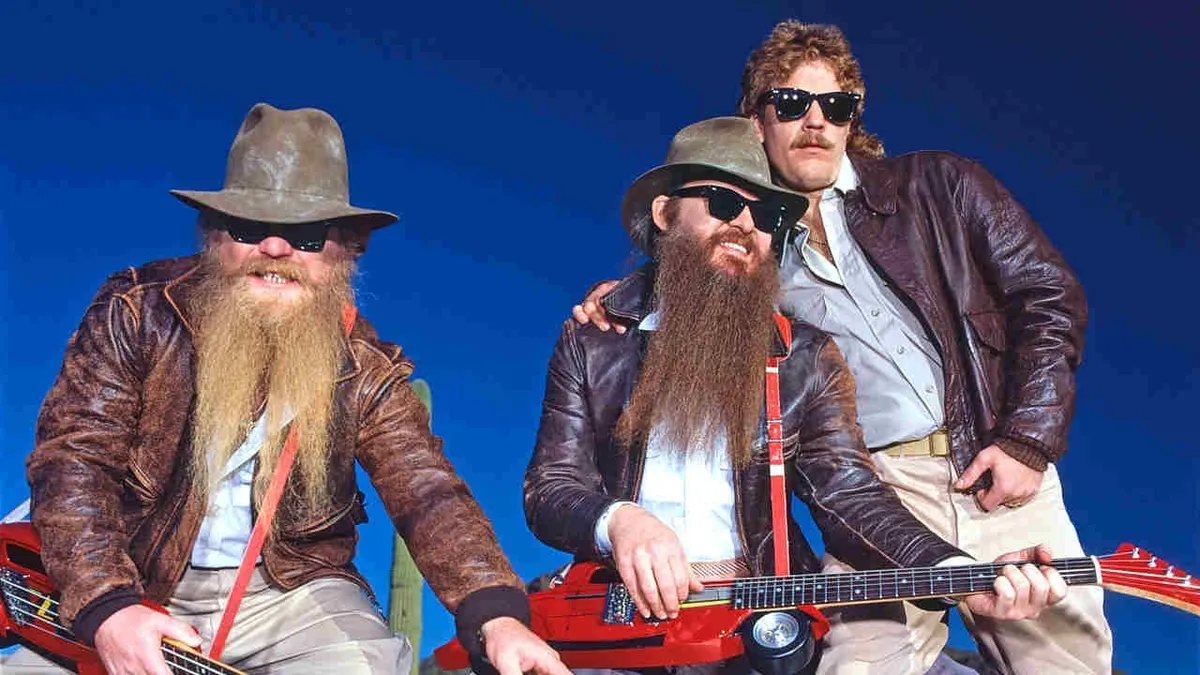
In the mid-1980s, ZZ Top, the iconic Texas trio, continued their unlikely ascent to MTV superstardom with their ninth studio album, Afterburner. Released in 1985, the album served as a follow-up to the massively successful Eliminator, building upon its innovative blend of blues-rock and synthesized sounds, and cementing the band’s distinctive visual identity. Despite Billy Gibbons’ playful remark about not belonging on television and Dusty Hill’s humorous self-deprecation about needing a circus, the band leveraged their unique charisma, eccentricity, and undeniable talent to maintain their commercial appeal.
The ‘Afterburner’ Sound and Visuals
Afterburner maintained the sonic blueprint established by Eliminator, featuring a “cyber-blues” sound heavily influenced by sequenced synthesizers and drum machines, expertly integrated with the band’s signature gritty guitar work. The album’s cover art itself, depicting their iconic 1933 Ford Coupe transformed into a space shuttle, signaled a futuristic direction that resonated with the era’s aesthetic. This visual theme was mirrored in the album’s promotional videos, which continued the playful and sassy style that had captivated audiences.
The album spawned several successful singles, including the US No. 8 hit “Sleeping Bag.” Its accompanying music video reprised visual elements from Eliminator‘s successful promos, once again featuring actress and model Kymberly Herrin, who had previously appeared in the video for “Legs.” The titles Eliminator and Afterburner were strategically chosen by the record label to suggest a sequential release, offering fans more of the sound and style they had come to love. While not threatening Madonna’s reign as the queen of 80s MTV, ZZ Top’s singles, such as “Sleeping Bag,” “Rough Boy,” and “Velcro Fly,” ensured consistent airplay and kept the band in households nationwide.
Key Tracks and Recording Process
Afterburner marked a departure from ZZ Top’s earlier work in one significant aspect: it was the first album since 1972’s Rio Grande Mud not to feature engineer Terry Manning, who was unavailable. The album was recorded between March and July 1985 at Ardent Recording in Memphis, with long-time producer Bill Ham at the helm. The down-tempo power ballad “Rough Boy” emerged as a standout track. The song masterfully contrasted its pop-infused keyboards with Gibbons’ distinctive, pinch-harmonic-laden guitar solos. Billy Gibbons described the creative tension, stating, “The pretty music had to have a rough boy in it.” Dusty Hill later expressed his fondness for the track, recalling, “I like that song so much, I had it played at my wedding.”
Beyond “Rough Boy,” Afterburner delivered more of the characteristic ZZ Top sound. Tracks like “Woke Up With Wood” and “Dipping Low (In The Lap Of Luxury)” showcased the band’s penchant for graphic lyrical themes set to infectious riffs, with the latter sharing sonic DNA with Eliminator‘s “Gimme All Your Lovin’.”
Commercial Success and Critical Reception
Commercially, Afterburner achieved significant success, reaching No. 2 on the UK Album Charts and eventually achieving five-times platinum status in the United States. However, some critics and fans noted that it lacked the same level of wit, imagination, and consistent quality control found in Eliminator. The album’s success was largely attributed to the residual momentum from its predecessor, with the title Afterburner aptly reflecting its reliance on the white-hot success of Eliminator. Nevertheless, “Rough Boy” was widely regarded as a brilliant track, standing shoulder-to-shoulder with the hits from Eliminator.
Live Performances and Legacy
ZZ Top’s live performances during the Afterburner era were as visually striking as their music videos. A notable event was their first-ever live television performance on The Tonight Show Starring Johnny Carson on May 16, 1986. For the occasion, the band was accompanied by The NBC Orchestra, and even Carson and bandleader Doc Severinsen sported fake beards and sunglasses. Despite a minor vocal flub by Billy Gibbons on “Sharp Dressed Man,” the performance showcased the band’s synchronized choreography and iconic look, complete with shades, sharp suits, and matching guitars.
The Afterburner World Tour, which extended into 1987, featured a cutting-edge stage set designed in collaboration with Ty Reveen, son of illusionist Peter Reveen. The centerpiece was a colossal 20-foot-tall longhorn skull with laser eyes, which would dramatically snort smoke and reveal Frank Beard’s drum kit at the start of the show, a theatrical flourish befitting the era’s extravagant stage shows.
Later Years and Evolution
In an attempt to capitalize on the Afterburner phenomenon, Warner Bros. released The Six Pack, a box set compiling the band’s first five albums along with 1981’s El Loco. These reissued albums were controversially remixed with contemporary drum and guitar effects. Following this period, ZZ Top took a brief hiatus before releasing Recycler in 1990. While Recycler was envisioned as part of a stylistic trilogy with Eliminator and Afterburner, it marked a noticeable shift in direction. Gibbons explained that while the previous two albums were highly produced and experimental, Recycler saw the band returning to their roots. Recording sessions in Memphis for songs like “My Head’s In Mississippi” were influenced by visits to the Delta Blues Museum, signaling a renewed focus on a bluesier sound.
Ultimately, Afterburner stands as a testament to ZZ Top’s ability to adapt and thrive in the evolving landscape of 1980s music and visual media. It proved that their unique blend of blues, rock, and synthesized sounds, coupled with their unforgettable image, was a formula for enduring success.
