

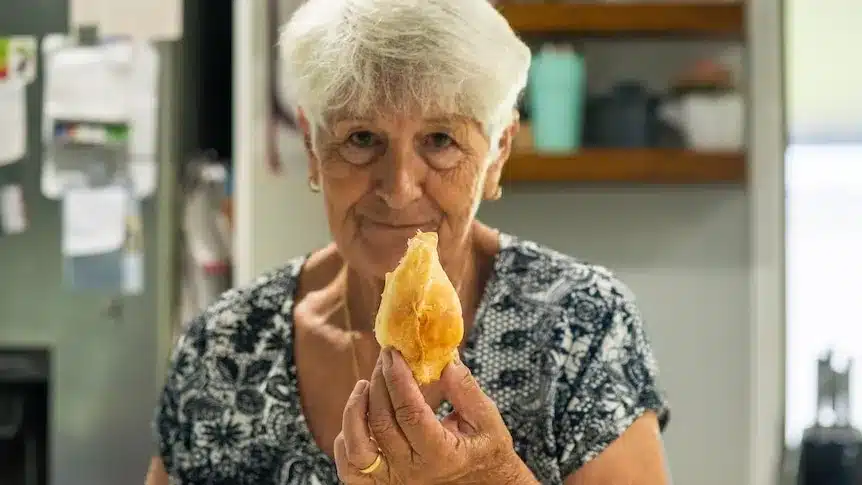
Eighty-year-old cheesemaker Philippa Abela rises before dawn each day to milk her cows and craft traditional cheeses on her property nestled among sugarcane fields in Habana, near Mackay in North Queensland.
Daily Milking and Cheesemaking Ritual
Philippa Abela heads to the milking shed where her Jersey-Swiss Brown cross cow, Meg, greets her enthusiastically. “You’ve got to keep out of her way because she runs in,” Mrs Abela laughs. The milking machine hums amid early morning birdsong, and with just two cows, she finishes by 6:30 a.m. She then stirs rennet into the warm milk, separating solid curds from liquid whey.
Maltese Roots Take Hold in Australia
Mrs Abela’s family emigrated from Malta to Australia in 1950 amid post-war hardship. Her courageous mother brought four young daughters to join her father on a cane farm in Habana, where they kept dairy cows to supply the local butter factory. “It was a hard life, but a good life,” she recalls.
Her mother taught her to produce ricotta-like cheese for pastizzis and firm, vinegar-pickled pepper cheese using cow’s milk—a staple originally made from sheep’s milk in Malta. Mrs Abela has refined about 13 varieties, but the originals remain favorites in the community’s strong Maltese enclave. “I’ve got friends who I’ve been supplying for a long time,” she says. “One year, I made about 90 kilos of pepper cheese. If there’s a street party, and you go without, it’s ‘where’s the pastizzis?'”
Secrets to Perfect Cheese
The finest cheese starts with well-fed, relaxed cows, clean equipment, and precise temperature control. “Each cheese has its own process; you never stop learning,” Mrs Abela explains. For basic fresh cheese, she strains the whey after careful stirring and temperature monitoring for 30 minutes. Curds are ready to eat or cook with.
On other days, she crafts halloumi and mozzarella by adding cultures to the whey, then heating, pressing, drying, or aging as needed. She shares her expertise with family and teaches community classes.
Growing Interest in Slow Food
Mrs Abela notices younger generations embracing her slow, natural methods. “The old ways are becoming more popular again,” she says.
Michael Zannella, general manager of Cheeselinks, a cheese-making supplies company, confirms this trend. Retail sales to hobbyists and small farmers have surged over 200 percent recently. He attributes it to a generational shift valuing artisan craftsmanship and food stories over convenience. “My parents never considered those sorts of things. I think we maybe had a convenience generation. The microwave was popular. It was about how convenient can we make our meals?”
Active Life at 80
Mrs Abela and her late husband ceased commercial dairying 30 years ago after market deregulation. Now widowed, she tends a dozen beef cattle, mows, and weeds while keeping two milkers for cheese. “I think you’ve got to contribute to society, you can’t stay idle. I don’t know what idle is,” she declares. Though she doesn’t sell commercially, demand from friends and family persists. “I also thought, ‘I don’t want to be milking the rest of my life’, but here I am at the age of 80, still milking,” she laughs.
