

The sharp calls of jackdaws and rooks fill the air as they lift from the ground, their flight a familiar rhythm against the wind. These corvids, a constant presence, circle above Soay/Hebridean cross sheep grazing the ancient slopes of the Old Oswestry hillfort, known locally as Hen Ddinas. The stark contrast of black birds, black sheep, and vibrant green grass paints a scene that has likely remained unchanged for millennia, stretching back to before the Roman conquest of this elevated, earthwork-ringed landscape.
These hardy, horned sheep bear a striking resemblance to those farmed by the Iron Age Cornovii people, known as ‘the people of the horn.’ Their confident presence on the plateau seems to echo the enduring spirit of these ancient inhabitants.
A Bohemian Visitor Takes Flight
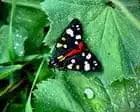
Just a short distance away, down at the Gatacre allotments, a different kind of aerial display unfolds. The scarlet tiger moth, Callimorpha dominula, emerges. Its wings, a striking combination of silky black with a green sheen, are adorned with white and yellow markings, while its hindwings flash a brilliant scarlet. This moth, with a flair that is part burlesque, part pirate, possesses a visual vibrancy that evokes the bold strokes of an artist like David Hockney. It is a common sight during sunny afternoons from May through July.
The caterpillars of the scarlet tiger moth, distinctively striped in yellow and black, have a particular fondness for comfrey. This plant, abundant on the allotments where it is traditionally used as a fertilizer, provides a crucial food source.
Synanthropy and Shared Spaces
This year has proven particularly bountiful for the scarlet tiger moth. Their success is partly attributed to their synanthropic nature – their ability to thrive alongside human environments. As they expand their territories around the edges of English towns, they have broadened their diet to include garden plants, making allotments like Gatacre ideal habitats.
Situated in the shadow of the ancient hillfort, these allotments serve as a testament to how history is not solely the domain of human endeavors. They highlight the interconnectedness of life, encompassing the lives of our fellow creatures – the corvids, the sheep, and the moths – who bear silent witness to the passage of time.
In a moment that beautifully underscores this ancient kinship, a spent scarlet tiger moth on the allotment is swiftly caught by a blackbird. The bird, head cocked, shares a knowing glance. Its beak is filled with the remnants of scarlet wings and plump worms, a stark contrast to the bag of salad greens and raspberries I hold, a shared harvest from this vibrant, living landscape.
