

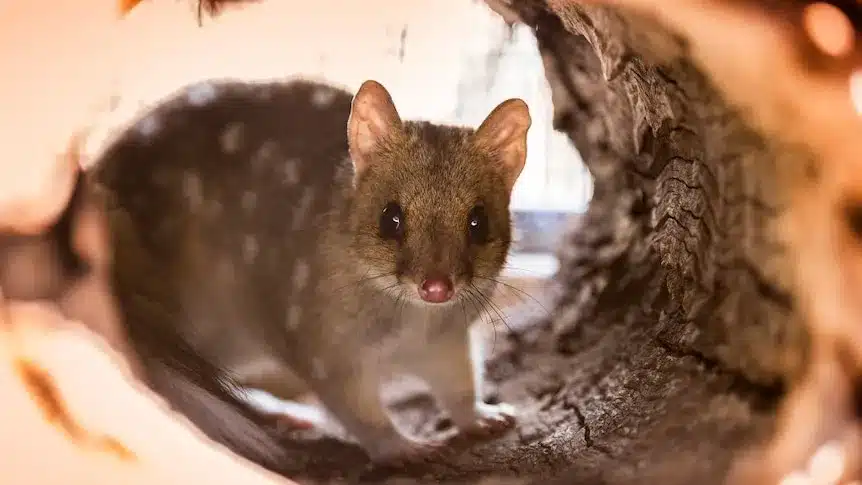
Canberra Wildlife Reserve Builds Quarantine Pens to Safeguard Endangered Quolls
Wildlife officials are implementing a critical conservation measure at Mulligans Flat Nature Reserve, constructing 16 specialized quarantine pens to protect a vulnerable population of eastern quolls from the potential arrival of avian influenza in the Australian Capital Territory (ACT).
Dietary Habits Raise Bird Flu Concerns
The eastern quoll, an endangered marsupial, faces a heightened risk from the H5 strain of bird flu due to its natural diet, which includes sick and deceased birds. This dietary behavior could expose them to the virus should it reach the reserve.
Jason Cummings, Chief Executive of the Woodlands and Wetlands Trust, expressed concerns that the virus could “decimate” the local quoll population. “We have such small populations of these endangered species that it’s a significant risk that they could negatively impact the population,” Cummings stated. “We would expect the eastern quoll population to decline in the sanctuary, but hopefully not go extinct again here.”
Quarantine Pens as a Vital ‘Insurance Policy’
The newly constructed quarantine facilities are described as an “insurance policy” designed to ensure the species’ survival even if a significant portion of the wild population is lost. The strategy involves temporarily housing a select group of quolls in isolation until the threat of bird flu has passed, after which they will be reintroduced to bolster the remaining population.
“The concept we’ve got is to bring some in, keep them separated from the bird flu, and then re-release them once the bird flu’s passed through to re-bolster that population,” Cummings explained. “And so what we’re about here is trying to do the preparatory work so that we’ve got options to respond when it does come.”
Challenges in Quoll Management
Managing the quarantined quolls presents unique challenges, as eastern quolls are not inherently social animals, particularly during their breeding season. “Eastern quolls are tricky to keep together because at different stages of their lifestyles they fight with each other,” Cummings noted. “So depending on what time of the year we might bring some in, that’ll determine how many we can bring in and how we locate them together and keep them together and look after them through time.”
Dean Maxworthy, Mulligans Flat wildlife project manager, detailed the engineering of the pens, emphasizing the need for escape-proof enclosures. “We will have a skirt that sits … underneath the ground so when they dig down … they’ll hit that skirt and hopefully won’t keep on digging into the other side,” Maxworthy said. “These guys are going to be checked on every single day to check on their welfare.”
To address the psychological well-being of the quarantined animals, the reserve will provide enrichment activities. “They are technically wild quolls, so we’re going to have to keep an eye on them and make sure they’re not going too stir crazy,” Maxworthy added. “But they’re going to have lots of little hidey holes and stuff as well. We’ve got a bunch of hollows and stuff that we’re going to put inside there and create them some really cool little dens so that they feel as safe as they possibly can inside the enclosures.”
Food Security Measures Underway
In addition to the quarantine infrastructure, the sanctuary is also preparing for potential disruptions to the poultry industry, which could impact food availability for the quolls. A stockpile of meats, including chicken, rabbit, and kangaroo, is being assembled to ensure a consistent food supply.
“We’re building up a little stockpile of chickens and rabbits and kangaroo meat and things like that so … we’ve got some food on hand to feed these critters while we’ve got them,” Cummings stated.
Monitoring and Preparedness
The activation of the quarantine pens will depend on specific trigger points, with current efforts focused on ongoing monitoring. “It [H5 bird flu] is not going to get here overnight … but we’ll keep an eye on the records,” Cummings said. “If it gets into New South Wales or it gets to our coast, that’ll take us to the next level of preparedness and that’s when we might start thinking about going and bringing some in. So it’s a process, watching and learning as it unfolds around the country, and then we’ll be looking to take action before it gets to us in Canberra.”
