

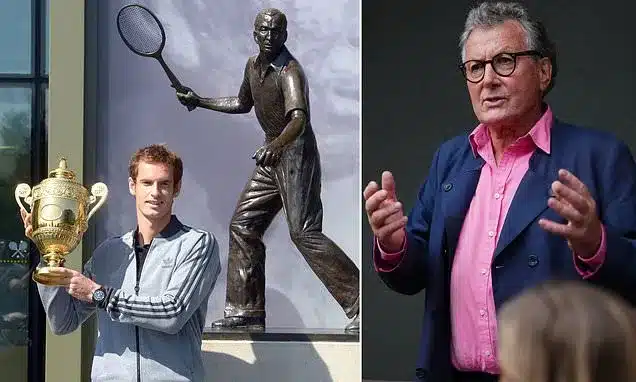
A new statue honoring two-time Wimbledon champion Andy Murray is in development, with sculptor David Williams-Ellis revealing a unique approach to capture the tennis star at the height of his powers. The life-size-plus bronze sculpture, commissioned for Wimbledon, will depict Murray in a dynamic mid-shot pose, balancing on one foot with a racquet in hand. Set to be unveiled in 2027 to coincide with the tournament’s 150th anniversary, the artwork aims to embody Murray’s athleticism, determination, and a less-seen “softer side.”
Sculptor’s Vision for the Andy Murray Statue
David Williams-Ellis, known for his work on the Normandy D-Day landings sculpture, has been tasked with immortalizing the Scottish tennis icon. He explained that the statue will represent Andy Murray as a younger man, specifically between the ages of 23 and 25, reflecting the period of his Wimbledon victories in 2013 and 2016. Williams-Ellis noted that while Murray, now 38, is still a formidable figure, his physique has changed since his peak playing days. “Andy at 38 is a bit gnarly,” Williams-Ellis commented, explaining the need for a stand-in model to accurately portray the fluidity and musculature of a younger athlete.
To achieve this, Williams-Ellis enlisted a 23-year-old sportsman named Joe. This model, while strong and athletic, differs slightly in build from Murray. Therefore, the sculptor meticulously recreates poses by studying extensive video footage and approximately 150 photos and screenshots of Murray in action. “I trawled everywhere to find a young athletic stand in – Andy is quite stocky and muscular so the person that stands in has to be strong enough to do the pose,” Williams-Ellis stated. “He needed to be similar and Andy is really quite big.” The sculptor emphasized the importance of capturing not just the physical likeness but also the “movement and energy” characteristic of a top tennis player.
Collaboration with Andy Murray and Kim Sears
The creation process has involved close collaboration with Andy Murray and his wife, Kim Sears. Williams-Ellis has held several meetings with the couple, who have been actively involved in the project. “Kim was definitely very involved and they played a big part in the selection and seemed to like what I had done,” he shared. Murray himself has been patient during sittings at the artist’s Oxfordshire studio, posing for the dynamic stances required. Williams-Ellis praised Murray’s ability to follow instructions precisely, likening it to his experience on the tennis court. “He took instruction incredibly well and someone commented that it was probably because he was used to being coached,” the sculptor observed.
Murray’s primary concern, according to Williams-Ellis, is that the final statue avoids the pitfalls of some less successful sporting sculptures seen elsewhere. The sculptor aims to create a piece that is not merely a static representation but one that conveys a sense of ongoing motion and captures the essence of Murray’s character – his fierce on-court determination and his “laconic, wonderful smile” and dry wit off the court.
The Sculpting Process and Challenges
The statue, which will stand significantly taller than life-size due to its “life-size plus a fifth” scale and Murray’s own height of 6ft 3in, is currently being fashioned from a half-tonne of clay over a steel frame. Williams-Ellis highlighted the practical challenges of working with such a large clay model, particularly managing moisture levels to prevent drying or dissolution. “It is like having a skeleton inside which is then cast and moulded in about 400 kilos of bronze with a bronze plinth,” he explained.
One of the most unexpected difficulties has been sculpting modern tennis shoes. Williams-Ellis described them as “incredibly difficult to sculpt and are computer designed,” presenting a significant challenge compared to traditional footwear. “They’re not like normal shoes – it’s the hardest pair of shoes I have ever had to do,” he admitted.
Despite the pressures and potential risks involved in capturing such a well-known figure, Williams-Ellis expressed his commitment to delivering a successful and recognizable artwork. He aims to capture the “spring and that power and that instantaneousness that great tennis players have as well as his character.” The sculptor also humorously anticipates the critique from Murray’s four children, whom he expects to be the toughest critics due to their honesty.
Wimbledon’s Artistic Legacy
The commission places Williams-Ellis in esteemed company at Wimbledon, which already features a bronze statue of Fred Perry, the last British man to win the singles title before Murray. Observing the crowds gathered around the Perry statue, Williams-Ellis recognized the significant honor of being chosen to create a new piece for the iconic venue. The selection process involved an initial pool of ten sculptors, and Williams-Ellis’s past work, including the D-Day sculpture, ultimately led to his appointment.
The final bronze sculpture, standing on a plinth at an undisclosed location within the Wimbledon grounds, is anticipated to be a powerful tribute to Andy Murray’s impact on British tennis and his enduring legacy at the Championships.
