

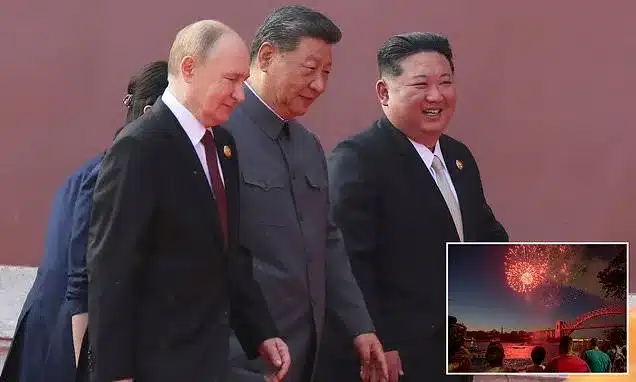
A significant portion of American voters identify Russia as the nation’s principal historical adversary, according to a recent survey. The poll also revealed deep-seated concerns about the future stability of the United States, with economic collapse emerging as the most prominent existential threat.
Russia Identified as America’s Foremost Historical Enemy
Findings from an exclusive survey indicate that 36 percent of registered voters consider Russia to be America’s biggest enemy over the past 250 years. This perception positions Moscow as the leading historical adversary in the eyes of the American electorate.
Following Russia, China was named as the second most common choice for America’s biggest enemy, cited by 13 percent of respondents. Iran was close behind, identified by 12 percent of voters. Other nations mentioned include Iraq (seven percent), North Korea (six percent), and the United Kingdom (four percent). Afghanistan and Germany were each selected by three percent of those polled, with an additional two percent choosing an ‘other’ unspecified country.
Public Anxiety Over America’s Long-Term Future
Beyond historical rivalries, the survey also shed light on considerable public apprehension regarding the United States’ future trajectory. When asked to identify the most likely reason America might not exist in another 250 years, voters overwhelmingly pointed toward internal economic instability.
Economic Collapse Tops Existential Fears
Economic collapse was identified as the most probable cause of the nation’s potential demise, with 22 percent of respondents selecting this option. This concern significantly outweighs other perceived threats to the nation’s longevity.
Other significant fears for America’s future include:
- Nuclear War: Cited by 16 percent of voters as a potential cause for the nation’s end.
- Civil War: Ten percent of respondents expressed fear of a future civil conflict.
- Artificial Intelligence Takeover: A modern concern, AI was cited by nine percent of voters, surpassing many traditional or science-fiction-based anxieties.
A variety of other potential triggers for national decline were also noted, though at lower percentages. These included pandemics, absorption into a one-world government, natural disasters, and a takeover by China, each cited by four percent of those surveyed. Depopulation due to declining birth rates also garnered four percent of the vote.
Further down the list of concerns were:
- Annexation by Canada or Mexico (three percent).
- Takeover by radical Islam (three percent).
- Takeover by Russia (three percent).
Less frequently cited existential threats included alien invasion and famine, each mentioned by one percent of voters. Seven percent of respondents selected ‘other’ reasons for potential national decline.
Key Allies Identified by Voters
In contrast to the identification of adversaries, the survey also explored perceptions of America’s most important allies over the past 250 years. The United Kingdom emerged as the most frequently chosen ally, selected by 33 percent of voters, underscoring the enduring strength of the transatlantic ‘special relationship’.
Canada followed as the second most important ally, receiving 17 percent of the vote. Israel was named by 14 percent of respondents, with France at eight percent. Japan and Mexico were each selected by three percent of those surveyed, while Ukraine and ‘other’ options garnered two percent each.
Survey Methodology
The poll surveyed 1,059 registered voters. The findings carry a margin of error of three percent, indicating a high degree of statistical reliability for the reported figures.
Conclusion
The survey results present a dual perspective on American public opinion: a clear identification of historical adversaries, with Russia at the forefront, and a profound concern for the nation’s future, primarily driven by anxieties over economic stability. While international relations are viewed through the lens of past conflicts and present alliances, the most pressing perceived threat to America’s long-term existence appears to be internal economic fragility.
