

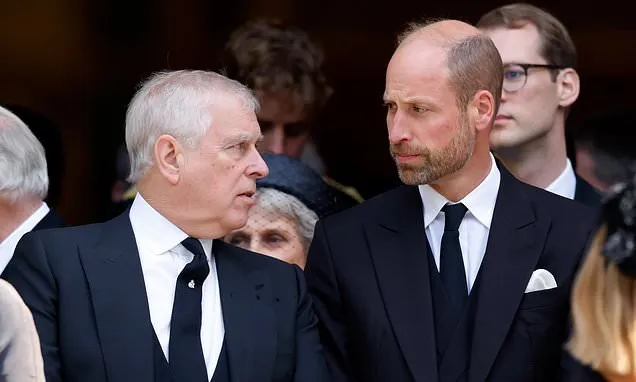
A seemingly brief interaction between Prince Andrew and his nephew, Prince William, at the funeral of the Duchess of Kent in September of last year may have been a critical juncture in the former Duke of York’s diminished public standing, according to royal author Andrew Lownie. The author suggests that Andrew’s eagerness to engage with William, coupled with William’s apparent discomfort, vividly illustrated the strained relationship and the perceived distance from which Andrew was held by the Prince of Wales.
A Solemn Occasion and a Frosty Exchange
The funeral service, held at Westminster Cathedral, saw Prince Andrew standing alongside his ex-wife, Sarah Ferguson. Eyewitness accounts and subsequent analysis of video footage suggest that Andrew’s demeanor, described by some as a grin, was perceived as incongruous with the solemnity of the occasion. This reportedly caused discomfort for Prince William, who was later quoted as advising his uncle that his outward display was “not a good look.” This moment, captured on camera, offered a public glimpse into the Prince of Wales’s reported feelings towards Andrew, who has been navigating significant controversy stemming from his past association with Jeffrey Epstein.
Andrew Lownie, author of the book “Entitled: The Rise And Fall Of The House Of York,” posits that this funeral encounter was a significant catalyst. “The pictures of the former Prince Andrew at the funeral of the Duchess of Kent’s funeral was a pivotal moment in his fall from grace,” Lownie stated. He further elaborated that this event seemed to underscore a sense of entitlement surrounding Andrew, leading to a subsequent escalation of his difficulties. “From then on his troubles snowballed,” Lownie observed.
A Plea for Forgiveness and Public Scrutiny
Lip reading analysis of the exchange, conducted by Nicola Hickling, suggests that Prince Andrew may have used the opportunity to seek forgiveness from his nephew. According to the analysis, Andrew’s words to William, who was accompanied by his wife Catherine, included a plea: “I’ve learnt from what I’ve done but before I forget, and if I can, I’d like to ask you if you can forgive?” This occurred in the context of ongoing scrutiny over Andrew’s ties to Jeffrey Epstein, which had already led to the stripping of his royal titles and his eviction from Royal Lodge the month following the funeral.
The interaction began with pleasantries, with Andrew greeting William and Catherine. Ms. Hickling’s analysis indicates that William appeared uneasy, responding to Andrew’s inquiry with a somewhat reserved, “What can I do for you?” Andrew’s subsequent remark, “We’re really closed in together,” was met with a simple, “Yes,” from William, as interpreted by the lip reader.
Escalating Troubles and Future Concerns
Lownie views the funeral encounter not as an isolated incident, but as the prelude to further challenges for Prince Andrew. The author points to Andrew’s arrest and questioning later that year on suspicion of misconduct in public office, related to allegations of passing sensitive information to Epstein during his tenure as a UK trade envoy. “Phil Noble’s snap of Andrew slumped in the back of a car looking obviously shocked after his day of questioning brought home to the public that the Queen’s second son might actually be held to account for his actions,” Lownie commented. He believes this period marked a moment when Andrew himself may have begun to grasp the gravity of his situation.
However, Lownie also suggests that any newfound seriousness was short-lived, with Andrew reportedly reverting to blaming external factors for his predicament. The royal author expresses concern that Prince Andrew’s difficulties are far from over. “That may be about to change with fresh documentation likely to be released in the coming months from a libel case settled by Ghislaine Maxwell and the release of more Epstein files,” he stated. Lownie anticipates that the one-year anniversary of the Duchess of Kent’s funeral could coincide with further significant developments in Andrew’s public narrative.
Shifting Royal Dynamics and Future Reigns
The year following the funeral has been marked by significant scandal for Prince Andrew. Lownie has previously commented on the complexities within the Royal Family, suggesting that King Charles’s sentimental nature and perceived indecisiveness regarding his brother may have frustrated Prince William. According to Lownie, William, as the future monarch, has reportedly taken a more assertive stance, influencing decisions regarding Andrew’s public role and residence. Reports suggest William opposed Princess Anne’s offer for Andrew to reside with her, deeming it “madness” and prioritizing a “clean stable” monarchy for his own future reign, with Catherine by his side.
Royal expert Richard Fitzwilliams also weighed in on Prince William’s approach, noting his commitment to the Church of England and his “quiet faith.” Fitzwilliams suggested that William’s perceived “ruthless streak” is a necessary attribute for navigating the modern monarchy, especially given its intense public scrutiny. He praised William’s judgment and diplomatic skills, indicating a readiness for the responsibilities of kingship.
Conclusion: A Legacy in Question
The events surrounding Prince Andrew’s interaction with Prince William at the Duchess of Kent’s funeral continue to be analyzed as a symbolic moment in the former Duke’s declining public image. As Lownie suggests, the ongoing controversies and potential future revelations may further shape the public’s perception of Prince Andrew and the broader dynamics within the British monarchy.
