

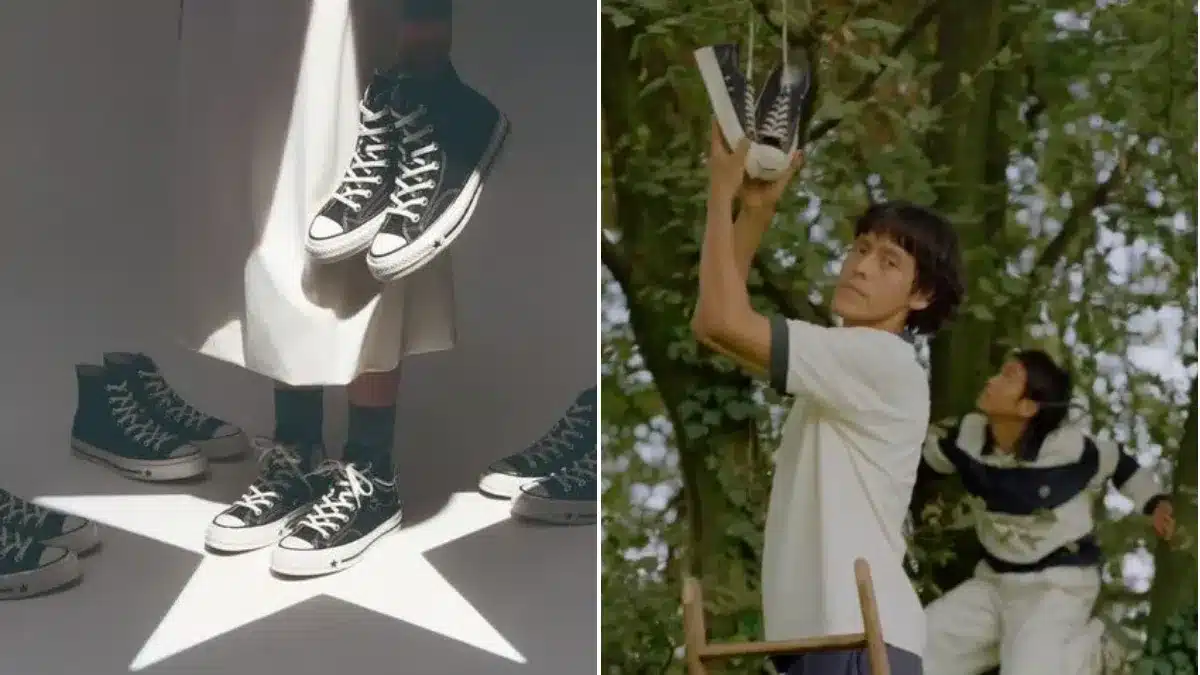
Converse has issued a formal apology following widespread criticism of its latest advertising campaign, which featured imagery that many observers likened to symbols associated with the Ku Klux Klan and racial violence. The controversy erupted after images from the global Chuck 70 X campaign, featuring K-pop star Karina of the girl group Aespa, were released.
Controversial Campaign Imagery
The campaign’s central image depicted Karina holding a pair of black Converse sneakers while positioned within the illuminated star that serves as the Converse logo. Observers noted that the styling of her white satin skirt, combined with the lighting and shadows, created a triangular shape that bore a resemblance to the pointed hoods worn by Ku Klux Klan members. The sneakers were shown dangling below this formation.
A second image, shared on the Converse Malaysia Instagram account as part of the Converse x Palmes campaign for the Jack Purcell PDM collection, showed two models climbing a tree. One model was on a ladder, hanging a pair of Converse sneakers from a branch by their laces. This visual also drew sharp criticism.
Public Reaction and Accusations
As the images circulated on social media, many users expressed outrage, labeling the campaign “atrociously racist” and highlighting the perceived symbolism of lynching. Critics questioned how such imagery could have passed through the brand’s various approval stages, from concept development to final sign-off.
One widely shared comment from user @LeeMerrittesq on X (formerly Twitter) stated, “I was appalled that someone signed off on this.” The user added that Converse’s apology “doesn’t undo what got past legal, marketing, and leadership at every step.” Another user, @unique56301, described the campaign as “tone deaf” and “a slap in the face,” even if the intent was unintentional.
User @narindertweets called the ad “dreadful” and “disgusting.” Meanwhile, @LaPistolaDulce elaborated on the severity of the issue, stating, “Whether that imagery was intentional or not, I cannot understand how something with those visual associations made it through concept development, photography, editing, marketing, executive review, and final approval without someone stopping and saying, ‘Do you see what this looks like?'”
This commenter emphasized that the problem extended beyond mere poor taste: “It is an appalling failure to recognise or adequately safeguard against imagery inseparable from generations of racial violence, terror, intimidation, hate, and trauma that did not magically disappear when the history books turned the page.”
Other reactions included @rabbitSZN2’s assertion that dismissing the controversy as “just a shoe ad” was “not a defence,” and @KW33NSOHI9H’s declaration that it was “definitely the most racist ad of the season.” Adjectives such as “abhorrent,” “unfathomable,” and “repugnant” were also used to describe the marketing materials.
Converse’s Response and Apology
In response to the backlash, Converse removed the controversial images from its social media channels. A spokesperson for the Nike-owned company issued a statement to Footwear News, beginning with a direct apology: “We’re sorry.”
The statement continued, “We understand why this image is deeply upsetting and recognise that we got this wrong. We removed it from our channels and are working to remove it everywhere it appeared. This should not have happened, and we will do better.”
Historical Context of KKK Imagery
The Ku Klux Klan (KKK) is an American white supremacist hate group founded in 1865. Historically, its members have worn distinctive white robes and pointed hoods to conceal their identities and instill fear. The group has been responsible for widespread acts of violence, including beatings, lynchings (hangings), and other forms of terror, primarily targeting African Americans, and later extending to Jewish people, Catholics, and immigrants.
While the KKK has evolved and fragmented over time, its symbols and association with racial terror remain potent. The history of racially motivated hangings in the United States is a deeply painful one, with some instances allegedly being misclassified as suicides to evade investigation. Reports from civil rights organizations continue to highlight the persistence of such violence. For example, a report by JULIAN earlier this year documented over 70 suspected modern-day lynchings in seven Southern states between 2000 and 2025.
Moving Forward
The incident underscores the critical importance of cultural sensitivity and thorough review processes in advertising and marketing. Brands are increasingly held accountable for the messages their campaigns convey, and the potential for unintended offense, particularly concerning sensitive historical issues like racial violence, requires rigorous vetting. Converse’s swift removal of the ads and public apology indicate an acknowledgment of the severe misstep, though critics emphasize the need for robust internal checks to prevent similar occurrences in the future.
