

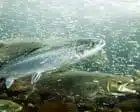
Traces of cocaine in rivers and lakes accumulate in salmon brains, potentially disrupting their behavior and posing risks to fish populations, new research indicates.
Juvenile Atlantic salmon exposed to environmentally realistic levels of the drug and its main metabolite, benzoylecgonine, swam greater distances and spread more widely across a lake. These changes suggest impacts on fish feeding patterns, habitat choices, and predator vulnerability.
Experiment Design
Researchers fitted two-year-old hatchery-reared Atlantic salmon with implants releasing cocaine or benzoylecgonine at levels mimicking wild pollution. A control group received neutral implants. All fish carried acoustic transmitters and were released into Lake Vättern, Sweden’s second-largest lake at nearly 2,000 square kilometers, home to predatory pike.
Sensors tracked the salmon for two months. Initially, all groups settled into specific lake areas, but cocaine-exposed fish grew more active later.
Key Behavioral Changes
In the final two weeks, cocaine-exposed salmon swam 5 kilometers farther than controls. Those with the metabolite implant covered nearly 14 kilometers more—twice the distance.
Exposed fish also ventured farther north, with metabolite-affected salmon traveling 12 kilometers beyond controls. The metabolite showed the strongest effect, despite occurring at higher wild concentrations.
“It was really the metabolite, which we know occurs at higher concentrations in the wild, that had the much more profound effect on fishes’ behaviour and movement,” said Dr. Jack Brand of the Swedish University of Agricultural Sciences.
Brand noted that overlooking metabolites in risk assessments misses significant environmental threats. Increased activity may force fish to expend more energy, forage openly, and risk predation.
“Largely, we don’t know the consequences, but I expect there to be trade-offs. They may end up in worse condition or have to offset it by foraging a lot more, meaning they spend more time out in the open.”
Broader Environmental Risks
Pollution from pharmaceuticals, including cocaine, methamphetamine, antidepressants, and antipsychotics, threatens aquatic biodiversity. Past studies link antidepressants to perch losing predator fear and methamphetamine to trout addiction-like behaviors. Tests in Suffolk rivers detected multiple drugs in freshwater shrimp, though harm levels remain unclear.
Experts urge greener pharmaceuticals that break down naturally. Prof. Leon Barron, who leads emerging chemical contaminants research at Imperial College London, stresses verifying wild exposure effects against other pollutants.
“Better wastewater management, particularly reduced raw sewage discharges, could help lower any risks to wildlife and their ecosystems,” Barron said.
Standard treatments remove many illicit drugs effectively, but raw sewage from storm overflows and plumbing issues persists as a key waterway source.
