

Concerns Mount Over Exploitation of Common Travel Area by Migrants
Authorities are facing increasing pressure to address alleged abuse of the Common Travel Area (CTA) by asylum seekers, following a recent knife attack in Belfast. A Sudanese national has been charged with attempted murder in connection with the incident.
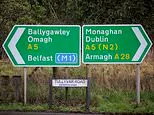
The CTA, a long-standing arrangement between the United Kingdom and the Republic of Ireland, permits citizens of both nations to travel, reside, and work freely across the island of Ireland. Established over a century ago, the agreement originated from the creation of the Irish Free State, the precursor to modern-day Ireland.
However, post-Brexit, concerns have been raised that the CTA is being utilized by asylum seekers who might otherwise not be granted entry into the UK. The suspect in the recent Belfast attack, described by police as a 30-year-old asylum seeker with indefinite leave to remain, reportedly first resided in Dublin before traveling to Northern Ireland by bus.
The Sudanese national has been formally charged with attempted murder and appeared in court following a period of far-right related unrest in Belfast. Notably, government figures on the number of individuals claiming asylum after entering via this route are not publicly available.
Understanding the Common Travel Area
The CTA’s origins trace back to the period following the Irish War of Independence. The British government grappled with the challenge of policing a new border between Ulster and the Irish Free State. Recognizing the extensive social and economic ties, including individuals living in one country and working in the other, both sides agreed to a reciprocal arrangement.
Initially suspended during World War II, full free movement was reinstated in 1952. Successive UK administrations have largely viewed the border as impractical to police due to these cross-border connections. Crucially, the CTA was enshrined in the 1997 Belfast/Good Friday Agreement, which concluded decades of conflict in Northern Ireland.
How the CTA Operates
The Irish government summarizes the deal as an agreement for both governments to treat each other’s citizens similarly, allowing for unimpeded movement, residency, and employment across both jurisdictions without special permissions.
While land travel between the two countries is unrestricted for citizens, air and sea travel from Great Britain to Ireland, for example, requires standard passport checks.
A post-Brexit agreement in 2019 reaffirmed that citizens of both nations would continue to have access to employment, healthcare, education, and social benefits on par with citizens of the other state, along with voting rights in local and national elections. This agreement was emphasized as predating EU membership and therefore unaffected by the UK’s departure from the bloc.
Allegations of Exploitation
Reports earlier this year indicated that the CTA was being exploited by individuals seeking illegal entry and by smuggling operations as a ‘back-entry route’ into the UK. Law enforcement officials have also noted its use for drug and black market goods trafficking. However, the use of the border by asylum seekers is reportedly not a primary focus for police operations.
Due to Ireland’s membership in the European Union, individuals can arrive in other EU countries, travel to Ireland, and then proceed to Northern Ireland without border checks. The Sudanese suspect in the recent Belfast incident legally entered Northern Ireland from the Republic of Ireland approximately three years ago, traveling by bus from Dublin and subsequently claiming asylum. The Home Office granted him refugee status with a five-year visa a few months later.
Madeleine Sumption, director of the Migration Observatory at the University of Oxford, suggests that the number of individuals entering the UK via Ireland represents a ‘relatively small’ portion of overall arrivals. However, official statistics on this specific route are not published, with governmental focus often placed on other immigration challenges, such as Channel crossings.
Sumption noted that the flow can be bidirectional, with the Irish government reporting asylum seekers arriving via the UK and then moving through the CTA. She stated, “It’s not clear whether the number of people coming via Ireland to the UK is larger than the number going in the opposite direction.”
Potential for Tightening Controls
Modifying the CTA presents significant political challenges, particularly given its foundational role in the Good Friday Agreement. Any attempt to alter the agreement is likely to face strong opposition due to its historical significance in ending decades of conflict.
A joint statement accompanying the 2019 Memorandum of Understanding affirmed the commitment of both the Irish and UK governments to maintaining the CTA under all circumstances, recognizing its independence from EU membership.
However, the agreement’s provisions are explicitly stated to apply only to Irish and UK citizens.
Political Reactions
Democratic Unionist Party MP Carla Lockhart has called on the government to review border controls, expressing concerns about “uncontrolled immigration.” Lockhart stated that the issue stems from the current border arrangements and warned of potential community unrest if the government does not take action.
Responding to questions about the significance of free movement given the suspect’s legal entry, Lockhart highlighted the individual’s travel route from Paris to Dublin and then to Northern Ireland without checks, arguing that asylum should have been sought at the first point of entry.
Government Response and Future Outlook
The Labour Party has indicated a commitment to maintaining the CTA while focusing on addressing its alleged exploitation. Anna Turley, Labour Party chairwoman, stated that exploiting the agreement is “not acceptable” and “not what it’s there for.” She emphasized the importance of a data-driven system to prevent the asylum system from being abused and confirmed that discussions are ongoing to ensure the CTA is not used as a “back route” for illegal immigration.
