

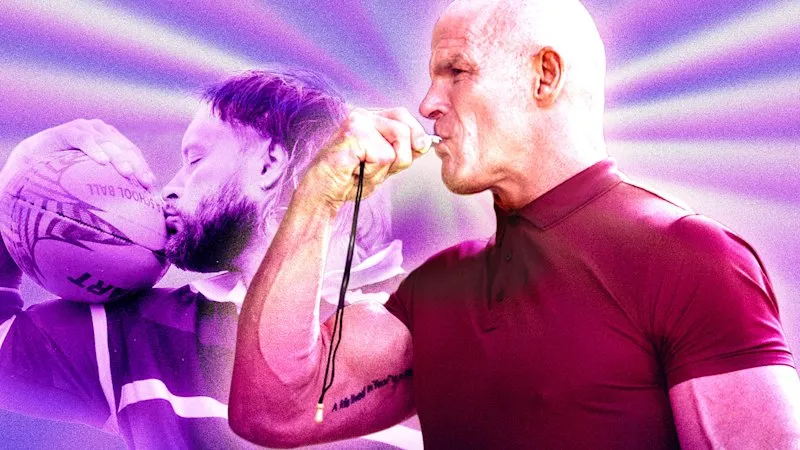
A new music video by rising Australian artist ANDY (Andy Cook) delves into the complexities of sexuality within the world of contact sports, featuring former AFL player Mitch Brown and NRL legend Ian Roberts. The video, for the single ‘Can’t Wait,’ uses the backdrop of intense physical sport to explore themes of gay awakening, the homoerotic nature of athletic competition, and the persistent presence of homophobia.
Exploring Sexuality in Sport
The music video opens with a depiction of a rugby scrum, culminating in a scene where Mitch Brown, who publicly came out as bisexual last year, shares a kiss with artist ANDY. This moment signifies a public expression of his sexuality following years of feeling shame as an active AFL player. Brown stated that participating in the video felt liberating, allowing him to represent his bisexuality openly.
The project also features Ian Roberts, a pioneering figure in Australian sport who came out as gay in 1995 while playing for the Manly Sea Eagles. Roberts, the first Australian male athlete to publicly disclose his sexuality during his playing career, described his involvement as a “no-brainer,” emphasizing that he sees no inherent controversy in the video’s message.
The Homoerotic vs. Homophobia Paradox
Mitch Brown articulated a central theme of the video: the paradoxical nature of homophobia within sports that are inherently physical and intimate. He pointed out the common acceptance of close physical contact and the sharing of bodily fluids among athletes during games and training. “In sports… you are putting your bodily fluids all over each other in the huddles and tackling, and that is like spit, and you’re sharing a drink bottle,” Brown explained. “Why are [players] comfortable with that, but not when it’s, in a sense, that in a different environment?”
Brown suggested that this acceptance of physical closeness, even to the point of sharing drinks, indicates an underlying comfort with aspects of homosexuality that are present within the games themselves. He argued that this contrasts sharply with the outright rejection or discomfort some players and institutions exhibit towards openly gay or bisexual individuals. “Like you guys are actually really accepting of homosexuality because it actually exists in certain nature and traits within this game you love so much,” he added.
Critique of Sporting Institutions
As a queer-rights activist, Brown expressed skepticism about receiving support from his former AFL peers or clubs for his role in the music video. He directly criticized the AFL for what he perceives as a failure to foster a safe environment for queer players. “The AFL is the last professional men’s space in the world that has had no queer players who have ever actively played and come out whilst they’re playing,” Brown stated.
He drew comparisons to other traditionally masculine industries, such as the defence forces and mining sector, suggesting that these fields, despite potentially harsher stereotypes, have seen openly queer individuals. “There’s defence forces, there’s mining industries – there’s all these industries that arguably have worse stereotypes than the AFL, but yet they’ve got queer men in those industries that the AFL seems not to have,” he observed.
Brown questioned the AFL’s commitment to inclusivity, citing statistics and his own experience as evidence. “Do I think the AFL and the clubs are providing a safe place and have the systems in place for a gay person to speak up? Well, if I’m going by the statistics, I would say no… I’ve been one of them that played and remained closeted. There is a broader issue at play here.”
The Artist’s Vision
The music video for ‘Can’t Wait’ also depicts a younger version of artist ANDY (Andy Cook) in a boys’ locker room, grappling with his sexuality. The narrative progresses to show the captains of opposing teams, portrayed by Cook and Brown, sharing a kiss, with other characters also engaging in similar displays of affection. Cook described the video’s essence as a blend of traditional locker room camaraderie and romantic connection, encapsulated by his phrase, “It’s ‘yeah the boys’ meets ‘kiss the boys’.””
Roberts acknowledged that while he doesn’t find the video controversial, he anticipates that its depiction of “overtly sexual” same-sex interactions will provoke reactions. “Anything to do with anything like that’s same-sex… is always – like I know it feels stale and dated, but people still see it as somehow debatable,” he commented.
Cook himself admitted to some apprehension about the video’s potential to “ruffle some feathers.” He reflected on the evolving social climate and his personal experiences as a gay individual. “The current climate of the world we live in, and my experience as a gay person in it, I just feel like even in the last five years, I have felt a different experience walking around as myself,” the pop singer said.
He elaborated on the video’s intent: “[The video is] commenting on the homoeroticism and the homophobia that kind of flirts quite dangerously together at times, and we are basically bridging that gap. I think there will be people who love it and think it’s beautiful and understand what it is, but I think there will be people that won’t necessarily agree with my point of view.”
Addressing Societal Perceptions
Ian Roberts highlighted the persistent societal perception that homosexuality equates to weakness in men’s contact sports. “There was still an underlying current in contact sports that being gay translated to weakness. To be attracted to other men if you’re a man is almost feminised somehow,” he stated.
Roberts also shared his ongoing work in sports education, noting that discussions around sexuality, particularly among men, remain challenging. “I do [education] with the NRL. I do a lot of stuff with the other major sporting leagues and, like, I don’t know why… like, it’s still uncomfortable to say this, but particularly with men, it’s still an awkward conversation.”
The video’s narrative was partly inspired by the story of former Roosters player Kane Evans, who came out as gay after his professional career and spoke about the profound impact of hiding his sexuality, which led to addiction and suicidal ideation. Cook emphasized that the video aimed for a diverse representation, including both straight and gay individuals, to showcase authenticity. “That’s why when I cast the music video, I didn’t just want it to be a locker room of queer people; it needed to be straight people, gay people, a whole boiling pot of people who are showing up authentically as themselves, and that doesn’t take away from anyone,” Cook said.
He expressed a hope for a future where such interactions are normalized: “In an ideal world, it would be great for the captain of the Parramatta Eels to kiss the captain of the Manly Sea Eagles.”
The Ongoing Struggle for Visibility
Mitch Brown concluded by reflecting on the personal challenges of advocating for queer and women’s rights as a retired athlete. He described the experience as isolating. “In terms of being a man and standing up for a better AFL culture, it’s quite lonely. It’s extremely lonely. It makes you feel like the AFL men’s players don’t care sometimes because you’re just, like, where are your voices?”
Brown further illustrated this point by referencing a lack of public support from AFL players regarding issues of women’s safety, particularly in light of events involving the Sydney Swans. “I would honestly struggle to name one current player that spoke up in support of women’s safety after everything around the Sydney Swans situation. It’s again on these other issues that don’t necessarily affect them, you don’t hear from them.” His sentiments underscore the broader societal and institutional shifts still needed to create truly inclusive environments in professional sports.
