

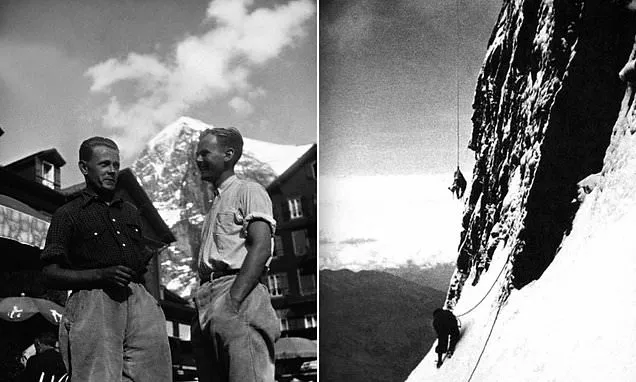
The Eiger North Face, a formidable 4,000-meter wall of rock and ice in the Swiss Alps, earned its grim moniker, the ‘Murder Wall,’ for a reason. Avalanches, rockfalls, and brutal storms have historically made it one of mountaineering’s most perilous challenges. In 1936, this unforgiving landscape became the stage for one of the most infamous climbing tragedies, as four ambitious climbers attempted to conquer the north face, only to perish one by one in a harrowing ordeal that captivated and horrified onlookers below.
The 1936 Eiger North Face Expedition
In July 1936, four experienced climbers – Germans Toni Kurz, 23, and Anderl Hinterstoisser, alongside Austrians Willy Angerer and Edi Rainer – united with a singular goal: to be the first to successfully ascend the Eiger’s treacherous north face. The mountain had already claimed lives, with two climbers succumbing to its dangers just the year prior, yet the allure of conquering the ‘Murder Wall’ proved irresistible to this determined quartet.
Their expedition began with remarkable speed and skill. Hinterstoisser, in particular, showcased his prowess by executing a daring diagonal traverse across a smooth rock slab, a section later known as the Hinterstoisser Traverse. He then secured a rope, allowing the others to follow safely. This initial success, however, would be overshadowed by a critical decision that ultimately sealed their fate.
A Series of Disasters Unfold
Believing they would descend via a different route, the climbers removed the rope that had aided their ascent. Pressing onward, they entered an ice field notorious for its instability. As the afternoon sun warmed the frozen rock, dislodged stones began to rain down. Tragically, a falling rock struck Willy Angerer, inflicting severe injuries.
The injured state of Angerer prompted the group to attempt a retreat. Their hopes were quickly dashed when they discovered that the Hinterstoisser Traverse, their only viable descent route, had become coated in verglas – a thin, almost invisible layer of ice formed from freezing rain, making it treacherously slick.
As if their predicament wasn’t dire enough, a violent storm descended upon the mountain. Trapped at a high altitude with no safe passage up or down, the climbers faced a desperate situation. They initiated a perilous descent, but catastrophe struck again. As Hinterstoisser unclipped from the group to prepare for an abseil, approximately 200 feet from a point of relative safety, a massive avalanche swept across the face.
The Harrowing Ordeal of Toni Kurz
The force of the avalanche hurled Angerer and Kurz from their precarious perch. Angerer was either killed by the impact or suffocated by his tangled ropes. Rainer, also caught in the avalanche’s fury, was pinned against a snap-link, the immense pressure slowly crushing his diaphragm. Hinterstoisser, no longer attached to the others, plummeted an estimated 2,000 feet to his death.
Amidst this unfolding horror, Toni Kurz remained, clinging to the near-vertical rock face. Below, villagers at the Kleine Scheidegg railway station watched in stunned silence. Alerted to the dire situation, veteran guides Christian Almer Jr. and Hans Schlunegger defied orders and launched a rescue attempt, braving the worsening weather.
Despite their efforts, the guides were still about 150 feet below Kurz. The route they would need to climb was deemed impossible due to the thick ice coating the mountain. As night fell, the rescue attempt was suspended, leaving Kurz alone, exposed to the elements, and suspended by his rope.
A Fight for Survival
Against all odds, Kurz survived the night. As dawn broke, the guides returned, but the icy conditions still prevented them from reaching him. The only remaining hope was for Kurz to descend towards them. This required him to first free himself from the ropes binding him to his deceased companions.
In an extraordinary display of endurance and willpower, Kurz painstakingly worked to sever the ropes. He cut away Angerer’s body, then climbed to sever the rope above him. With one frozen hand, his teeth, and sheer determination, he spent five agonizing hours untangling and tying the frozen strands into a single, usable rope. He lowered this to the waiting guides, who attached another length.
The Final Moments
As Kurz began his descent, salvation seemed within reach. The guides could see his legs dangling beneath an overhang. However, fate intervened once more. The knot connecting the ropes jammed against the metal snap-link on Kurz’s harness, leaving him suspended mere meters above his rescuers.
Kurz battled the jammed knot with his frostbitten hands and even his teeth. Summoning his last reserves of strength for one final effort, he was ultimately unsuccessful. His final words, a whispered “I’m finished,” echoed in the vastness of the Alps. Moments later, his body slumped forward, swinging just out of reach, marking the tragic end of one of mountaineering’s most harrowing tales.
Legacy of the Eiger Tragedy
The 1936 Eiger North Face tragedy remains a stark reminder of the immense power of nature and the extreme risks inherent in mountaineering. The ‘Murder Wall’ has continued to claim lives, with over 70 climbers having perished on its slopes since that fateful expedition. The story of Toni Kurz and his companions serves as a profound and enduring testament to human ambition, courage, and the devastating consequences when nature’s fury is met head-on.
