

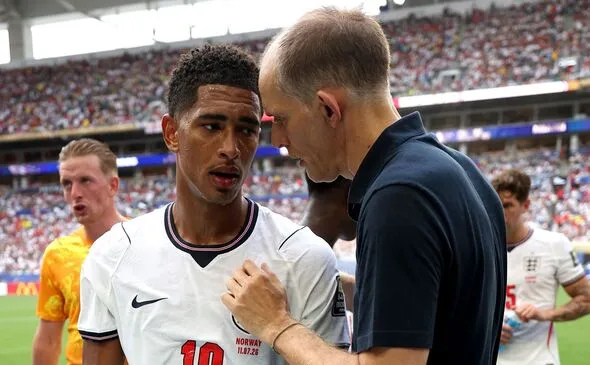
Following a tense exchange after England’s World Cup quarter-final victory, manager Thomas Tuchel has confirmed he held discussions with the squad, including star player Jude Bellingham, to address comments made in a post-match television interview. The situation arose after Bellingham reacted strongly on air to reports of Tuchel’s critique of the team’s performance against Norway, a match England ultimately won after extra time.
The Post-Match Exchange
Jude Bellingham, visibly emotional after a demanding 120-minute performance that saw him score twice, expressed his frustration when informed of his manager’s assessment. Bellingham suggested that Tuchel might not fully grasp the challenges of playing under such intense conditions, implying the heat and physical exertion played a significant role in the team’s display. Reports indicate his remarks were primarily in reference to the challenging weather rather than a challenge to Tuchel’s tactical acumen or playing history.
Tuchel, upon hearing Bellingham’s response, initiated a collective debrief with the entire England squad in the immediate aftermath of the match. He reiterated his points the following evening, aiming to clarify his intentions and ensure the team could move forward with a unified focus on the upcoming semi-final. The manager emphasized that his critique was aimed at the team’s tactical execution, not their commitment or effort.
Tuchel’s Perspective on Bellingham’s Reaction
Speaking about the incident, Thomas Tuchel stated that he understood Bellingham’s reaction, describing it as a natural response from a highly competitive player who had given his all. “I think we come from the same place,” Tuchel explained. “Our comments come from the same place from being competitive and having the edge when competition is on.” He acknowledged that Bellingham was presented with a negative framing of his manager’s comments, specifically the notion that the team had been “sloppy.”
Tuchel highlighted that his assessment of Bellingham’s performance was largely positive, noting his “world-class player” status and “world-class actions” that decided the match. He also praised the team’s “outstanding mentality.” However, he reiterated his dissatisfaction with certain tactical aspects of the game, which he felt needed addressing. “Of course, I would maybe also bite back when I come from 120 minutes, scored two goals, gave literally everything that is in my body,” Tuchel commented on Bellingham’s response. “It’s just a very normal thing, a very normal reaction for a player of his mindset.”
Moving Forward: Focus on the Semi-Final
The manager stressed that the discussions were aimed at resolving any misunderstanding and refocusing the squad’s attention. “I spoke to the whole team after in the dressing room, which was basically the same message,” Tuchel said. “And I explained it again the next evening to just move on forward.” The immediate priority, he noted, was to shift their collective mindset towards the next crucial challenge: the semi-final match against Argentina.
Tuchel’s approach underscores a management style that balances accountability with an understanding of player psychology. By addressing the situation directly and engaging in open dialogue, he sought to prevent any lingering discontent from affecting team morale or performance. The emphasis was on learning from the experience and channeling the competitive spirit, both from the players and the coaching staff, into future endeavors.
The Importance of Clear Communication
This incident serves as a reminder of the high stakes and intense emotions involved in elite international football. Post-match interviews, especially after significant victories, can be a pressure cooker of reactions. Bellingham’s forthright response, while perhaps unexpected, demonstrated his passion and commitment to the England cause. Tuchel’s subsequent actions – engaging in transparent conversations with the team – highlight the critical role of effective communication in maintaining team cohesion and focus, particularly during major tournaments.
Ultimately, the manager’s objective was to ensure that any perceived friction was resolved swiftly, allowing the squad to concentrate fully on their pursuit of World Cup glory. The focus quickly shifted from the quarter-final’s tactical nuances and post-match reactions to the strategic preparations required for the semi-final showdown. This proactive approach by Tuchel aimed to reinforce the team’s unity and determination as they progressed deeper into the competition.
